In Animals
Canine disease is more commonly disseminated beyond the lungs at the time of diagnosis (Legendre 2012). Chest radiographs may show focal airspace disease or a “snowstorm” pattern of reticulonodular disease (Crews et al.
2008b) (Fig. 8.1). Ocular disease is much more common in dogs than in humans, occurring in up to half of all cases (Bloom et al. 1996; Arceneaux et al. 1998). Among these, bilateral disease occurs in half (Bloom et al. 1996). Ocular disease can be localized to anterior segments, posterior segments, or, most commonly, both (i.e., endophthalmitis) (Bloom et al. 1996). Like in human disease, cutaneous involvement is common in canine blastomycosis, occurring in approximately half of infected dogs (Arceneaux et al. 1998). An example of a dog with bilateral ocular and cutaneous disease is shown in Fig. 8.2. Other common sites of extrapulmonary disease include lymphatic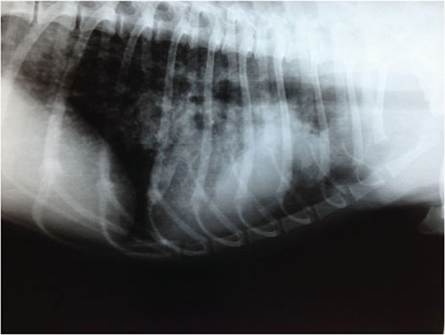
Fig. 8.1 Lateral thoracic X-ray of a dog with pulmonary blastomycosis demonstrating diffuse reticulonodular disease (Courtesy of Dr. Peter Schwartz, DVM, Assiniboine Animal Hospital, Winnipeg, Manitoba)
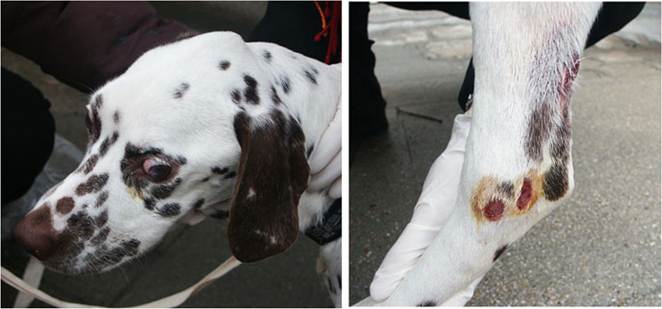
Fig. 8.2 Ocular involvement and ulcerative cutaneous lesions in a dog infected in Quebec, Canada (Courtesy of Dr. Rene Chermette, DVM, dipl. EVPC, Parasitology-Mycology, EnvA, Maisons- Alfort, France)
and osteoarticular structures (Arceneaux et al. 1998). Central nervous system disease is less common, occurring in 6% of dogs in a series (Arceneaux et al. 1998). Cardiovascular blastomycosis has been reported in nine dogs (Langlois et al. 2013; Schmiedt et al. 2015); it is extraordinarily uncommon in people.
Like the disease in humans, clinical signs commonly encountered in canine blastomycosis are nonspecific. In decreasing frequency of occurrence reported by a large study, these include fever, lymphadenopathy, harsh lung sounds, cutaneous lesions, chorioretinitis, anterior uveitis, cough, emaciation, and retinal detachment (Arceneaux et al. 1998).
Cats are often diagnosed only upon autopsy and with widespread disease (Davies and Troy 1996). In one series, clinical signs of respiratory, neurologic, and cutaneous disease were present in 59, 41, and 18% of cats, respectively (Davies and Troy 1996).
In horses, clinical signs generally include pneumonia and with reports of respiratory infection or cutaneous and subcutaneous lesions (Wilson et al. 2006; Stewart and Cuming 2015).
8.4
More on the topic In Animals:
- Conclusions and Future Directions
- Das Pradip Kumar, Sejian V., Mukherjee J., Banerjee D. (eds.). Textbook of Veterinary Physiology. Springer,2023. — 795 p., 2023
- REFERENCES
- Vogelnest L., Portas T. (Eds.). Current Therapy in Medicine of Australian Mammals. CSIRO,2025. — 848 p., 2025
- Lymph Node Enlargement
- Smith Bradford P., Van Metre David C., Pusterla Nicola (eds.). Large Animal Internal Medicine. Part 2. 6th edition. — Elsevier,2020. — 2279 p., 2020
- References
- Rana Tanmoy (ed.). Principles of Veterinary Animal Physiology. CRC Press,2026. — 290 p., 2026
- Introduction