Chytrids
The causative agents of the disease chytridiomycosis belong to a “lower” fungal phylum: the Chytridiomycota (Longcore et al. 1999). Bd and Bsal belong to the order of the Rhizophydiales and are, together with the enigmatic fish pathogen Ichthyochytrium vulgare (Plehn 1920), to date the only known members of this phylum, which are adapted to vertebrate hosts.
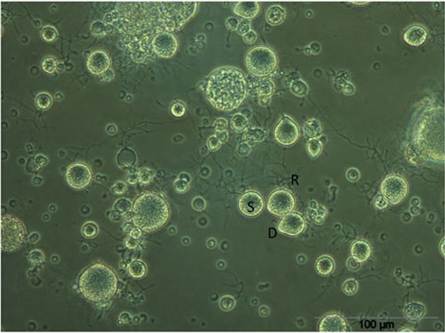
Chytridiomycota are unusual among the fungi in that they produce zoospores. Asexual reproduction in Bd and Bsal occurs through the release of motile flagellated spores (zoospores) from the reproductive body or thallus in which they are produced (zoosporangium) (Fig. 14.1) (Longcore et al. 1999). Neither Bd nor Bsal have yet been observed in culture to reproduce sexually. However, as several genetic studies have identified Bd isolates with a hybrid genotype, sexual recombination and hybridization must have been important mechanisms in its evolutionary history (Farrer et al. 2011; Schloegel et al. 2012; Rosenblum et al. 2013).
In vitro, both pathogens grow well in tryptone broth and have a similar life cycle (Van Rooij et al. 2015). The zoospore first encysts by developing a cell wall and absorbing its flagellum and forms a germling with fine threadlike rhizoids. The germling matures into a zoosporangium in which the cytoplasm cleaves mitotically to form new zoospores. Discharge papillae or tubes are formed during the growth of the sporangium. At maturity, the plug blocking the papillae dissolves, and the zoospores are released into the environment to continue their life cycle (Longcore et al. 1999; Berger et al. 2005; Van Rooij et al. 2015). Bd zoosporangia are, in contrast with Bsal thalli, predominantly monocentric (a thallus containing a single
Fig. 14.1 In vitro culture of Bsal in TGhL broth at 15 oC. Monocentric thalli predominate, with the rare presence of colonial thalli. Sporangia (S) with rhizoids (R) develop discharge tubes (D) to release zoospores (Scale bar, 100 μm) (© Pasmans and Martel 2015. All Rights Reserved)
sporangium) rather than colonial (a thallus containing more than one sporangium). Despite the difference in thermal preference (Bd 22 °C, Bsal 15 °C), the life cycle of both chytrids in culture is completed within 5 days (Berger et al. 2005; Martel et al.
2013). The life cycle of Bd in amphibian skin is largely similar to that observed in culture (Van Rooij et al. 2015).
14.2