Conclusions
Sandfly-borne viral pathogens are widespread in both old and new worlds particularly in tropical/subtropical areas, and temperate zones including southern Europe, Asia, Africa, Australia and Central and South America [24].
Due to vector sandfly species activity, the sandfly-borne viral diseases peaks during summer which affect both urban, peri-urban and rural population, but mostly the communities with poor living conditions [3, 4] (Figure 1, Table 1).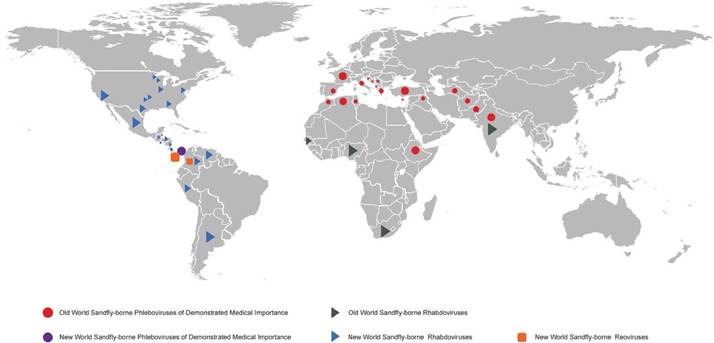
Figure 1.
Schematic overview of the sandfly-brone viruses, according to geographical regions.
| Group | Virus | Virus origin | Country | ||
| Sandfly-borne phleboviruses of demonstrated medical importance | |||||
| Old World Sandfly-borne phleboviruses of demonstrated medical importance | |||||
| Sandfly fever Naples Species | Sandfly fever Naples virus Sabin | Blood sample | Italy | ||
| Sandfly fever Naples virus R-3 | Human sera | Cyprus | |||
| Sandfly fever Naples virus Namru | Phlebotomus papatasi | ⅛ypt | |||
| Sandfly fever Naples virus | Human | Turkmenistan | |||
| Sandfly fever Naples virus | Human | Afghanistan | |||
| Sandfly fever Naples virus | Phlebotomus longicuspis | Algeria | |||
| Sandfly fever Naples virus | Phlebotomus spp. and humans | India | |||
| Sandfly fever Naples virus YU 8-76 | Phlebotomus perfiliewi | Serbia | |||
| Toscana virus | Phlebotomus perniciosus | Italy | |||
| Toscana virus | Human CSF | Italy | |||
| Toscana virus | Pipistrellus kuhli brain | Italy | |||
| Toscana virus | Phlebotomus spp. | Italy | |||
| Toscana virus | Phlebotomus perniciosus | France | |||
| Toscana virus | Sergentomyia minuta | France | |||
| Toscana virus | human CSF | Croatia | |||
| Toscana virus | Phlebotomus neglectus | Croatia | |||
| Toscana virus | Phlebotomus spp. | Cyprus | |||
| Toscana virus | Human sera, urine | Turkey | |||
| Toscana virus | Phoenicopterus roseus, Pelecanus onocrotalus, Ciconia nigra | Turkey | |||
| Toscana virus | Phlebotomus perniciosus | Morocco | |||
| Toscana virus | P. longicuspis, P. sergenti | bgcolor=white>Morocco||||
| Group | Virus | Virus origin | Country | ||
| Toscana virus | Phlebotomus spp. | Algeria | |||
| Toscana virus | Phlebotomus spp. | Tunisia | |||
| Toscana virus | Human CSF | Greece | |||
| Sandfly Fever Sicillian Species | Sandfly fever Sicilian virus Sabin | Human sera | Italy | ||
| Sandfly fever Sicilian virus | Phlebotomus spp. | Iran | |||
| Sandfly fever Sicilian virus | Human sera | Cyprus | |||
| Sandfly fever Sicilian virus | Phlebotomus papatasi | Pakistan | |||
| Sandfly fever Sicilian virus | Phlebotomus ariasi | Algeria | |||
| Sandfly fever Sicilian virus | Phlebotomus papatasi | Algeria | |||
| Sandfly fever Sicilian virus | Human | Afghanistan | |||
| Sandfly fever Sicilian virus | Phlebotomus spp. | India | |||
| Sandfly fever Sicilian virus | Human | Ethiopia | |||
| Sandfly fever Cyprus virus | Human sera | Cyprus | |||
| Sandfly fever T urkey virus | Human sera | Turkey | |||
| Sandfly fever T urkey virus | Phlebotomus major complex | Turkey | |||
| Dashli virus | Phlebotomus spp./ Sergentomyia spp. | Iran | |||
| Salehabad Species | Adria virus | Human blood | Greece | ||
| Adria virus | Phlebotomus spp. | Albania | |||
New World Sandfly-borne phleboviruses of demonstrated medical importance
| Punta Toro Species | Punta Toro virus Adames | Human | Panama | |
| Punta Toro virus Balliet | Human | Panama | ||
| Punta Toro virus | Human | Panama | ||
| Punta Toro virus | Human | Panama | ||
| Punta Toro virus | Sentinel hamster | Panama | ||
| Punta Toro virus | Sentinel hamster | Panama | ||
| Punta Toro virus | Lutzomyia spp. | Panama | ||
| Punta Toro virus | Human | Panama | ||
| Punta Toro virus | Human | Panama | ||
| Punta Toro virus | Human | Panama | ||
| Punta Toro virus | Human | Panama | ||
| Sandfly-borne Rhabdoviruses | ||||
| Vesiculovirus Species | Vesiculovirus | Horse | South Africa | |
| Vesiculovirus | Bovine | Indiana, USA | ||
| Vesiculovirus | Bovine, equine | New Jersey | ||
| Vesiculovirus | Cattle, horse | Wisconsin, Minnesota, Dakota | ||
| Vesiculovirus | Cattle, horse | Argentine | ||
| Vesiculovirus | Cow, horse, pig | Venezuela | ||
| Vesiculovirus | Horse | Texas, Louisiana | ||
| Vesiculovirus | Horse | Kansas | ||
| Vesiculovirus | Horse | Colorado | ||
| Vesiculovirus | Swine | Colombia | ||
| Group | Virus | Virus origin | Country | |
| Vesiculovirus | Swine | Venezuela | ||
| Vesiculovirus | Swine | Missouri | ||
| Vesiculovirus | Swine | Colorado | ||
| Vesiculovirus | Cattle | California | ||
| Vesiculovirus | Horse | Arizona | ||
| Vesiculovirus | Cattle | Mexico | ||
| Vesiculovirus | Horse | Alabama | ||
| Vesiculovirus | Horse | Mississippi, Georgia, Tennessee, Florida | ||
| bgcolor=white>Vesiculovirus | Bovine, porcine | Guatemala | ||
| Vesiculovirus | Equine | Belize | ||
| Vesiculovirus | Bovine | Honduras | ||
| Vesiculovirus | Bovine | El Salvador | ||
| Vesiculovirus | Bovine, porcine | Nicaragua | ||
| Vesiculovirus | Bovine | Costa Rica | ||
| Vesiculovirus | Bovine | Peru | ||
| Chandipura virus | Human | India | ||
| Chandipura virus | Sandfly | India | ||
| Chandipura virus | Sandfly | Senegal | ||
| Chandipura virus | Sandfly | Nigeria | ||
| Sandfly-borne Reoviruses | ||||
| Changuinola virus Species | Changuinola virus | Lutizomyia sp. | Panama | |
| Changuinola virus | Rice rat, armadillo, sloth | Panama | ||
| Changuinola virus | Human | Panama | ||
| Changuinola virus | Lutzomyia sp. | Colombia | ||
| Changuinola virus | Bradypus variegatus, Choloepus hoffmanni | Panama | ||
Table 1.
Features of the medically important sandfly-borne viruses.
Both molecular characterization and Seroepidemiological studies demonstrated broad distribution of sandfly-borne phleboviruses in the old world in the Mediterranean region, in the African continent, in the Indian subcontinent, in the Middle East and in Central Asia. However, the pathogen sandfly-borne phleboviruses were recorded in the limited geographical area (Panama) in the new world with sporadic human cases. This must be due to (i) limited investigations in the new world; (ii) vector competence of phlebovirus in the new world; (iii) small-sized human population and (iv) lack of case report.
Acknowledgements
This work was supported in part by the European Virus Archive goes Global (EVAg) project that has received funding from the European Union’s Horizon 2020 research and innovation programme under grant agreement No 653316. Nazli Ayhan is a Post-Doctoral fellow supported by a IRD grant.