Diagnosis
The typical patient is a middle aged to elderly small or toy breed dog presenting with a classical goose honking cough as the primary complaint. A prolonged history (months to years) is common and useful in distinguishing tracheal collapse from differentials.
Caregivers may observe exercise intolerance, respiratory distress, and/or cyanosis with or without syncope in more severely affected animals.A nonspecific harsh honking cough is frequently elicited by tracheal palpation. Respiration and lung sounds may be normal or abnormal, especially if concomitant lung disease is present. In some patients, the tracheal collapse may be palpable in the neck region. Increased airway noises are potentially audible in severely collapsed tracheas and increased respiratory effort may be observed. Hepatomegaly may be palpated.
Tracheoscopy remains the gold standard diagnostic modality (Johnson, Singh, and Pollard 2015). Figure 34.1 shows a tracheoscopy from a dog with tracheal collapse. While most practitioners have access to thoracic radiographs; falsely diagnosing or excluding the condition with this diagnostic modality is not uncommon (Johnson and Pollard 2010; Johnson et al. 2015; Lindl Bylicki, Johnson, and Pollard 2015). When available, fluoroscopy may show the dynamic
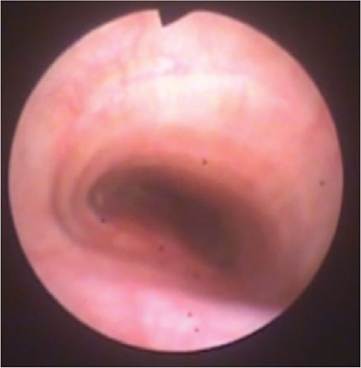
Figure 34.1 Tracheoscopy from a dog with tracheal collapse.
changes of the tracheal diameter during the respiratory cycle, aiding diagnosis with a greater accuracy than radiography. The use of ultrasound has also been reported, but remains an ancillary diagnostic tool that is surpassed by the other modalities (Rudorf, Herrtage, and White 1997; Eom et al. 2008). Computed tomography and tidal breathing flow-volume loop analysis have also been able to document tracheal collapse but remain largely available only in referral practices. Echocardiography and broncho-alveolar lavage are not useful in the diagnosis of tracheal collapse per se, but are frequently performed as part of a holistic cardio-res- piratory system investigation, especially considering the association between inflammatory airway disease and tracheal/airway collapse (Singh et al. 2012; Zhu, Johnson, and Vernau 2015).