ETHICAL AND ANIMAL WELFARE CONSIDERATIONS IN CONSERVATION TRANSLOCATIONS
CTs, as part of a broader conservation-based ethic, are typically carried out for the benefit of a particular species or ecosystem and are often concerned principally with survival, establishment and fecundity as measures
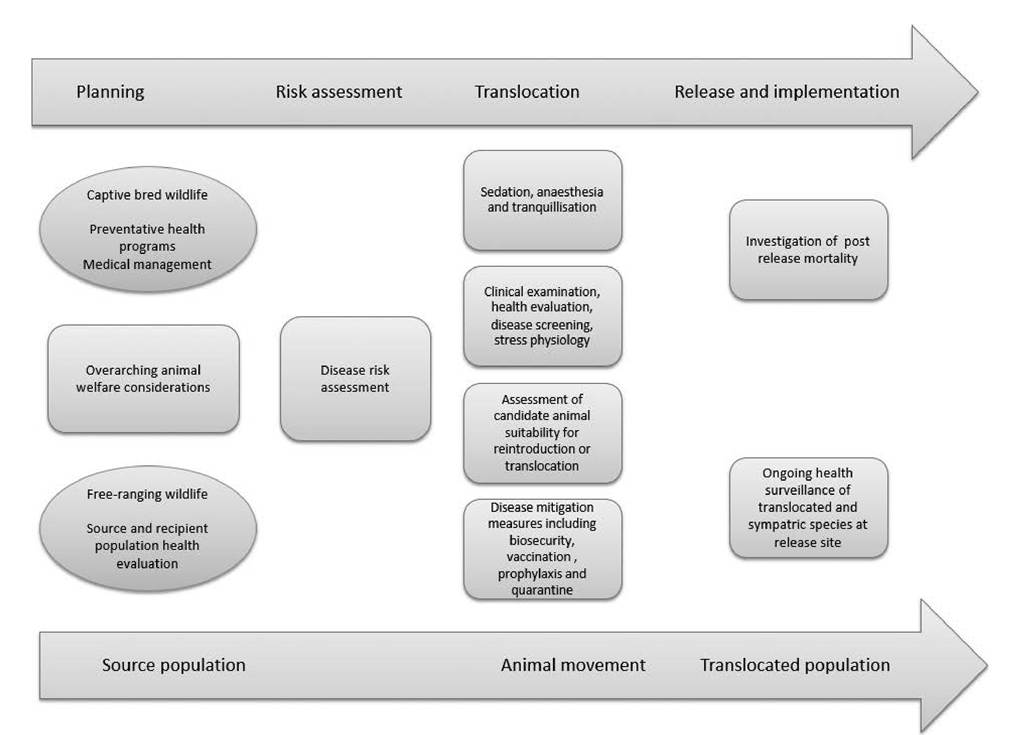
Fig.
2.1. Schematic representation of the conservation translocation pathway (arrows) and the related points where veterinarians play an important role.of success (Teixeira et al. 2007). In contrast, the ethical concern for appropriate animal welfare outcomes necessarily focuses on the individual animal. As such, there is the possibility for conflict between the broader conservation or ecological goals of CTs and animal welfare outcomes (Swaisgood 2010). Potential adverse animal welfare outcomes in CTs include mortality and acute and cumulative stressors associated with managed care, handling and restraint, dispersal and human-wildlife conflict (Harrington et al. 2013). Appropriate animal welfare outcomes should be a primary consideration and an overarching theme in planning for and implementing CTs. Veterinarians are uniquely placed to provide advice on monitoring and management techniques to ensure animal welfare is accorded a high priority and integrated within the CT program.
1.2 Monitoring for animal welfare
Overall animal welfare outcomes can be improved by monitoring parameters that may be indicative for welfare such as morbidity and mortality, dispersal and fecundity; parameters that are also indicative of the overall success of the CT. Recently, an assessment of dietary changes in translocated brush-tailed possums (Trichosurus vulpecula) provided evidence that changes in dietary preferences may be an additional important consideration when assessing acclimation post CT (Bannister et al. 2021). Additional parameters that have been monitored in native mammals include bodyweight, body condition index and physiological variables such as haematology, biochemistry and the oxidative stress index (Schultz et al.
2011; Clarke et al. 2013; Portas et al. 2016; Hing et al. 2017; Portas et al. 2020; Hall et al. 2021). Monitoring physiological variables provides baseline data that can be utilised for selection of suitable candidates for CT and to adapt and refine CT methodologies, both of which enhance animal welfare outcomes through reduction and refinement (Tarszisz et al. 2014). Because CTs can affect the welfare of conspecif- ics and sympatric species that may be present at the release site, monitoring should also cover these groups where possible.More specific monitoring relating to animal welfare includes monitoring stress physiology throughout the process, although this is frequently limited and often undertaken opportunistically. Nonetheless, animal welfare during CTs is an area of growing concern and the cumulative effects of stress at various points in the CT pathway have been demonstrated (Dickens et al. 2009). Potential limitations to effective monitoring of stress physiology during CTs include the relatively limited number of validated techniques for the non-invasive monitoring of glucocorticoids or their metabolites in native mammals (Hing et al. 2014; Fanson et al. 2017; Narayan 2017) and difficulties in obtaining regular biological samples from animals post release (see Chapter 8).
Two recent studies in potoroid marsupials have specifically monitored faecal glucocorticoid metabolite concentrations (FGMC) to assess stress physiology during the CT process. Peak elevations in FGMC were observed in brush-tailed bettongs (Bettongia penicillata) post-translocation and were associated with declining body condition (Hing et al. 2017). However, elevations in FGMC were also observed in resident bettongs at the translocation site, making it difficult to assess if these changes were a result of the translocation per se or other undetermined factors. An assessment of the effect of the release tactic (delayed versus immediate) on FGMC in a reintroduction program for wild-caught eastern bettongs (B.
gaimardi) revealed elevated FGMC in bettongs that were held in managed care (delayed release) for up to 11 mo before release, suggesting managed care was associated with chronic stress (Batson et al. 2017).This is in contrast to wild-caught Tasmanian devils (Sarcophilus harrisii), which exhibited an apparent rapid acclimation (as evidenced by declining plasma cortisol concentrations), albeit with sex-related differences, to managed care (Jones et al. 2005). Similarly, an assessment of faecal cortisol metabolites and neutrophil/lymphocyte ratios in resident koalas following translocation of bushfire-rescued koalas into their habitat found little evidence of stress (Beaman et al. 2023). These findings highlight that species-specific and program-specific differences can occur and there is a need for monitoring to inform adaptive management strategies when considering stress and its consequences in CTs.
1.2 Veterinary and other animal management considerations for animal welfare
There are a range of specific management techniques that can be used to support appropriate animal welfare in native mammal CTs. This includes appropriate trap design; appropriate restraint and handling techniques to minimise the chance of injury and stress; anaesthesia for physical examination; health and disease screening to ensure selection of suitable candidates; parasite treatment (where appropriate) and vaccinations; use of analgesics where indicated; and appropriate design of transport containers. The use of sedatives for transport and the judicious use of neuroleptic drugs should be considered in light of the species involved, the duration of transport and the nature of the CT (wild to wild, wild to managed care, managed care to wild). Capture myopathy is an important consideration in macropod CTs and the use of diazepam appears to have ameliorated the effects of exertional myopathy in translocated eastern bettongs (Portas et al. 2014).
Ejection of large PY is a risk when trapping, handling and transporting female marsupials, in particular macropods (Parker et al.
2015). In some species such as potoroids, even small furless PY may be ejected from the pouch if the female is unduly stressed. Female macropods with large PY should be excluded from CTs and the pouch of females with furless PY should be taped closed, where appropriate, for handling and transportation. The tape is left in situ at release, with females invariably removing the tape once they have settled. Additionally, female macropods with two active mammary glands should be precluded from CTs because of the possibility of an untrapped emergent or young at-foot joey that remains dependent on milk. In species with seasonal breeding patterns, including many dasyurids and tammar wallabies (Notamacropus eugenii), movement of animals can be timed to avoid the presence of PY. Small PY are less likely to be ejected and eastern quolls (Dasy- urus viverrinus) with neonatal PY have been successfully transported by road and air for translocation without loss of PY.Telemetry (VHF and/or GPS) is frequently used for post-release monitoring and veterinarians should have input into the design and be involved in the application of
| Species and conservation translocation type | IUCN Classification* | Source population | Translocation site | Veterinary contribution |
| Northern hairy-nosed wombats (Lasiorhinus krefftii) (Reintroduction) | CE | Free-ranging, Epping Forest National Park, Qld | Richard Underwood Nature Reserve, Qld | Pre-translocation health and disease screening, sedation for transport, post-release health and disease surveillance |
| Gilbert's potoroo (Potorous gilbertii) (Assisted colonisation and reintroduction) | CE | Free-ranging, Two Peoples Bay Nature Reserve, WA | Bald Island Nature Reserve, WA Waychinicup National ParkzWA | Establishment of baseline health and disease parameters, development of health screening and quarantine protocols for translocations, longitudinal population health surveillance |
| Brush-tailed rock-wallaby (Petrogale penicillata) (Reintroduction) | V | Zoo-bred, Zoos SA, SA and Tidbinbilla Nature Reserve, ACT | Grampians National ParkzVic. | Medical management of zoo animals, development of assisted reproductive technique, translocation planning, pre-translocation health and disease screening, establishment of baseline health and disease parameters, post-release health and disease surveillance |
| Tammar wallaby (Notamacropus eugenii eugenii) (Reintroduction) | LC (extirpated from mainland SA) | Feral population repatriated from New Zealand then zoo-bred by Zoos SA, SA | Innes National Park, SA | Quarantine protocols, medical management of animals in managed care, development Ofassisted reproductive technique, post-release health and disease surveillance |
| Eastern bettong (Bettongia gaimardi) (Reintroduction) | NT | Free-ranging at various IocationszTas., or F1 offspring bred in managed care by Tidbinbilla Nature Reserve, ACT | Mulligans Flat Nature Reserve, ACT | Translocation planning, disease risk assessment, sedation for transport, health and disease screening at translocation, establishment of baseline health and disease parameters, medical management of zoo-housed animals, post-release health and disease surveillance |
| Eastern quoll (Dasyurus viverrinus} (Reintroduction) | E | Free-ranging at various IocationszTas. and bred in managed care by Mount Rothwell Biodiversity Interpretation Centre, Vic. | Mulligans Flat Nature Reserve, ACT | Translocation planning, disease risk assessment, health and disease screening at translocation, establishment of baseline health and disease parameters, post-release health and disease surveillance |
| Tasmanian devil (Sarcophilus harrisii) (Assisted colonisation) | E | Bred in managed care at various locations, mainland Australia | Maria Island National ParkzTas. | Disease screening of ex situ-breeding program founders, medical management of managed animals, translocation planning, pretranslocation health and disease screening, post-release health and disease surveillance |
Species and conservation
| translocation type | IUCN Classification* | Source population | Translocation site | Veterinary contribution |
| Eastern barred bandicoot (Perameles gunnii) (Reintroduction and assisted colonisation) | V | Bred in managed care, Zoos VictoriazVic., Kyabram Fauna Park, Vic., Serendip SanctuaryzVic. | Various mainland and island sites in southwestern Vic. | Medical management of animals in managed care, establishment of baseline health and disease parameters, investigation Oftelemetry application techniques, pre-translocation health and disease screening, biosecurity protocols, post-release health and disease surveillance |
| Southern brown bandicoot (Isoodon obesulus) (Reintroduction) | LC | Free-ranging, Timbillica State Forest, NSW | Booderee National ParkzNSW | Translocation planning, disease risk assessment, health and disease screening at translocation, establishment of baseline health and disease parameters, post-release health and disease surveillance |
| Bush rat (Rattus fuscipes) (Reintroduction) | LC | Free-ranging, Ku-ring- gai Chase National Park, NSW | Sydney Harbour National Park, NSW | Disease risk assessment, zoonotic disease risk assessment, telemetry application, pre-translocation health and disease screening, establishment of baseline health and disease parameters, postrelease health and disease surveillance |
| Leadbeater's possum (Gymnobelideus Ieadbeateri) (Assisted colonisation) | CE | Free-ranging, Yellingbo Nature Conservation Area | Montane ash forest near MansfieIdzVic. | Disease risk assessment, pre-translocation health and disease screening, establishment of baseline health and disease parameters, post-release health and disease surveillance |
* CE = critically endangered, E = endangered, LC= least concern, NT = near threatened, V = vulnerable.
- Veterinary aspects of native mammal conservation translocate
telemetry devices. Neck collars are most commonly used in native mammals, but broad anatomical variation across species means careful attention should be paid to collar fit during application and follow-up examinations should be carried out to assess for collar-associated injuries. Potential complications include: forelimb entrapment if fitted too loosely; alopecia, dermatitis, abrasions and ulceration of in-contact skin; subconjunctival oedema and haemorrhage when fitted too tightly; and entanglement of antennas in vegetation. Alternative methods for telemetry device attachment include intraperitoneal implantation and various adhesive techniques used at different anatomical locations (see Chapters 10 and 35). Deaths associated with telemetry devices have been reported for numerous native mammals, including macropods, bandicoots, possums and koalas. Investigations into a range of telemetry transmitter application techniques in eastern barred bandicoots (Perameles gunnii) demonstrated limitations to all techniques, including injury associated with neck collars, skin wounds associated with adhesive mounts and the death of one animal in which an intraperitoneal device was placed (Coetsee et al. 2016). Where possible, telemetry devices should be applied and assessed while in managed care where close monitoring can occur before field application during a CT.
2.