Fiber
Insoluble dietary fiber is indigestible or slowly digested organic material of feeds that occupies space in the digestive tract (Mertens 2003). Fiber is mostly cell wall material consisting of cellulose, hemicellulose, and lignin.
Different roughages contain different amounts of these constituents. During analysis procedures, roughages are subjected to several treatments that distinguish these constituents (Figure 19.2).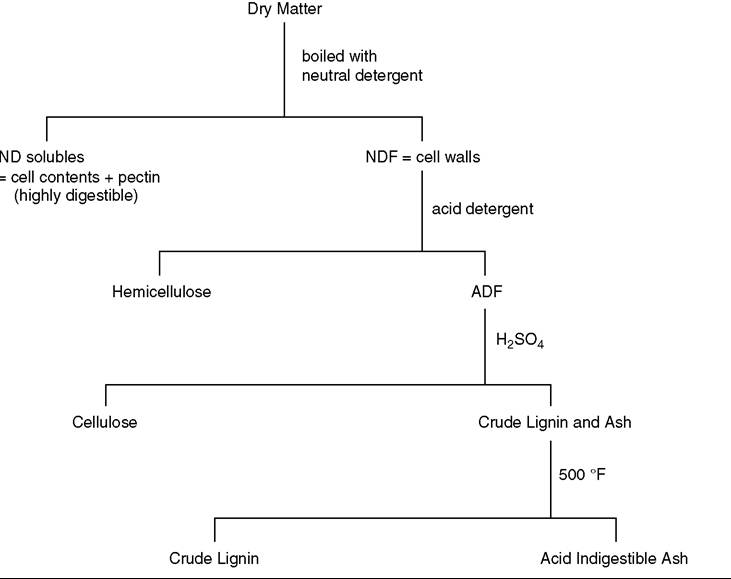
Figure 19.2 Laboratory scheme for fiber analysis. ADF, acid detergent fiber; ND, neutral detergent; NDF, neutral detergent fiber.
Thus, acid detergent fiber (ADF) is a measure of cellulose plus lignin, while neutral detergent fiber (NDF) represents the total cell wall content. Because pectin in the cell wall is highly soluble and lost from the NDF fraction, fiber is underestimated in pectin-rich feeds such as alfalfa or citrus pulp. The difference between ADF and NDF is essentially the hemicellulose content of the roughage. Laboratories usually calculate the energy value of a feed from the ADF and a formula appropriate for the class of feedstuff.
The goat, like other ruminants, is able to digest fiber such as cellulose and hemicellulose into volatile fatty acids by means of fermentation in the rumen. There is conflicting evidence on whether goats are more efficient at digesting fiber than are other species of ruminants. In some instances, the apparent superiority of the goat to survive on poor roughages is because of its ability to choose the most digestible parts of the plant. Lignin in the cell wall bonds to cellulose and imparts structural strength to the plant as it matures, but markedly reduces its susceptibility to microbial digestion in the rumen (NRC 2007). Mature grasses with increased lignin content have lowered digestibility.
Goats undoubtedly have a requirement for fiber to maintain healthy rumen function and butterfat production (Santini et al. 1991; Lu et al. 2005). Little research data is available to document exactly how much NDF or ADF should be included in a goat's rations. Meanwhile, recommendations for dairy cows (more than 25% NDF and more than 19% ADF) may be used as a starting point. One paper suggests 18-20% ADF or 41% NDF for high-producing lactating dairy goats, and 23% ADF for growing kids (Lu et al. 2005). Particle size is also important, because it determines the time required for mastication and the amount of saliva produced to buffer rumen contents.