Fiber-responsive large bowel diarrhea
Some dogs with chronic idiopathic large bowel diarrhea can be successfully managed by feeding a highly digestible diet supplemented with soluble fiber. Such patients are diagnosed as having fiber-responsive large bowel diarrhea (FRLBD).
Most of these dogs are middle-aged.29Pathophysiology
Some of the dogs with FRLBD (especially those with abnormal personality traits or environmental stressors identified in the history) can be diagnosed with IBS. Presently, the relationship between IBS and FRLBD is unclear and an overlap of cases may exist. However, many of the dogs with FRLBD have hematochezia, a clinical sign considered uncommon in dogs with IBS.25,26 In addition, dogs with IBS only rarely have been described as responding to dietary fiber supplementation alone.25 Thus, it is possible that dogs with FRLBD may represent a separate syndrome or a subset of IBS patients that respond to dietary fiber supplementation. Some of the dogs with FRLBD also may have Clostridium perfringens enterotoxicosis (see below). The pathophysiology of FRLBD is unknown.
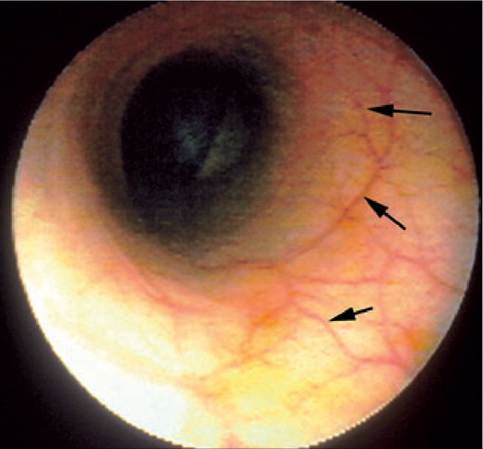
Figure 6.9:
Normal colonic mucosa. Endoscopic appearance of normal colonic mucosa in a dog with idiopathic large bowel diarrhea. The mucosa is smooth and glistening, and submucosal blood vessels are clearly visible (arrows).
Clinical signs
The predominant clinical sign of dogs with FRLBD is chronic intermittent large bowel diarrhea, with hematochezia, excess fecal mucus, and tenesmus. Some dogs may have continuous diarrhea. Occasionally, vomiting and decreased appetite can occur. Abnormal personality traits and environmental stress factors are found in approximately 38% of affected dogs. Only rarely do owners describe their dogs as nervous or highly strung.
Separation anxiety, submissive urination, noise sensitivity, fear of thunderstorms, or aggression occur rarely. In most cases, it is not possible to relate stressors or personality traits to the development or intensification of the diarrhea. Some stressful factors that have been identified include: household visitors, travel, moving, construction, installation of an invisible fence, death of another household pet, or visits to the groomer, veterinarian, or a dog show.Diagnosis
The diagnosis of FRLBD is based on exclusion of known causes of large bowel diarrhea after a thorough diagnostic evaluation, including colonoscopy (Figure 6.9) and mucosal biopsy. If no cause of diarrhea is identified, the diagnosis of idiopathic large bowel diarrhea is made. If the diarrhea responds to fiber supplementation, the diagnosis is amended to FRLBD.
Treatment
Dietary fiber is a collective term for a wide variety of plant polysaccharides and lignins that are resistant to mammalian digestive enzymes.30 There are many types of dietary fiber, each with diverse chemical, physical, and physiological properties. Water-soluble fibers include pectin, gums, mucilages, and some hemicelluloses.30 They are found in the parenchymatous portions of fruits and vegetables, and in the seeds of leguminous plants. Water-insoluble fibers include cellulose, lignin, and some hemicelluloses, and are found in cereal grains and seed coats.
Dietary fiber supplementation has been shown to normalize colonic myoelectrical activity and colonic motility in humans. There are several potential mechanisms by which dietary fiber supplementation results in clinical improvement in dogs with FRLBD. Soluble fibers adsorb a large quantity of water, improving fecal consistency. Colonic bacteria, which make up approximately 40-55% of the dry stool mass, ferment soluble fiber, which results in a vast increase in the numbers (but not types) of colonic bacteria and quantity of bacterial byproducts.31,32 Bacterial fermentation of fiber leads to the production of short-chain fatty acids, of which butyrate serves as an energy source for colonocytes.31,32 In addition, short-chain fatty acids promote differentiation and proliferation of colono- cytes, stimulate absorption of water and electrolytes, and stimulate contraction of longitudinal muscle. Insoluble fiber greatly adds to fecal volume.
Thus, dietary fiber can increase fecal bulk, which increases colonic distension, the major stimulus for normal colonic motility. With increased colonic distension, an improved motility pattern in dogs with FRLBD may result in normal defecation and resolution of clinical signs.Psyllium comes from the seeds or husks of the plant Plantago ovata and consists of approximately 90% soluble fiber. Although there are no studies evaluating the use of soluble fibers in dogs with diarrhea, there are such studies in human beings. Psyllium was beneficial in treating a group of children with idiopathic chronic nonspecific diarrhea.33 Since the beneficial effects persisted after the withdrawal of fiber supplementation, the authors postulated that psyllium led to an alteration of the colonic flora. In addition, psyllium has also been shown to be beneficial in human adults with nonspecific chronic diarrhea, ulcerative colitis in remission, some patients with IBS, burn patients receiving enteral nutrition, other patients being tube fed, and some patients with other diarrheal disorders.29
A highly digestible low-fiber diet supplemented with psyllium hydrophilic mucilloid (Metamucil®; 1-3 tablespoons/day) will benefit many dogs with chronic idiopathic large bowel di-
arrhea. In the cases reported by the author, the median amount of Metamucil® added to the diet was 1.33 g/kg/day (range: 0.31-4.9 g/kg/day). In some cases, drug therapy for IBS may need to be added to the treatment protocol.
Some dogs can have the amount of supplemented fiber reduced and possibly withdrawn entirely, while others require long-term supplementation. In addition, some dogs can be switched from a highly digestible diet to a regular maintenance diet without relapsing diarrhea.
Prognosis
The prognosis for dogs with FRLBD is very good to excellent for those patients that respond to soluble fiber supplementation. Since no specific clinical findings have been identified that can predict whether an individual dog will respond to fiber therapy, a therapeutic trial is necessary.
The prognosis is more guarded for those patients that only partially respond to fiber supplementation and require drug therapy for IBS.??9 Key Facts
■ The major functions of the large intestine are extraction of water and electrolytes from the ileal effluent, storage of feces, and defecation.
■ The most common clinical sign of large intestinal disease is diarrhea, usually characterized by increased frequency of defecation, decreased quantity of stool per defecation, tenesmus, hematochezia, and excess mucus.
■ Trichuris vulpis infestation is one of the most common causes of acute or chronic large bowel diarrhea in dogs.
■ In dogs, irritable bowel syndrome is a diagnosis of exclusion and known causes of large bowel diarrhea must be eliminated before a diagnosis of irritable bowel syndrome can be made.
■ A highly digestible low-fiber diet supplemented with psyllium hydrophilic mucilloid at 1-3 tablespoons/day will benefit many dogs with chronic idiopathic large bowel diarrhea.