Handling Goats
Group Considerations
It is generally recognized that goats are more interactive with humans than are other domesticated ruminant species, and behavioral studies have demonstrated that goats show referential and intentional communicative behavior with humans that is similar to that exhibited by domestic companion animals such as dogs and horses (Nawroth et al.
2016). Goats are highly adaptable and trainable animals. Feral goats captured in Australia and New Zealand may become used to handling in confinement within weeks, although if frightened suddenly they can clear sheep fences with ease. Dairy goats are readily trained into milking routines involving parlors and machine milking. Although Angora kids may scream the first time they are sheared, they get used to the procedure.Goats used to human contact can be mustered by calling. Moving less tame goats on open range is similar to moving sheep. Dogs can be used, but they must be well trained. The flight distance of feral goats is 8-10 m. Goats are more likely to turn and fight than are sheep if pro - voked by a dog. Animals that break away from the group should be left to follow along rather than chased. The presence of sheep with the goats can actually facilitate flocking and driving, although on hills goats tend to move upward and sheep downward. When collected in yards, anxious goats may pile up in a corner and some may suffocate, so they should be divided into small groups. When possible, goats should be allowed to spend 24 hours in a handling facility before they are worked so they are more comfortable with their surroundings. Horned goats may be very wary of entering narrow races and gates. When working horned goats in close quarters, the danger of face and eye injuries to handlers is high, and protective eye wear should be used.
Individual Restraint
Tame goats will stop when caught by the gastrocnemius tendon.
However, if a frightened or wary goat is actively fleeing or struggling, capture by the limb can lead to serious dislocations of joints or fractures of long bones, particularly in young animals. It is preferable to catch animals by hooking an arm around the neck or torso or by grabbing the collar, horns, beard, or, less desirably, the ears.Goats used to human contact can be trained to lead. Goats that pull strongly against neck chains will commonly cough and, rarely, cause trauma to the trachea. Goats accustomed to being handled are usually easily restrained for examination, administration of medication, or routine sample collection. Such goats can be haltered or lead shanks can be tied to neck straps and then secured. Uncooperative goats can be straddled over the withers by a handler with the goat's hind end backed into a corner and the head held firmly by the handler (Figure 1.1). If a goat is horned, the horns should be held when restraining goats in close quarters to avoid injury to the handler. Bearded goats can be led by the beard and non-bearded goats by the ears, though some owners may object to the latter practice. For smaller, uncooperative goats, flipping the animal into lateral recumbency and then placing the handler's knee on the goat's neck may provide effective restraint.
Goats do not become passive when tipped up on the rump in the manner used for sheep, so this method of restraint is less useful; this is a problem regarding shearing. A modification of the technique to avoid struggling is first to tip up the goat, and then to allow the head to fall backward between the handler's thighs so that the goat's back is resting on the handler's shins. This redistributes the goat's weight from the bony rump to the back, making it more comfortable for the goat. Tipping up the goat is useful for examining the prepuce and penis of male goats suspected of urolithiasis. In this case, the weight of the goat's upper body needs to be shifted forward to facilitate extension of the penis.
Foot trimming is most easily carried out by raising the distal limbs of the standing goat.Administering Medications
Oral Medications
Mass medication of feed and water is no more reliable in goats than in other species because sick animals are likely to have reduced feed and possibly water intake. In addition, goats, being fastidious about water supplies, may detect a change in the odor or flavor of the water and refuse to dr ink it.
When drenching individual goats, the head should be held horizontally and not tilted up, reducing the chances of aspiration pneumonia. The drenching gun should be inserted at the commissure of the lips and the medication dispensed. To successfully administer boluses with a balling gun, the gun must be carefully worked over the base of the tongue before dispensing the bolus or the pill will be chewed and spit out. Put the gun into the mouth at the commissure of the lips to facilitate this process. Do not force the gun into the pharynx or traumatic injury can occur. Balling and drenching guns should be examined before use to ensure that they do not have sharp defects that could injure the goats. Passing a stomach tube in goats via the mouth is not particularly difficult if proper restraint and a suitable speculum are available. Commercially available sheep speculums work well with goats, as does a block of wood with a circular hole cut through it. Small-diameter, well-lubricated tubes can be passed through the nose to the stomach.
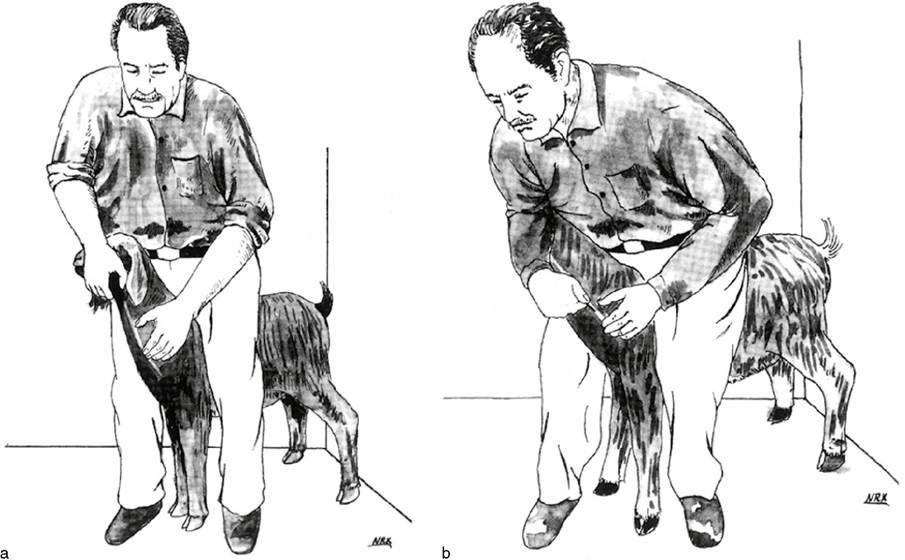
Figure 1.1 Useful restraint methods for intravenous blood sampling or medicine administration via the jugular vein of a goat. Backing the goat into a corner, as shown, improves control. In Figure 1.1a, the goat is restrained so that an assistant, kneeling in front of the goat, can easily take the sample or give the medicine. In Figure 1.1b, the goat is positioned with the head tucked under the handler's arm so that sampling or medicine administration can be accomplished by the handler alone.
Source: Illustrations by Mr. Nadir Kohzad.Injections
Mass medication or vaccination using a common needle has long been practiced by some farmers and veterinarians. In the case of goats, as with other species, it is time to rethink this practice, particularly in light of the growing importance of caprine arthritis encephalitis virus (CAEV) in goats. This retrovirus may be transmissible by blood- contaminated needles. Certainly, in herds where the virus is known to exist, or attempts are under way to control it, it would be counterproductive and negligent to use common needles. Additional discussion of this important caprine disease is found in Chapters 4 and 5.
Another reason to use individual needles in conjunction with other good hygienic practices during vaccination is the tendency for goats to develop large swellings and even abscesses at injection sites after vaccination with clostridial, chlamydial, and paratuberculosis vaccines. If the veterinarian's technique is exemplary, he or she is unlikely to be held accountable for any problems that develop later.
If skins are marketed from a goat herd, the veterinarian should avoid injections of any kind in regions of the body that become part of the marketed skin, because defects can occur secondary to injection site reactions and devalue the skin. Therefore, the back and upper flanks should be avoided, even though they are often convenient.
Intramuscular injections can cause difficulties in goats. The preferred site is in the neck, in a triangular region bounded by the vertebral column ventrally, the nuchal ligament dorsally, and the shoulder caudally. The triceps can also be used. If skin quality is not a consideration, the lon- gissimus muscles over the back in the lumbar region may also be used. In all cases, the volume of drug administered in one site should not be greater than 5 mL. Needles should be 2-3 cm long and no larger than 18-gauge unless the medication is highly viscous. Shorter needles should be used for young kids.
The thigh muscles should be avoided as a site of intramuscular injection in adults and especially young goats. The muscle mass is small compared to other ruminants, and sciatic nerve damage is not uncommon. Owners should be counseled against using this site. Even when the nerve is not damaged, marked lameness can occur when irritating drugs such as oxytetracycline are given in the leg. Permanent muscle damage can also occur that devalues the carcasses of meat goats.
Subcutaneous injections are commonly given in the neck in the same region described for intramuscular injections, or on the chest wall about 5 cm behind the point of the elbow. Injections ahead of the shoulder should be avoided in show goats because local reactions near the superficial cervical (prescapular) lymph node may be confused with caseous lymphadenitis. Needles should be 18-20-gauge. The risk of accidental intramuscular injection may be increased if long needles are used.
Intravenous drugs are given via the jugular vein, generally using 2-3 cm long needles of 18- or 20-gauge. Blood samples can be taken from the jugular vein using an 18- gauge needle. Intradermal injections are given using 26- gauge, 1 cm long tuberculin needles. Intraperitoneal injections are rarely used, except to treat neonates for hypoglycemia with glucose solutions or navel infections with aqueous-based antibiotics. With the kid held hanging by the front legs, an 18- or 20-gauge needle is inserted perpendicular to the skin about 1 cm to the left of the navel, no deeper than 1 cm.
When intramammary infusions are given, the teat should first be cleaned and swabbed with alcohol. As in cattle, single-use teat cannulae should be used for each infusion, with the cannula inserted into the teat only enough to gain entry into the teat cistern. For very small teat openings, sterile tomcat catheters can be used to infuse the teat.