Life Cycle of Coccidioides
Coccidioides immitis and C. posadasii are dimorphic fungi that switch between a mycelial phase and a spherule phase (Fig. 4.1). A switch from polar to isotropic growth occurs when a susceptible host inhales clonal arthroconidia, and the development of the unique infectious structure is initiated.
The spherule matures and releases endospores, which may develop into new spherules or arrest growth. Mild or asymptomatic infections generally stay localized to the lungs. More severe infections can disseminate to other body sites (spleen, synovial joints, liver, kidneys, etc.), and endospores can cross the blood-brain barrier (Nguyen et al. 2013). The fungus can initiate mycelial growth from excised tissue or other biosamples (biopsy, sputum, synovial fluid, etc.) even at 37 °C, although how and when this occurs in nature are not known. High temperature, elevated CO2 concentration/low oxygen, and specific nutrients all play a role in the formation, growth, and maintenance of the spherule/endospore cycle (Converse and Besemer 1959). Conditions consistent with development of spherules include shaking cultures at 37 °C, under 6-20% CO2, with a liquid medium containing glucose, ammonium acetate, potassium phosphate, magnesium sulfate, and zinc sulfate at a pH of 6.3 (Breslau and Kubota 1964; Brooks and Northey 1963; Northey and Brooks 1962; Converse 1955). There is variation among strains, but generally mature spherules develop in 3-6 days (Pappagianis et al. 1956; Huppert et al. 1982).Whereas U. reesii has a defined sexual life cycle, the sexual cycle of Coccidioides is unknown (Sigler et al. 1998). However, typical ascomycete mating-type (MAT) loci were identified in Coccidioides using comparative genomics methods (Mandel et al. 2007; Fraser et al. 2007). MAT1-1 and MAT1-2 are present in a 1:1 Mendelian ratio in over 400 strains of Coccidioides immitis and C. posadasii, which suggests the sexual recombination is frequent in these species (Mandel et al. 2007). Moreover,
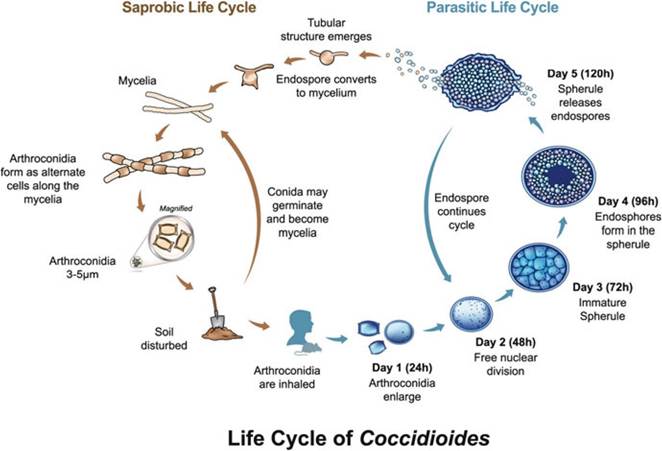
Fig. 4.1 Dimorphic asexual life cycle of Coccidioides. From Lewis et al. 2015, used with attribution
mRNA is transcribed for genes in the MAT locus, which supports the hypothesis of a functional sexual cycle. All data obtained to date are consistent with the prediction that both species of Coccidioides are highly recombining sexual organisms (Burt et al. 1996; Engelthaler et al. 2015).
4.3