I NUTRITIONAL SUPPORT
In order to provide complete patient care the clinician should include nutritional support as part of the therapeutic plan. Providing nutrition may accomplish several goals (Box 12-1).
We recommend the 2-step approach: step 1— the clinician assesses the PATIENT (What is the physiological state of the patient?), FEED (What nutrients am I concerned with and what diets are available to meet those concerns?), and MANAGEMENT (How will I administer nutrition?); step 2—the clinician formulates and initiates a feeding plan, including assessment and alteration of the plan as needed.
Importance of Providing Nutritional Support
A few days of food deprivation is not detrimental to healthy animals; however, it may be detrimental to a sick animal (Table 12-1). Animals are cyclic eaters. Short periods of food deprivation are not a problem because the body is able to use endogenous energy substrates such as glycogen. During prolonged food deprivation the body shifts to a hypometabolic state to conserve structural and functional proteins as much as possible. Thus glucose and fatty acids become the major energy sources. During periods of food deprivation associated with stress and illness, however, the body cannot utilize fatty acids or glucose efficiently. Therefore, amino acids are mobilized and used for gluconeogenesis, for DNA and RNA synthesis, and for acute phase protein production, and malnutrition can occur rapidly (Figure 12-1).
Indications for Nutritional Support
Whether nutritional support is indicated or not can usually be determined by taking a good history and performing a thorough physical examination (Box 12-2). In patients with acute weight loss the decrease in body weight likely reflects fluid
BOX 12-1
Goals of Nutritional Support
1. Minimize metabolic derangements
a. Maintain hydration
b. Attenuate acid-base disorders
c.
Attenuate electrolyte disturbancesd. Provide disease-specific nutrients
2. Provide nutrients to facilitate recovery
a. Suppress hypermetabolic response
b. Reverse protein catabolism and negative nitrogen balance
c. Maintain gastrointestinal tract integrity and function
d. Optimize immune function
3. Maintain lean body mass and body weight
4. Avoid complications associated with refeeding loss (dehydration). If a critically ill patient has not eaten for 3 or more days, if there is evidence of increased nutrient demands (e.g., surgery, infection, fever), or if there is evidence for nutrient losses (e.g., vomiting, diarrhea, wounds), then nutritional support is indicated. Physical examination may reveal that nutritional support is indicated if the patient is underweight or cachectic, has decreased muscle mass, is generally debilitated, and has evi-
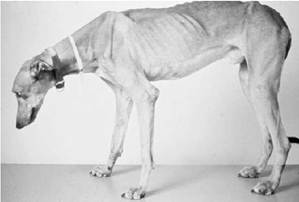
Figure 12-1 An adult male Greyhound with severe protein-calorie malnutrition.
dence for diseases associated with increased nutrient demands or excessive nutrient losses. Use of a body condition score can aid the clinician in determining the overall nutritional status of the patient (Table 12-2).The clinician should be careful not to overinterpret edema, ascites, or excessive body fat as representing adequate body mass. There are no good laboratory tests for aiding in assessment of nutritional status. Hypoalbuminemia is associated with increased morbidity and mortality; however, a normal serum albumin concentration does not rule out malnutrition.
TABLE 12-1
Comparison of Simple Starvation and Stressed
Starvation in Humans
Rights were not granted to include this table in electronic media. Please refer to the printed publication.
Decisions on How to Provide Nutrition
There are 2 main “Golden Rules” of nutrition: (1) if the gut works, use it, and (2) keep it simple. As much of the gastrointestinal (GI) tract should be used as possible. Parenteral nutrition is limited to comatose or paralyzed patients or those with severe GI dysfunction such as intractable vomiting, malassimilation syndromes, severe pancreatitis, or peritonitis. Parenteral nutrition should be considered in patients in which provision of nutrients is not feasible using the enteral route. The clinician should use common sense in providing nutrition. Nutritional support should be an integral part of the therapeutic plan.