Quality ofLife
Mild to moderate impairments in mobility may be of no functional significance to some animals and their owners. In these cases, the cost of treatment to maintain stability or to prevent secondary complications may be the primary factor an owner considers in assessing the treatment plan for their pet.
Some owners may need to be shown videos of dogs in various states of immobility to better understand the functional limitations and behaviors of affected dogs. Patients who are not suffering from pain generally do not require constant inventory of the patient's clinical condition. The exception would be for animals with concurrent pain, in which case pain inventories can be utilized to track progress in controlling such signs, which are likely to be of great significance to animal and owner.Severely impaired mobility without significant pain or discomfort is arguably one of the most difficult situations an owner may encounter if an animal's cognition is normal. The resiliency of pets produces a situation in which they may be emotionally unaffected by their altered mobility even when completely nonambulatory or paralyzed. Consequently, owners may significantly struggle with a decision on whether to continue treatment or to euthanize based upon their animal having a progressive decline, as compared to a sudden worsening of a terminal clinical condition. Therefore, owners often have time to consider all possibilities and to err on the side of waiting for an additional deterioration before confronting end-of-life or quality-of-life issues. Such declines may be gradual and the owner may not recognize deterioration, or when worsening of signs does occur the owner may recant previous statements about their endpoints of care. Frequent visits between the veterinarian and the owner may forge a strong enough bond whereby the veterinarian's assessment carries significant decision-making influence.
Many veterinarians struggle with such responsibility and try not to advocate in any potential benchmark in the animal's care. However, this subjective assessment of the veterinarian may be required by the owner and unfortunately quality of life assessments specifically targeting mobility have not yet been validated in dogs or in cats. There are however other scoring systems which may be adapted for this purpose.Patient Assessment/Scoring Systems
The following scoring systems are applicable to mobility impairment when pain is present.
For osteoarthritis, Table 3.12 is an example of a subjective scoring system which is
Table 3.12 Clinical scoring system for assessing dogs with osteoarthritis.
| Criterion | Clinical evaluation |
| Lameness | 1) Walks normally 2) Slightly lame when walking 3) Moderately lame when walking 4) Severely lame when walking 5) Reluctant to rise and will not walk more than five paces |
| Joint mobility | 1) Full range of motion 2) Mild limitation (10-20%) in range of motion; no crepitus 3) Mild limitation (10-20%) in range of motion; with crepitus 4) Moderate limitation (20-50%) in range of motion; ±crepitus 5) Severe limitation (>50%) in range of motion; ±crepitus |
| Pain on palpation | 1) None 2) Mild signs; dog turns head in recognition 3) Moderate signs; dog pulls limb away 4) Severe signs; dog vocalises or becomes aggressive 5) Dog will not allow palpation |
| Weight-bearing | 1) Equal on all limbs standing and walking 2) Normal standing; favours affected limb when walking 3) Partial weight-bearing standing and walking 4) Partial weight-bearing standing; non-weight-bearing walking 5) Non-weight-bearing standing and walking |
| Overall score of clinical condition | 1) Not affected 2) Mildly affected 3) Moderately affected 4) Severely affected 5) Very severely affected |
Source: McCarthy (2007). Reproduced with permission of Elsevier.
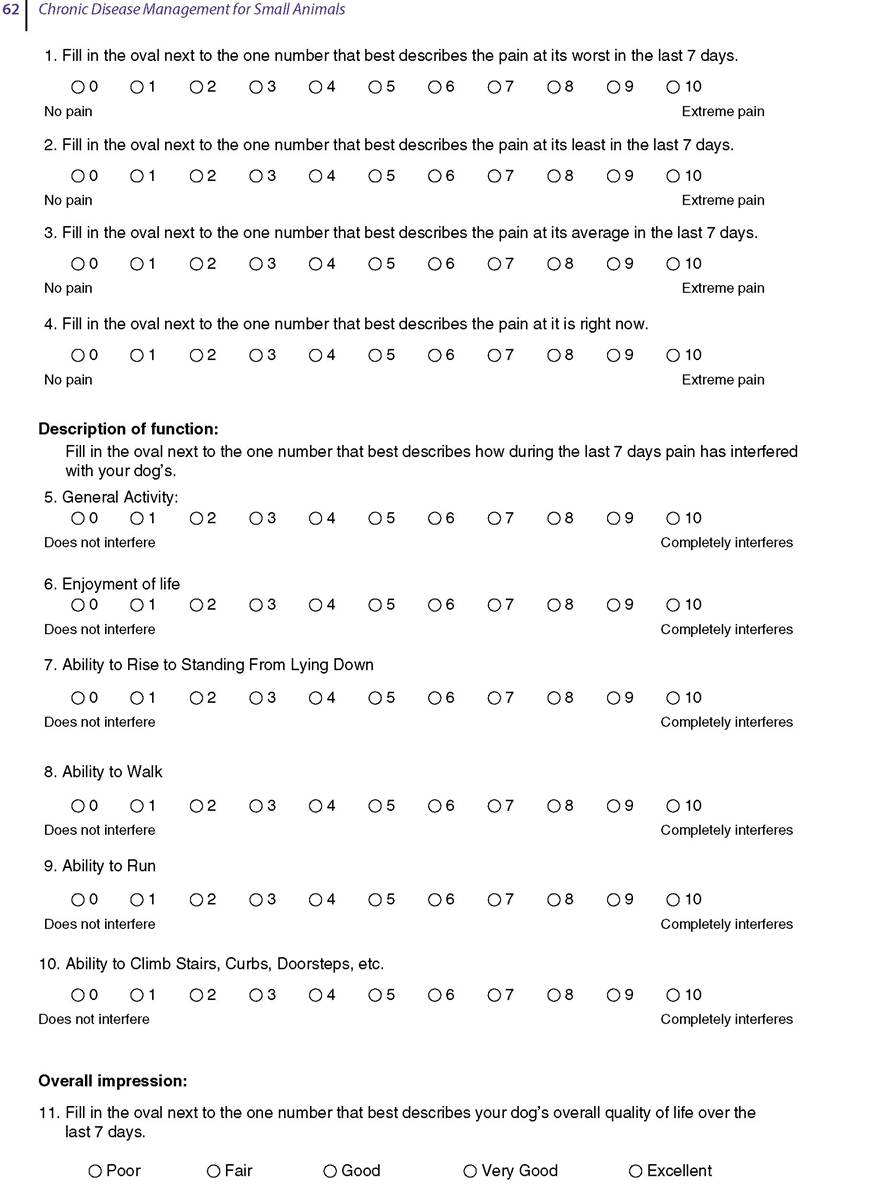
Figure 3.1 Canine brief pain inventory.
Source: Courtesy of Dr. Dorothy Cimino Brown.consistent with those often published in studies examining an intervention (McCarthy et al., 2007).
A more general canine brief pain inventory may be more applicable to other conditions (Figure 3.1, PennVet, 2013):
Feline pain inventories are unfortunately not yet validated, so clinicians are left with subjective assessments of activity and comfort, recognizing that feline pain manifests quite differently than canine pain.
When mobility impairment is not associated with pain, currently validated tools do not appear adequate to objectively assess an animal's progress. Consequently, a hybrid system may be necessary.
Figure 3.2 is an example of a questionnaire which could be used for patients with altered mobility but without significant pain. The survey has not, however, been subjected to validation and as such should be used with caution and in combination with other assessment findings and tools.