Anatomical terminology
Directional terms used for quadrupeds are different to those used in bipedal animals, which have an upright posture.
In regions cranial to head-neck junction
■ Cranial, caudal, dorsal, ventral
In regions caudal to the head-neck junction:
■ Rostral, caudal, dorsal, ventral
(cranium - L = skull, cauda - L = tail, dorsum - L = back, venter - L = belly, rostrum - L = beak)
■ Use of the terms anterior, posterior, superior, inferior:
Used in conjunction with the eye and the inner ear
Otherwise ventral, dorsal, cranial/rostral and caudal
(ante - L = before, post - L = behind/afterward)
Median plane - longitudinal midline of the animal, divides the animal into two symmetrical halves (medius - L = in the middle)
Sagittal plane - parallel to the median plane but off the midline; planes close the midline may be called paramedian (sagitta - L = arrow, as if it had pierced the body from front to back or back to front)
DorsalZhorizontal plane - parallel to the dorsal aspect of the animal
Lateral - towards the side; (latus - L = flank)
Medial - towards the midline; (medius - L = in the middle)
Transverse plane - transects the trunk, head, limb or appendage perpendicular to its long axis (trans- L = across or over, versus - L = turned so as to face)
Limbs:
■ Cranial and caudal, if proximal to the carpus or tarsus
■ Dorsal and palmar, if distal to the carpus; palma - L = palm of hand
■ Dorsal and plantar, if distal to the tarsus; planta - L = sole of foot
■ Proximal lies towards the junction with the body; proximus - L = near
■ Distal lies further away from the junction with the body; distare - L = distance
■ Axial - towards the axis/midline of the limb; axle - L = axle or pole around which rotation occurs
■ Abaxial - away from the axis/midline of the limb; ab - L = from
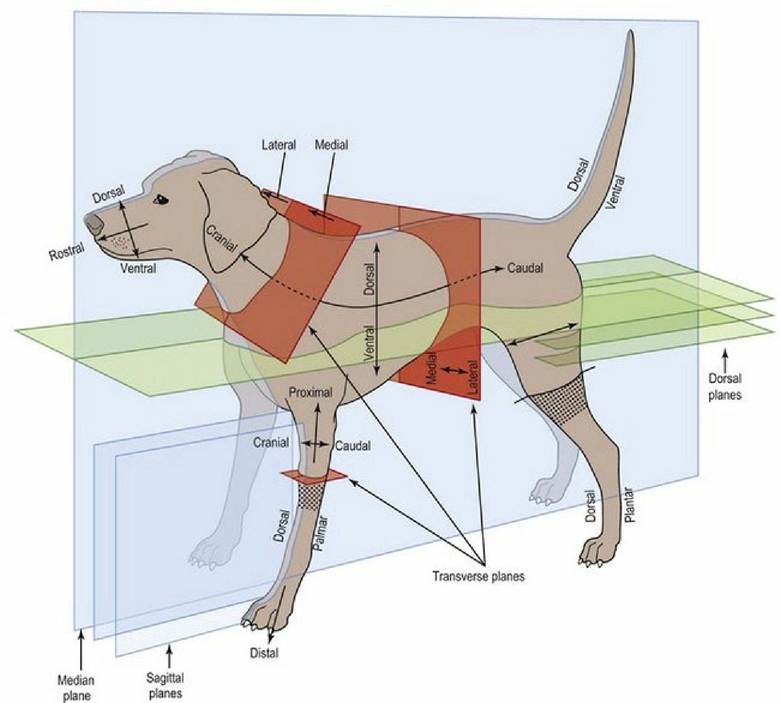
Reprinted with permission Dyce KM, Sack WO, Wensing CJG. Textbook of Veterinary Anatomy, 4th Edition, Saunders, Philadelphia, 2010.