CENTRAL PATHWAY FOR OLFACTION
Olfactory nerve fibers, known as fila olfactoria, gracefully culminate in the ipsilateral olfactory bulb, a realm inhabited by tufted cells and mitral cells. As revealed in the captivating tableau, within this sensory symphony, dendrites of tufted and mitral cells intricately intertwine with the terminal ends of olfactory nerve fibers, giving birth to the mesmerizing glomeruli of the olfactory bulb.
The alchemy of neurotransmitters, likely peptides, emanates from the terminal realms of olfactory axons, sparking a ballet of excitement in mitral and tufted cells, their movements finely tuned by the artistry of inhibitory periglomerular interneurons. Embarking on a grand journey, the axons of mitral and tufted cells venture beyond the olfactory bulb, crafting the majestic tapestry of the large lateral olfactory tract. The hallowed sanctuaries that receive these olfactory signals include the amygdala and entorhinal cortex, which, in turn, dispatch olfactory signals to the esteemed hippocampus and frontal cortex. In a departure from the norm, olfactory signals, rather than traversing the thalamus, navigate a direct course to evoke emotional responses. The saga continues as mitral and tufted cells extend their influence to the ipsilateral septal nucleus, while their emissaries traverse the enigmatic realms of the medial olfactory tract and the anterior commissure to reach the distant shores of the contralateral olfactory bulb. This intricate projection of olfactory signals unveils a narrative where emotional resonance finds its home in the entorhinal cortex, hippocampal formation,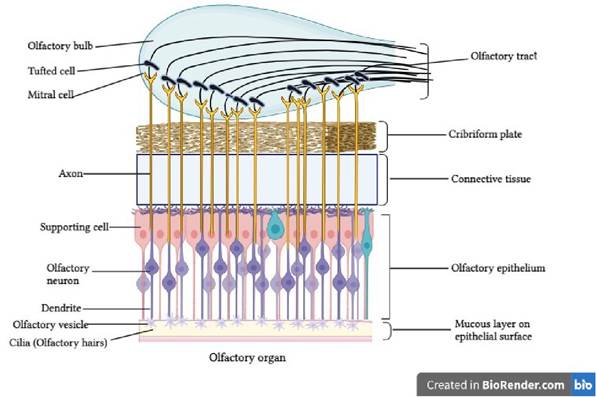
FIGURE 12.4 Lateral view of the olfactory neurons, olfactory nerve, olfactory bulb, and olfactory tract. Dendrites of the olfactory bipolar neurons bear 10-20 short cilia. Axons of the olfactory neurons form olfactory fibers, which terminate in the olfactory bulb to synapse with tufted and mitral cells
septal nuclei, and amygdala of the limbic system. Moreover, the autonomic responses to olfaction find their maestros in the hypothalamus and periaqueductal gray of the midbrain, integral components of the autonomic nervous system intertwined with the limbic symphony. In this orchestration, the olfactory signals transcend mere detection, becoming the very essence of olfactory memories and the evocation of profound emotional reactions (Figure 12.4).
12.7