CYTOPLASM
The cell’s cytoplasm is the jelly-like substance that contains 80% water. It contains a clear liquid portion called the cytosol and various particles of different shapes and sizes.
The nature of these particles includes proteins, carbohydrates, lipids, or electrolytes. The cytoplasm also contains numerous organelles with distinct structure and function.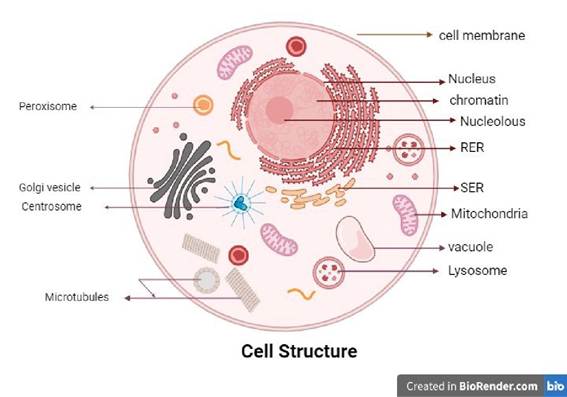
FIGURE 2.1 Cell structure
Two zones in the cytoplasm:
1. Ectoplasm: The portion of the cytoplasm that is located just below the cell membrane.
2. Endoplasm: The inner part of the cytoplasm present between the ectoplasm and the nucleus.
Numerous cellular structures immersed in the cytoplasm are called cytoplasmic organelles. Cytoplasmic organelles are considered small organs of the cell. Some organelles are bound by limiting membranes (endoplasmic reticulum, Golgi apparatus, lysosome, peroxisome, centrosome, secretory vesicles, mitochondria, and nucleus) while others do not have limiting membranes (ribosomes and microtubules). Each organelle has a definite structure and functions
2.4