EPIDERMAL GROWTH FACTOR (EGF)
Present in sub-maxillary and parotid glands and play important role in cell proliferation and differentiation. Injection of salivary gland extract from the male mice to the newborn mice causes gross anatomical changes like
• Opening of eyelids occurs as early as 7 days instead of 14 days.
• Eruption of incisors occurs as early as 6-7 days instead of 8-10 days.
Nerve growth factor (NGF): NGF is synthesized in neurons and enhances the growth and differentiation of sympathetic ganglia. NGF stimulates incorporation of amino acids and increased RNA synthesis. In newborn (9 days old) mice, these ganglia respond by hypertrophy.
Erythropoietin (EP): Mainly produced by kidney in all species of animals. It facilitates the entry of Fe into the bone marrow before synthesis of hemoglobin and increases the release of erythroid cells into the circulation.
• Retine and promine
Retine - Growth inhibitors.
Promine - Growth promoters.
Present in thymus, muscle, tendon, urine, large blood vessels. Both are present together in the tissue. They stimulate or inhibit cell growth depending upon their ratio and concentration.
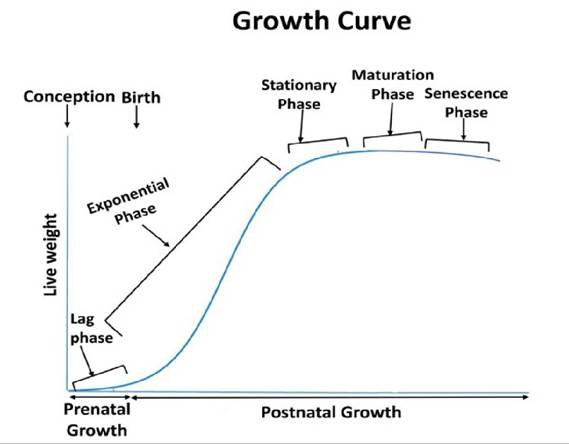
FIGURE 23.5 Growth Curve
Chalone Substances inhibit the mitotic activity of specific tissue. Isolated from liver, kidney, epidermis and granulocytes.
23.9.1 Growth Curve
The growth rate of an individual at different phase of life can be represented by plotting the live weight of individual at different Phase of life on a graph paper is called growth curve. The growth curve of animal is “sigmoid or S” shaped. The difference between the initial and final weight or initial and final size of an individual for any period of time is the absolute growth (Figure 23.5).
23.9.2 Sigmoid Growth Curve Has Three Phases
Lag Phase: It is the first period during the growth phase, where the curve rises gradually. In this phase, the organism is getting prepared for growth by synthesizing enzymes, cells, and accumulating substances to metabolize protoplasmic components.
Log/Exponential Phase: During this period, growth begins slowly at first and becomes rapid later on. Hence, the curve rises steeply.
Stationary Phase: The exponential growth does not continue indefinitely. The curve, therefore, rises slowly and becomes horizontal, signifying the limit of growth. During this phase, the rate of anabolism is exactly equal to catabolism.
Thereafter, negative growth starts where catabolism exceeds anabolism, which finally leads to the death of animal.
Growth is a biological process which occurs through a series of cellular proliferation, differentiation, and morphogenesis resulting in a continuously increase in the size and weight of an animal. Growth takes place through the processes of increase of cell numbers and size. Growth and development of cells, tissues, and organs occur during prenatal and postnatal life of an organism. Various factors that regulate growth during prenatal periods include heredity, endocrine factors, maternal age and nutrition, sex of the fetus, litter size, and environment. Several factors which influence postnatal growth include genetic factors, nutritional, climatic, managemental, and health status of animal. The factors and biological process that influences the growth of meat-producing animals and poultry species is very much essential to maximize the growth for meat and egg production efficiency, and quality of the product yield by the animals. However, the growth process may be manipulated by using various growth promoter, feed additives, and supplementation of growth factors to improve the growth of animals.