GROWTH PATTERN
Isometric Growth: When growth rate of organs and the body is the same. Growth of young animals follows an isometric pattern.
Allometric Growth: When growth rate of organs and the body is different.
Growth of the mammary gland during puberty follow allometric pattern.23.3.1 Growth of Cells, Tissues, and Organs
Any increase in size inevitably involves a change in form (relative dimensions) e.g. a sphere.
If a sphere is doubled in weight and volume, its surface area is increased by 60% and diameter by 26%.
Now, if the sphere happens to be a cell. The surface area of the cell in relation to its mass may be very important for exchange between cells and between a cell and external environment i.e. incorporation of nutrients and removal of waste products through cell surface to the extra-cellular fluid.
There is a limit to the size to which an individual cell can grow.
Some organs have characteristically smaller cells than others and these have particularly higher rate of metabolism e.g. liver and kidney have smaller cells than the heart.
Differential growth: Proportional dimensions of the body organs may change during prenatal or postnatal period of development. The different growth centers of the body become active at different times and exhibit different rates of activity. Activity of these centers is coordinated to form pre-determined proportion.
Huxley gave an equation to pre determine the size of an
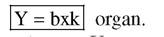
Where Y = is the size of organ, x = is the size of body, b = co efficient (which is function of body size that organ represents), k = 1; when the growth is isometric (K can be +ve or -ve)
Body organs and tissues grow at characteristic rate determined by the genetic set up. Some grow rapidly during early stage of life and others grow later. The maximum rate of growth occurs in a definite sequence; e.g. CNS has maximum growth rate first, followed by bones, muscle and adipose tissue respectively. The growth gradients run from
cranium backwards and from extremities of limbs upwards to meet in lumbar region. Loin region grows maximum followed by pelvis, thorax, neck, head and limbs grow least. The composition of the body varies according to growth, breed, sex, age, nutritional status and physical activity.
23.4