Innervation of the pharynx, larynx and oesophagus
Key points
■ Striated muscles of the pharynx, larynx and oesophagus are innervated by fibres from the nucleus ambiguus (CNN IX, X, XI). This nucleus also participates in coughing, swallowing, gagging and vomiting reflexes.
■ Axons of the external branch of the accessory nerve (CN XI) originate from the cervical spinal cord and innervate some of the extrinsic muscles of the shoulder.
Striated muscles of the pharynx and larynx are innervated by fibres from the nucleus ambiguus (CNN IX, X, XI). The nucleus ambiguus receives fibres from the nucleus of the solitary tract (taste and visceral afferents from the body) and participates in reflexes involving the pharynx, larynx and oesophagus such as coughing, swallowing, gagging and vomiting.
The nucleus ambiguus is a long, poorly defined nucleus located ventrolaterally in the medulla oblongata extending from just caudal to the trapezoid body to the level of the pyramidal decussation (see Fig. A27). Additional neurons associated with CN XI (accessory nerve) extend caudally from the nucleus ambiguus into the cervical spinal cord as far as C7. Thus the accessory nerve arises from two sites as follows: (see Figs. A2, A3, A24, A25)
1. Brainstem origin at the caudal end of the nucleus ambiguus. The cranial roots form the internal branch of the accessory nerve. This immediately joins the vagus nerve and ultimately contributes to the recurrent laryngeal nerve innervating the oesophagus and intrinsic muscles of the larynx.
2. The spinal origin (C1-C7) gives rise to the spinal roots that form the external branch of the accessory nerve. This branch innervates shoulder muscles such as the cleidomastoideus, sternomastoideus, cleidocervicalis and the trapezius muscles.
Sensory innervation of the larynx is via the cranial laryngeal nerve (a branch of the vagus nerve) as far as the glottis.
Caudal to the glottis it is innervated by the caudal laryngeal nerve, which is the termination of the recurrent laryngeal nerve. Innervation of the intrinsic muscles of the larynx is largely by the caudal laryngeal nerve, although the cranial laryngeal nerve supplies the cricothyroideus muscle. The caudal laryngeal nerve has a long course. The vagus and internal branch of the accessory nerve extend caudally down the neck in the vagosympathetic trunk. The recurrent laryngeal nerve detaches in the cranial thorax, with the right side nerve winding around the right subclavian artery and the left side nerve having a longer course as it passes around the ligamentum arteriosum of the aortic arch. Both nerves travel cranially in the carotid sheath innervating the cervical oesophagus. It terminates as the caudal laryngeal nerve innervating the majority of the intrinsic laryngeal muscles, which are responsible for both abduction and adduction of the vocal folds. Importantly the caudal laryngeal nerve innervates the only muscle that abducts the vocal folds - the cricoarytenoideus dorsalis muscle. Thus damage to the recurrent laryngeal nerve can result in failure of vocal fold abduction, causing narrowing of the glottis and inspiratory difficulties (stridor) or changes in phonation. Large dogs and horses are not uncommonly affected by degeneration in these nerves resulting in laryngeal paresis or plegia. In horses, the left recurrent laryngeal nerve seems particularly vulnerable, although lesser changes in other nerves have been noted. The aetiopathogenesis of this degeneration is still unclear (Figs. 10.19 and 10.20).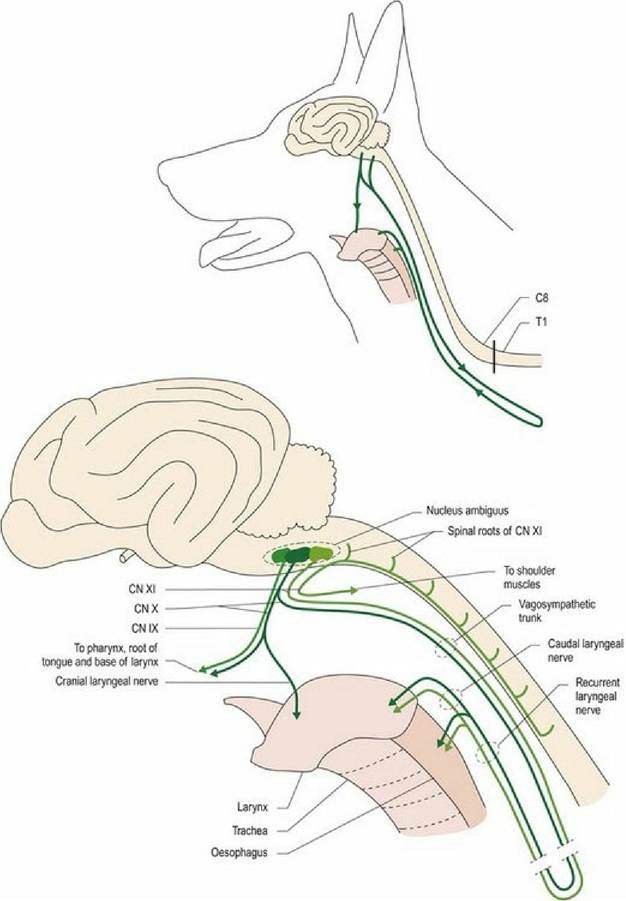
Fig. 10.19 Axons and nerves originating in nucleus ambiguus innervate the pharynx, larynx and oesophagus. Note: the sympathetic fibres of the vagosympathetic trunk are not shown.
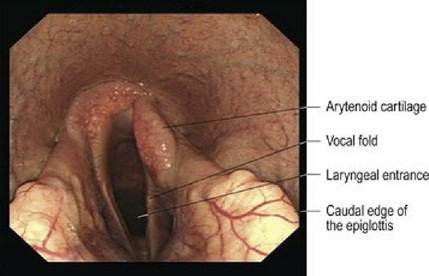
Fig. 10.20 Endoscopic view of the larynx of a horse with a neuropathy of the left recurrent laryngeal
nerve. The left arytenoid cartilage and vocal fold are adducted
(courtesy of Professor Paddy Dixon, Un ivers ity ofEdinburgh).
The vagus and glossopharyngeal nerves supply both sensory and motor innervation to the pharynx, root of the tongue and base of the larynx.