INTEGUMENT
Rabbits have three types of hair - long and short guard hairs and the undercoat - and it is these different lengths and types that have produced the wide variety of rabbit breeds.
The primary hair follicles produce the longer guard hairs or bristles and also have a sebaceous gland and erector pili muscle attached. This enables the guard hairs to “stand on end” when the animal is cold, trapping a layer of warm air for insulation. The short guard hairs or awns are produced by lateral primary follicles; secondary follicles produce the down hairs or undercoat (Cheeke 1987h).Rex breeds are derived from a mutation first observed in France in 1919. They have short, inconspicuous guard hairs that create fur of uniform length. The satin mutation occurred in America in the mid-1930s. The coat length is similar in this breed but the scales of the hair are smooth, creating a sheen appearance. Angora breeds have both long guard hairs and undercoat, with the females having longer hair than the males (Cheeke 1987h).
Secondary follicles can vary with the season, thickening the undercoat in rabbits from cold areas. In some wild rabbits, under the action of melatonin, the pineal gland produces a winter white coat for camouflage against the snow. Photoperiod and prolactin are the triggers for this coat change (Cheeke 1987h).
CLINICAL NOTE
The superficial fascia has a high elastic and collagen content, which means that subcutaneous injections in the scruff are much easier than in rats and guinea pigs (Cruise & Nathan 1994).
acid tyrosine under the influence of the enzyme tyrosinase, which needs copper and iron as cofactors. White hair is created by lack of pigment and reflection of light (Cheeke 1987h). The sheen will depend on sebaceous gland secretions, which is influenced by the level of fat in the diet.
Himalayan rabbits grow coat color based on environmental temperature.
The Himalayan gene restricts coat pigment to the extremities like the ears, nose, feet, and tail where the temperature is lower (Cheeke 1987h). Similarly, shaving hair drops the temperature and encourages the growth of pigmented hair after surgery.Molting
Rabbits molt when the new hair forces out the old hair from the hair follicle, and this occurs twice a year in Spring and Autumn. Molting starts at the head and proceeds downward to the rear and belly, creating an unkempt moth- eaten appearance over the rump.
Feet
Rabbits have no footpads but have coarse fur on the palmar and plantar surfaces of the feet. As rabbit skin is thin, this predisposes them to pressure sores if kept on hard flooring or in unhygienic conditions. The metatarsus is particularly vulnerable as rabbits sit plantigrade, so hard surfaces can erode the fur and skin leading to ulcerative pododermatitis. This is common in Rex breeds with less coarse hair to protect the thin skin (Fig. 8.27).
Scent glands
Both sexes have three sets of scent glands, which are used for territorial and sexual marking (Donnelly 1997). They are used mostly by males and dominant females. The chin (submental) gland is used for chin rubbing against objects. There are also anal glands and inguinal glands located in the hairless area on either side of the anogenital region. These glands are influenced by androgen and produce a mixture of hydrocarbons, proteins, fatty acids, and triglycerides.
Coat color
The original pet rabbits had the natural camouflage agouti coloration and the first color variants seem to have appeared only about the middle of the 16th century. The Madonna with the Rabbit was painted by Titian in 1550 and featured a white rabbit; by 1700 seven mutant colors were known. The hair pigments are melanin (brown/black) and pheome- lanin (red/yellow). These pigments are made from the amino
KEY POINTS
• The uterus is duplex, meaning there are two cervices leading into the vagina.
• The rabbit has only one lacrimal puncta situated on each lower lid.
• The two kinks in the duct make it difficult to cannulate and predispose it to infection.
• Incisor and molar tooth root problems can precipitate dacryocystitis.
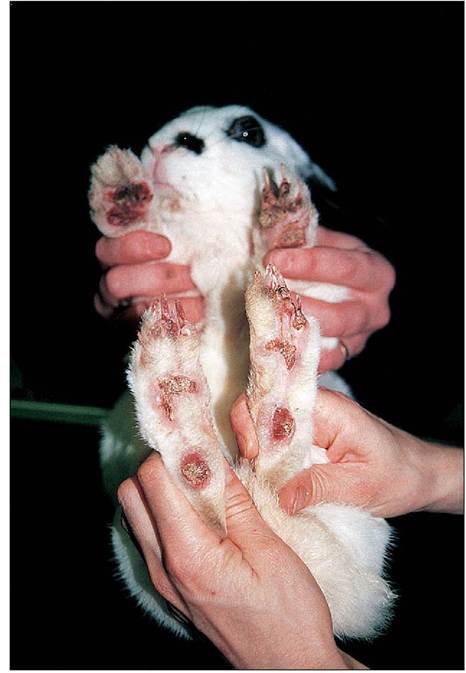
Figure 8.27 • A rabbit with severe ulcerative pododermatitis on all four feet secondary to severe urine scalding and neglect. This rabbit was found dumped in a filthy hutch in the back of a skip.