INTRODUCTION
Reptiles evolved from their amphibian ancestors about 250 million years ago (Evans 1986) and are now found on all continents except Antarctica. Some species like the Common adder (Vipera berus) and European lizard (Lacerta vivipara) can even be found as far north as the arctic circle.
Chelonians (and the tuatara) are the oldest living reptiles and have been around for over 200 million years, while snakes are the most recent arrivals (Evans 1986). Unlike amphibians, which need to return to water to breed, reptilesReptiles
can live independently of water and so can survive in a wider range of habitats, including arid desert conditions. They have achieved this by evolving scales to conserve water, laying amniotic eggs, and excreting insoluble uric acid.
Size
Reptiles have giant species like the Galapagos tortoise (Geochelone nigra) and anacondas (Eunectes murinus), but these are only found in the tropics. The majority of reptiles tend to be of smaller body size than mammals and birds, with most lizards weighing under 20 g (Pough et al. 1998a).
GENERAL INTEREST
The tuatara
The order Rhynchocephalia became virtually extinct over 65 million years ago and there are only two species of the tuatara (Sphenodon punctatus) remaining today (Fig. 2.1). The word tuatara means ‘peaked back' in Maori, referring to its spiny crest. One species is found on islands off the coast of New Zealand while the other species is found only on North Brother Island in the Cook Strait. They are nocturnal, mainly insectivorous and, unlike other reptiles, which need temperatures of at least 19° C, can be active at temperatures as low as 11° C.
The tuatara is the most primitive of living reptiles. It resembles lizards in general body shape but unlike the other reptiles it has a fixed quadrate bone and lacks a copulatory organ. They have uncinate processes on the ribs, like birds, and gastralia or abdominal ribs, like crocodiles. They also have a much longer incubation period for the eggs, burying them for up to 15 months (Carroll 1979; Evans 1986; Pough 1998a).
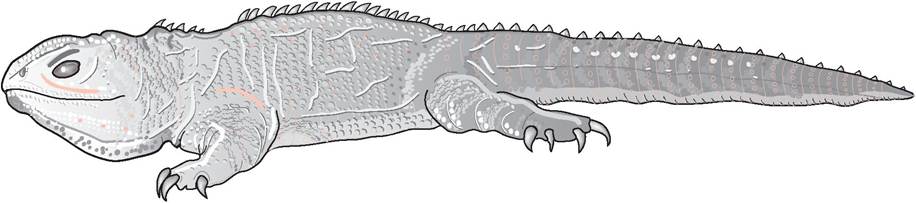
Figure 2.1 • The tuatara (Sphenodon punctatus) belongs to the order Rhynchocephalia and is the most primitive of living reptiles.