INTRODUCTORY CONSIDERATIONS
1. Know the order of the principal parts of the digestive tract. What are the accessory organs of the digestive tract?
Animals are classified, according to the diet in their natural state, as carnivorous, omnivorous, or herbivorous.
The extremes are represented by the carnivorous, or carnivorous, animals and by the carnivorous, or carnivorous, animals. Those subsisting on both flesh and plants are carnivorous animals. Because of the diversity of diet, various parts of the digestive system developed in different ways. Whereas the dog, a carnivorous animal, has an inconspicuous cecum, the horse, a herbivorous animal, has a voluminous cecum. The cecum of the horse facilitates the digestion of coarse plant materials by microbial fermentation. Only minimal fermentation is necessary in the dog, so its cecum is minimally developed. Whatever fermentation is required in the dog occurs mainly in the colon. The pig is an omnivorous animal. It not only has a relatively long small intestine for digesting and absorbing foodstuffs not requiring fermentation, but it also has an expanded part of its colon in which fermentation of the fibrous parts of its diet takes place. A comparison of the gastrointestinal tracts of the dog, horse, and cattle (a ruminant) is shown in Figure 12-1.
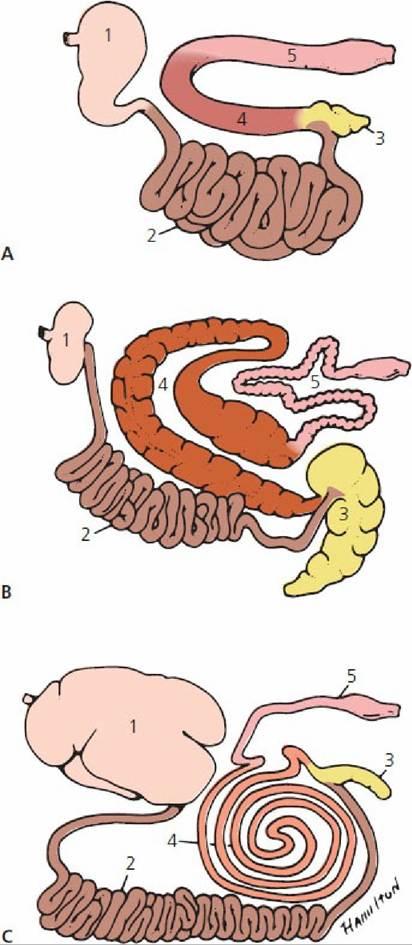
■ FIGURE 12-1 Comparisons of gastrointestinal tracts of the dog (A), of the horse (B), and of cattle (C). (1) Stomach; (2) small intestine; (3) cecum; (4) ascending colon in dog, large colon in horse, coiled colon (ansa spiralis) in cattle; (5) descending colon. (From Dyce KM, Sack WO, Wensing CJG. Textbook of Veterinary Anatomy. 2nd edn. Philadelphia: WB Saunders, 1996.)
The principal parts of the digestive tract as it courses through the body are the mouth, teeth, tongue, pharynx, esophagus, stomach, small intestine, and large intestine. The salivary glands, liver, and pancreas serve as accessory organs of the digestive tract. Generally, the digestive tract among the various animal species has the same parts, but the size and function of the parts for any one species differ according to the characteristics of the natural diet.
■