B Lymphocytes
B lymphocytes (B cells) are the lymphocyte subtype associated with the production of antibodies or the humoral component of a specific immune response (Fig. 16-1). The first step in the humoral response is recognition of a foreign antigen by B cells.
This occurs when an antigen (usually a protein as either a free molecule or a molecule on the surface of a cell membrane or a cell wall) binds to specific cell membrane receptors on a selected subpopulation of B cells. This subpopulation of B cells (a clone) is the only group of B cells with a membrane receptor capable of binding the antigen, and it is stimulated to proliferate. The process by which a particular subpopulation of B cells increases in number is termed clonal selection.For clonal section to be effective, each animal must have a ready supply of lymphocytes with unique membrane receptors (i.e., proteins) capable of binding every potential antigen that may be encountered throughout the life of the animal. These lymphocytes with their unique membrane proteins must develop in utero or early in life for the animal to be immunocompetent (i.e., capable of mounting a specific immune response). Protein synthesis in developing lymphocytes appears to have some unique aspects that permit synthesis of the necessary tremendous variety of membrane protein. A later section of this chapter has more on B cell development.
As the number of B cells in a selected clone increases during a mature immune response, some of the B cells begin to differentiate into plasma cells. Plasma cells can synthesize and secrete antibodies specific for the antigen that stimulated the development of the selected clone. Thus, each plasma cell secretes only one antibody. Other B cells in the selected clone develop into B memory cells (Fig. 16-1). These cells remain in the body for extended periods (years or perhaps throughout life).
since these cells developed from a clone specific for a given antigen, the ready supply of them means that the next time this specific antigen is encountered (e.g., a second infection or exposure after a vaccination), the immune response can be accelerated and amplified.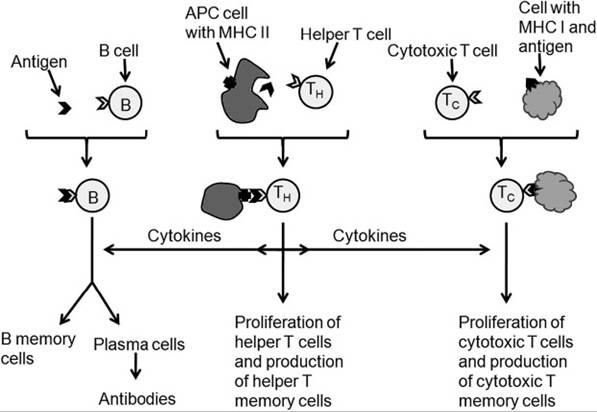
Figure 16-1. Development of major cell types contributing to specific immunity. Note location and role of major histocompatibility complexes I (MHC-I) and II (MHC-II). APC refers to antigen-presenting cell.
The development of B memory cells and plasma cells and the secretion of antibodies are modulated by numerous cytokines. Cytokines, as the chemical messengers (proteins) secreted by a variety of cells in response to injury or microbial invasion, modulate the activity of cells of the immune system. One cell type that secretes cytokines essential for a normal humoral response is the helper T cell (Fig. 16-1). T cells are another of the general classes of lymphocytes, and helper T cells are a specific subtype of T cells. The characteristics and functions of helper T cells are described later in this chapter.