Malformations of the nervous system
When development does not proceed according to plan, then a variety of malformations can occur. Several examples of malformations are given. If cerebrospinal fluid (CSF) flow in the neural canal is blocked then the CSF accumulates, resulting in hydrocephalus.
This causes dilation of the ventricular system and pressure on the surrounding brain tissue, which atrophies. The pressure may cause bulging of the skull (Fig. 2.5A). Failure of closure of the caudal neuropore can result in spina bifida, abnormal spinal cord formation and cystic dilation of the meninges, forming meningoceles. Similarly, if the rostral neuropore fails to close, forebrain development is compromised. The meninges may protrude through the defect forming meningoceles (Fig. 2.5B) or the forebrain may fail to develop (anencephaly). Teratogens (e.g. viruses or drugs) can cause abnormal development by destroying proliferating cells, resulting in hypoplasia, e.g. of the cerebellum causing cerebellar signs. Similarly teratogens may block proliferation in the developing forebrain resulting in compensatory ventricular distension, called hydranencephaly (Fig. 2.5C). Disturbed neuronal migration or axonal growth can result from mutations in genes encoding signalling proteins that are used by migrating cells or for directing axons. Failure of neuronal migration results in underpopulated cerebral cortices and lissencephaly (Fig. 2.5D).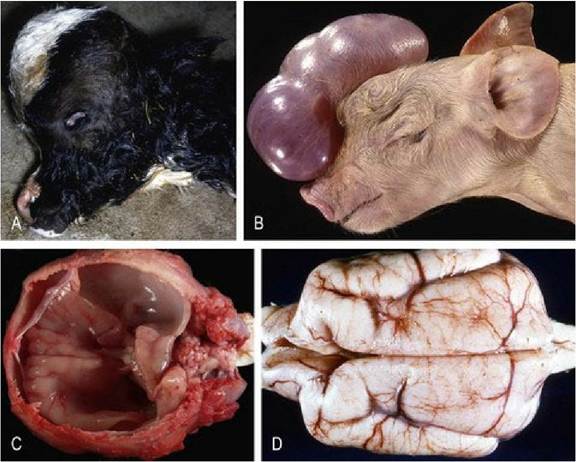
Fig. 2.5 Malformations of the nervous system resulting in (A) hydrocephalus, (B) menigocele, (C) hydranencephaly and cerebellar hypoplasia and (D) lissencephaly. Note, (C) and (D) depict the dorsal aspect of the brains. Images courtesy of the Pathobiology Group, IVABS, Massey University.
More on the topic Malformations of the nervous system:
-
Veterinarian -