MANIPULATION AND MODULATION APPROACHES
Reports indicate that adaptation often comes with a tradeoff in performance, where animals displaying lower performance levels tend to have better survivability. This advantage stems from their minimal body requirements and higher tolerance, significantly impacting the economic aspects for associated animal farmers.
The adoption of genetic selection for stress-tolerant animals, along with environmental modifications, improved nutrition, and crossbreeding for particular phenotypes, can mitigate the impacts of environmental stress (Habimana et al. 2023). Traits like tolerance to heat, cold, seasonal changes, parasite infestation, poor quality feed, and metabolic disorders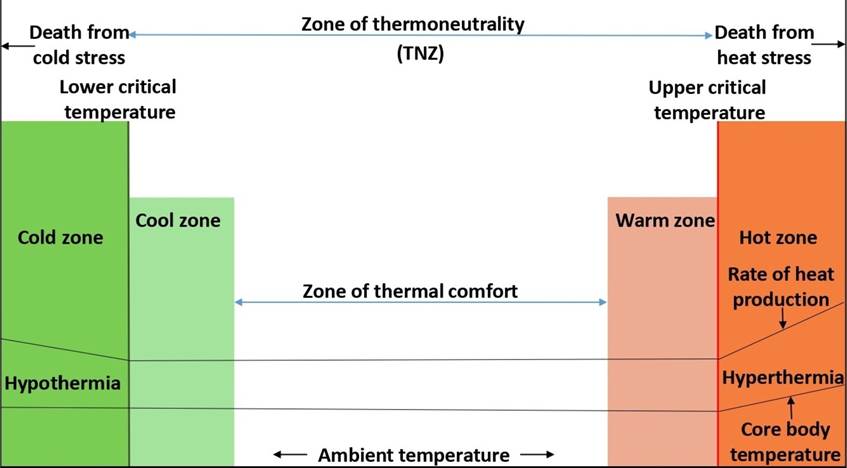
FIGURE 24.3 Thermoneutral zone.
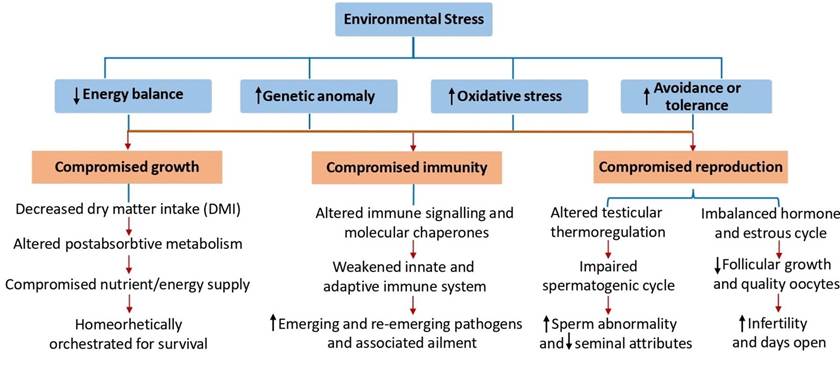
FIGURE 24.4 Impact of environmental stress on overall growth and physiology of animal.
are worthwhile in tropical climates. To achieve optimal production under changing climatic scenarios, a holistic approach is needed, tailored to environmental conditions and available resources employing vital strategies like genetic improvement, breeding management, grazing management, nutritional management, water management, shelter management, disease management, utilisation of unconventional feed resources, antioxidant supplementation, and hormonal therapy.
24.7.1 Physical Modification of Environment
and Shelter Management
The common strategies for improving the comfort of animals and sustaining their growth and production performance during inclement environmental conditions are mainly executed by physical modification of the production environment. Modification of the environment involves heat abatement and cold abatement technologies that alter the environmental conditions to prevent undesirable stress.
In addition, modification of the environment to provide physical and behavioural comfort is important both for welfare and production reasons (Mohankumar et al. 2012; Sejian et al. 2015). Modifications in response to heat stress include the management of shelter, such as proper ventilation, floor space, watering facilities, and other strategies that enhance heat exchange between the animal and the environment. The common strategies employed nowadays include the application of fans, misters, cooling pads, tunnels, and sprinklers that can enhance passive ventilation, improve body heat loss, decrease body temperature, and enhance dry matter intake (DMI).24.7.2 Nutritional and Feeding Strategies
Prolonged environmental stress with periods of limited or no water may reduce the quality and quantity of forage production for grazing and hay making. Modelling studies evaluating safe livestock carrying capacity based on resource characteristics and climate data suggest that even slight variations in climate significantly impact pasture growth. Feeding adjustments aimed at augmenting feed intake are tailored to individual production systems and contingent upon their added benefits in enhancing animal performance, health, and welfare relative to the associated expenses. It is hypothesised that nutrition, especially the inclusion of highly digestible ingredients, plays a crucial role in diminishing heat increment through efficient nutrient utilisation, thereby influencing overall animal growth and production. The provision of decreasing the forage to concentrate ratio by providing degradable starch such as cereal grains (e.g., wheat grain and corn grain) reduces the amount of heat produced and also increases the absorption of ration. During periods of scarcity, strategic utilisation of unconventional feed resources can help in fulfilling an animal’s nutritional needs by reducing the impact of anti- nutritional factors (ANF). Further exploration into the application of anti-stress minerals, vitamins, and herbal supplements, along with increased grain and supplemental fat, is warranted to mitigate the adverse consequences of drought on livestock health and productivity.
24.7.3 Genomic Responses During
Acclimation and Genetic Selection
Genetic variations at protein and DNA levels show increased diversity when exposed to environmental and genomic stress, a well-documented phenomenon by numerous researchers. Environmental diversity and stress contribute to the development of genetic variations, especially in environments with dynamic fluctuations, which can generate intricate cycles and behaviours reminiscent of chaos (Nevo 2001). Apart from the selection of phenotypes, as determined by genes and their constituent DNA, permanent changes in protein structure produce subtle changes in various biochemical and signalling activity which have effects on the expression of diverse proteins serving as raw material for adaptation. For instance, at the biochemical level, there may be increased thermal tolerance of an enzyme, or expression of a more pH-stable allozyme; physiologically, there might be altered signalling regimes, secondary messenger activity, or Na-K pump, all this, in turn, may lead to permanent heritable changes in the development of an organism. Estimation of genetic parameters against complex multiple stressors is crucial for designing optimal breeding schemes and for predicting selection response. For example, the genes found to be associated with heat tolerance can be used for molecular detection of thermotolerance and as candidate genes to explore their use in crossbreeding schemes to transfer their adaptation abilities and rusticity. Data from gene expression or genome-wide association studies (GWAS) can be applied to further enhance the accuracy of selection, genome editing technology and crossbreeding. Identifying and exploring signatures of selection, genomic diversity, and candidate genes and modelling the effect of a breed as a function of time and environment is an important progression toward better breeding strategy.
24.7