MILK REMOVAL AND OTHER CONSIDERATIONS
1. What causes the intramammary gland pressure increase associated with milk letdown?
2. What is the usual recommendation for “drying off” of a pregnant cow that is lactating with regard to time before parturition?
It was formerly believed that milk secretion occurred during milk removal and that certain stimulating factors caused this to occur.
The intramammary pressure of milk accumulation in the alveoli was thought to create the pressure difference by which milk could be withdrawn from the mammary gland.It is now known that all of the milk removed at a single milking is present in the mammary gland at the time of milking. The pressure increase that directs the milk from the alveoli through the ducts, cisterns, and teat canal is provided by the myoepithelial cells that surround the alveoli and ducts.
Stimulation of the teats or udder results in a reflex secretion of oxytocin (see Chapter 6),from the posterior pituitary gland, which, on reaching the myoepithelial cells, causes them to contract. Often the presence of the calf or other conditioned reflexes can cause the release of oxytocin. The phenomenon associated with contraction of the myoepithelial cells is generally referred to as milk letdown (Figure 16-9). The milk letdown effect ends in 10 to 15 minutes because of dissipation of the oxytocin. Until milk letdown, the pressure within the mammary gland is relatively low (0 to 8 mm Hg), but it increases to 30 to 50 mm Hg at the beginning of myoepithelial cell contraction.
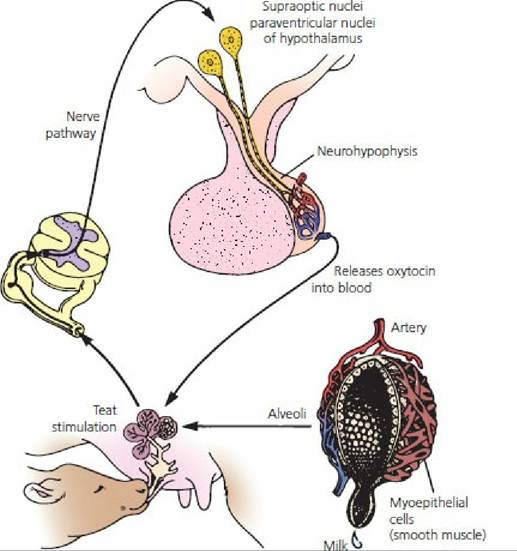
■ FIGURE 16-9 Milk letdown. Stimulation of the teats or udder results in a neuroendocrine reflex secretion of oxytocin from the posterior pituitary gland that, on reaching the myoepithelial cells, causes them to contract. (From Hafez ESE, Hafez B. Reproduction in Farm Animals.
7th edn. Baltimore, MD: Lippincott Williams & Wilkins, 2000.)The secretion of oxytocin for milk letdown is usually associated with tranquil situations and can be inhibited by stressful situations. Milk is not let down by tormented or frightened animals.
Milking Interval
It was generally believed that the intervals between milking should be evenly spaced, whether milking occurred twice or three times daily. Although some slight decreases are noted, it is now accepted that significant reductions do not occur if the intervals are not evenly spaced. It would seem that regularity of intervals might be a more important factor.
Regression of the Mammary Gland
Lactation does not continue indefinitely, either because animals are “dried off” (milk secretion is not removed) or because the secretion is gradually diminished to an insignificant amount. Several drying-off techniques can be used, including the intermittent, incomplete, and abrupt methods. In the intermittent method, the accumulated milk is removed at 2- or 3-day intervals and then stopped. In the incomplete method, milk is only removed partially at the usual regular intervals. The abrupt method is probably most widely used, where milk removal ceases completely. Milk secretion ceases when alveolar pressure increases to a certain point. The usual alveolar and duct accommodation is exceeded, and milk secretion ceases. The milk components are enzymatically digested, or reabsorbed, the alveolar cells break up, and the gland is infiltrated by phagocytic cells. In a nonpregnant cow that is dried off, insufficient hormones are present to stimulate or maintain mammary growth, and the lobules decrease in size, the alveoli collapse, and stromal tissue increases. These changes progress until ultimately the lobules are reduced to a few branching ducts.
In the lactating cow that is pregnant and is dried off 2 months before parturition, little regression occurs in the lobule and alveolar tissue. Unless 2 months are allowed for a dry period before the next parturition, milk yield in the subsequent lactation is depressed. Continued lactation apparently interferes with the normal renewal or regeneration of alveolar cells.
■