Nitrogenous Excretion
The kidneys are paired bean-shaped organs found in vertebrates. Their shape, size and location vary with species as described below, but in mammals they are found either side of the major vascular vessels, the aorta and caudal vena cava, in the roof of the abdomen.
The kidneys are covered by parietal peritoneum and so are outside the peritoneal cavity. The kidneys receive blood via the renal arteries, short, large-diameter branches of the dorsal aorta. The renal veins drain blood directly to the caudal vena cava. The function of the kidneys is to filter the blood and extract urine, which is passed through the ureters to the urinary bladder. The functional unit of a kidney is the nephron.There is some confusion in regard to the terminology used to name the components of the nephron. The nomenclature has been updated (NAV), and the most recent terms are used here. Each nephron includes a bundle of capillaries through which blood passes from afferent to efferent arterioles. This vascular knot is called a glomerulus and is surrounded by a Bowman’s capsule, the name retained for the double-layered hemisphere that is the blind-ending of the proximal convoluted tubule. The whole unit of glomerulus and Bowman's capsule is termed a renal corpuscle.
Further confusion surrounds the naming of some of the gross anatomical components of the kidney. The renal pelvis is the compartment that drains directly into the ureter. There is no boundary between the renal pelvis and the major calyx, so that they are effectively the same. Urine passes from the Bowman's capsule into the proximal convoluted tubule, which is separated from the distal convoluted tubule by an elongated mid-section called the hairpin loop. This extension, popularly called the loop of Henle, enters the kidney medulla before returning to the cortex and becoming the distal convoluted tubule. Each collecting tubule receives many distal convoluted tubules before becoming a papillary duct that drains urine into a minor calyx and then into the renal pelvis.
The loop of Henle is the site of resorption of water and electrolytes. In large dogs up to 2000 litres of blood pass through the kidneys daily, and 200-300 litres are filtered by the glomeruli daily. Following reabsorption by the loops of Henle, only 1-2 litres of
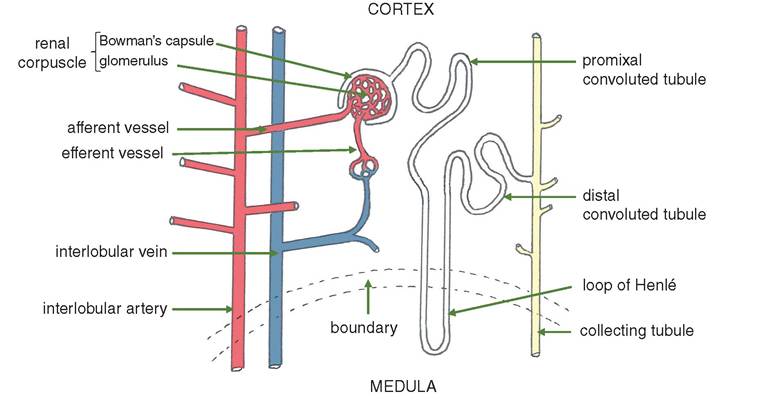
Figure 12.1 Diagram of a nephron showing a filtration arrangement unit for the production of urine.
urine pass through the ureters to the urinary bladder prior to urination. In addition to the voidance of water, certain electrolytes (sodium, potassium, chloride, sulphate and nitrogen compounds such as urea and uric acid) are also excreted.
12.2