OTHER HORMONES WITH KIDNEY ASSOCIATION
1. What is the relationship of parathyroid hormone, the kidneys, and calcium ion homeostasis?
2. What is the function of erythropoietin? Where is it produced?
Angiotensin II, ADH, and aldosterone have been mentioned because of their direct association with the functions of the kidney.
There are others that have an intermediate association with the kidney as a part of their overall function or that are produced in the kidney with functions elsewhere. Parathyroid hormone exemplifies the former and erythropoietin (EPO) the latter.Parathyroid Hormone
Parathyroid hormone, secreted by the parathyroid glands (see Chapter 6), acts,on the kidney tubules to increase reabsorption of Ca2+, while at the same time promoting the excretion of phosphorus..Parathyroid hormone is secreted in response to low concentrations of Ca2+ in the ECF. Another role of the kidney in response to.a decreasing Ca2+ concentration in the,ECF involves the formation of the active form of vitamin D (1,25-dehydroxycholecal-ciferol), also known as calcitriol (Figure 11-22). Active vitamin D promotes Ca2+ absorption from the intestine. Parathyroid hormone controls the formation of active vitamin D by the kidney.
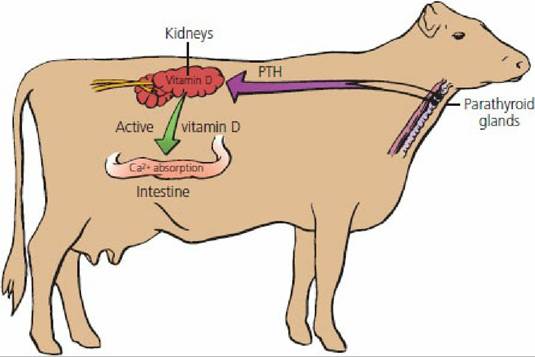
■ FIGURE 11-22 Relationship of parathyroid hormone (PTH), the kidneys, and calcium ion homeostasis in the cow. PTH from the parathyroid gland activates vitamin D in the kidney; activated vitamin D promotes absorption of Ca2+ from the intestine.
Erythropoietin
Erythropoietin (EPO) is a hormone produced in response to the tissue need for oxygen and stimulates the production of new erythrocytes by its activity in the bone marrow (see Chapter 3). The kidney is the major site (the only site in dogs) of EPO production in adult mammals.
EPO is produced by peritubular interstitial cells located within the inner cortex and outer medulla of the kidney. The liver is an extrarenal source of EPO in adults (the major site in the mammalian fetus). Extrarenal EPO production in certain animals and humans helps to maintain erythropoiesis during anemia caused by severe kidney diseases. Anemia is a common sequelae of chronic interstitial nephritis in dogs because of the lack of an extrarenal source of EPO.Prostaglandins
The space between the macula densa and the afferent and efferent arterioles, as well as the space between the glomerular capillaries, is known as the mesangial region and consists of mesangial cells and mesangial matrix (see Figure 11-11). Mesangial cells secrete the matrix, secrete the glomerular basement membrane, provide structural support, have phagocytic activity, and secrete prostaglandins. Prostaglandins are secreted by almost all body tissues and have diverse functions. More detail is provided in Chapter 6. The function of the prostaglandins at this location has not been described but may be related to the contractile activity of the mesangial cells and also to their influence on blood flow through glomerular capillaries.
■