Penis
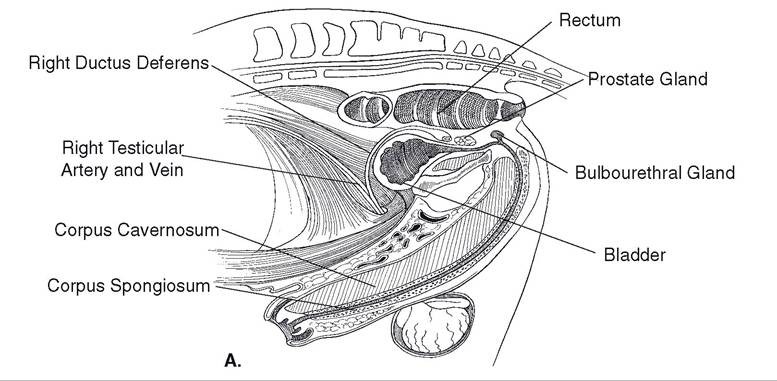
The male organ of copulation, the penis, may be divided into three general areas: the glans, or free extremity; the main portion, or body; and the two crura, or roots, that attach to the ischial arch of the pelvis (Fig.
24-9).The bulk of the penile body’s internal structure is composed of paired columns of erectile tissue, the corpora cavernosa. Each corpus cavernosum is replete with blood sinusoids divided by sheets of connective tissue called trabeculae. These are derived from the tunica albuginea,
MALE REPRODUCTIVE ORGANS
Accessory Reproductive Glands; dorsal view
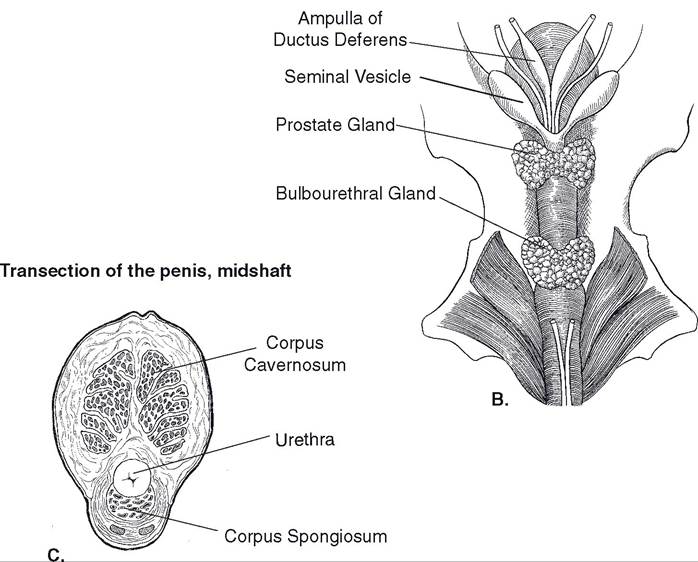
Figure 24-9. Anatomy of the equine penis. A) Lateral view, showing relationship of penis to body wall and pelvis. B) Dorsocaudal view of attachment of penis to pelvis and accessory sex glands. C) Cross-section of equine penis, midshaft.
a heavy, fibroelastic capsule surrounding the penis. In species with a fibroelastic penis (ruminants and swine), the trabeculae form the bulk of the penis, and as a consequence, in these species the penis is firm when not erect. The stallion has a musculocavernous penis, with the blood sinusoids predominating over connective tissue. The equine penis therefore is flaccid when not erect.
The two crura of the penis are the proximal parts of the corpora cavernosa. They originate on the caudal surface of the ischial arch, one on each side of the symphysis of the pelvis. The ventral midline groove between the corpora cavernosa contains the penile urethra and an associated unpaired body of erectile tissue, the corpus spongiosus. The proximal continuation of the corpus spongiosum is the bulb of the penis, which lies between the crura. In most animals, the corpus spongiosum penis is continuous distally with the erectile tissue of the glans.
In dressing a carcass for human consumption, the penis is removed. Removal of the penile crura leaves two round marks on the ischial arch. These are called pizzle eyes, and their presence is used to identify a dressed carcass as male.
The glans penis shows considerable variation from species to species. The horse and sheep both have a free portion of the urethra, the urethral process, that projects beyond the glans. The bull and ram have a helmet-shaped glans, and the external urethral opening of the bull opens into a twisted groove. The penis of the boar has a twisting cranial extremity and only a small glans (Fig. 24-10).
Erection of the penis occurs when more blood enters the penis by way of the arterial supply than leaves by the veins. The increased blood volume enlarges the penis and makes it turgid. In the stallion, whose penis is musculo- cavernous, the penis becomes much larger in all dimensions upon erection. The fibroelastic penis (as found in ruminants and swine) does not increase much in diameter during erection. Instead, the chief effect of erection of the penis in these animals consists of lengthening the penis by straightening the sigmoid fl exure,
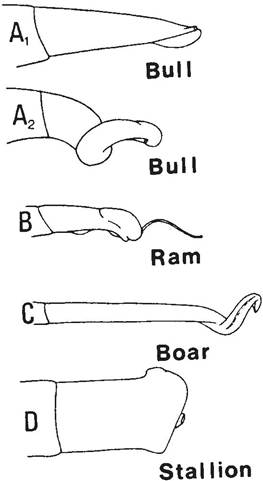
Figure 24-10. Free end of the penis. Al) Bull penis prior to intromission; A2) bull penis following intromission. Spiraling of the glans is a normal consequence of erection. (Reprinted with permission of Wiley- Blackwell from Hafez E.S.E and Hafez, B. Reproduction in Farm Animals. 7th ed. Philadelphia: Lippincott, Williams & Wilkins, 2000.)
much as a bent garden hose tends to straighten when water pressure increases.