PLASMA AND ITS COMPOSITION
1. What differentiates plasma from serum?
2. What is the concentration of protein in plasma?
3. What are the three major classes of plasma proteins?
4. Which one of the immunoglobulins is most abundant in normal animals?
5.
What is meant by a state of equilibrium among plasma proteins, amino acids, and tissue proteins?6. What plasma protein represents the major contribution to intravascular effective osmotic pressure? Why is this?
7. Which cation is most abundant in plasma? Which anion?
8. What is the concentration of glucose in the pig and dog? Is it lower in the ruminants and horse?
Plasma, the noncellular, liquid part of blood, may be obtained from drawn blood in which coagulation has been prevented. When blood has been allowed to clot, the coagulation factors are effectively removed and the liquid is known as serum. All the coagulation factors are present in plasma. Plasma is a complex fluid (containing numerous chemically active substances) that provides the medium of exchange between the blood vessels and the cells of the body. A number of these substances that are often referred to clinically are shown in Table 3-4 for several species. The major constituent of plasma is water (about 92-94%) and the percentage will vary depending mostly on the concentration of protein. Proteins are the most abundant of the substances dissolved or suspended in the water and their concentration varies from 6 to 8 g/ dL.
| TABLE 3-4 VALUES OF SOME CONSTITUENTS OF BLOOD FROM MATURE DOMESTIC ANIMALS | ||||||
| VALUE (RANGE) CONSTITUENTS | HORSE | COW | SHEEP | PIG | DOG | CHICKEN |
| Glucose (mg/dL) | 60-110 | 40-80 | 40-80 | 80-120 | 70-120 | 130-270 |
| 80-120 | 80-120 | |||||
| (calf) | (lamb) | |||||
| Nonprotein nitrogen (mg/dL) | 20-40 | 20-40 | 20-38 | 20-45 | 17-38 | 20-35 |
| Urea nitrogen (BUN) (mg/dL) | 10-24 | 10-30 | 8-20 | 8-24 | 10-30 | 0.1-1.0 |
| Uric acid (mg/ dL) | 0.5-1 | 0.1-2 | 0.1-2 | 0.1-2 | 0.1-1.5 | 1-2 |
| 1-7 | ||||||
| (laying hen) | ||||||
| Creatinine (mg/dL) | 1-2 | 1-2 | 1-2 | 1-2.5 | 1-2 | 1-2 |
| Amino acid nitrogen (mg/ dL) | 5-7 | 4-8 | 5-8 | 6-8 | 7-8 | 4-10 |
| Lactic acid (mg/dL) | 10-16 | 5-20 | 9-12 | 8-20 | 47-56 | |
| 20-98 | ||||||
| (laying hen) | ||||||
| Cholesterol (mg/dL) | 75-150 | 80-180 | 60-150 | 60-200 | 120-250 | 125-200 |
| Bilirubin | ||||||
| Direct (mg/ dL) | 0-0.4 | 0-0.3 | 0-0.3 | 0-0.3 | 0.06-0.1 | |
| Indirect (mg/dL) | 0.2-5 | 0.1-0.5 | 0-0.1 | 0-0.3 | 0.01-0.5 | |
| Total (mg/dL) | 0.2-6 | 0.2-1.5 | 0.1-0.4 | 0-0.6 | 0.10-0.6 | |
| Electrolytes (mEq/L) | ||||||
| Sodium | 132-152 | 132-152 | 139-152 | 135-150 | 141-155 | 151-161 |
| Potassium | 2.5-5.0 | 3.9-5.8 | 3.9-5.4 | 4.4-6.7 | 3.7-5.8 | 4.6-4.7 |
| Calcium | 4.5-6.5 | 4.5-6.0 | 4.5-6.0 | 4.5-6.5 | 4.5-6.0 | 4.5-6.0 |
| 8.5-19.5 | ||||||
| (laying hen) | ||||||
| Phosphorus | 2-6 | 2-7 | 2-7 | 3-6 | 2-6 | 3-6 |
| Magnesium | 1.5-2.5 | 1.5-2.5 | 1.8-2.3 | 2-3 | 1.5-2.0 | |
| Chlorine | 99-109 | 97-111 | 95-105 | 94-106 | 100-115 | 119-130 |
From Reece WO, Swenson MJ. The composition and functions of blood.
In: Reece WO, ed. Dukes’ Physiology of Domestic Animals. 13th edn. Ames, IA: Wiley-Blackwell, 2015.
Plasma Proteins
The three major classes of plasma proteins are albumin, globulins (αι, α2, βι, β2, γ), and fibrinogen. In humans, sheep, goats, and dogs, albumin predominates over the globulins; in horses, pigs, cows, and cats, the relative proportions of albumin and globulins are nearly equal.
The gamma-globulins contain antibodies called immunoglobulins (antibodies) and are produced by lymphocytes and plasma cells. There are five major isotopes of immunoglobulins, which are classified as IgG, IgE, IgA, IgM, and IgD. IgG is the most abundant immunoglobulin of normal animals. It crosses the dam’s placental barrier to provide immunity to newborns in some species (primates and rodents) but not others. In the latter, transfer depends on IgG presence in colostrum and early ingestion by the newborn (see Chapter 16). IgE, IgA, IgM, and IgD provide the immune response to allergic conditions or parasitisms (release of histamine), the microorganisms present in the mouth and gastrointestinal tract (via colostrum), activation of the complement system, and clone formation of lymphocytes, respectively.
The alpha and beta globulins serve as substrates for new substances and also perform transport functions (e.g., lactoferrin, a globulin that transports iron).
Origin
Plasma albumin, some of the globulins, and fibrinogen (and other coagulation factors) are formed in the liver. The balance of the globulins, including the gamma-globulins, is formed in the lymph nodes and mucosal tissues.
The plasma proteins, amino acids, and tissue proteins are in a state of equilibrium (Figure 3-18). When the amino acid concentration in tissue cells decreases below that of plasma, amino acids enter the cells and are used for synthesis of essential plasma and tissue proteins. The plasma proteins, formed mainly by the liver, may also be broken down into amino acids by MPS cells and made available for cellular protein synthesis.
This occurs especially when the amino acid supply from digestive processes is inadequate. Plasma proteins do leak from capillaries into the interstitial fluid and are returned to the blood via the lymphatics. In this way, there is a 12- to 24-hour turnover (time within which all protein is leaked and returned).
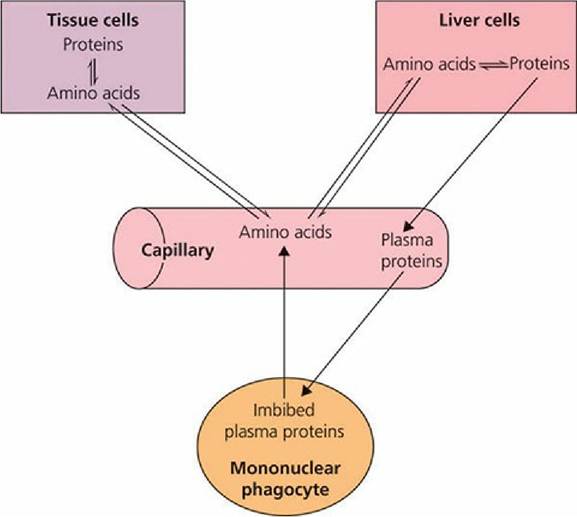
■ FIGURE 3-18 Reversible equilibrium among the tissue proteins, plasma proteins, and plasma amino acids. (From Reece WO, Swenson MJ. The composition and functions of blood. In: Reece WO, ed. Dukes’ Physiology of Domestic Animals. 13th Eedn. Ames, IA: Wiley-Blackwell, 2015.)
Plasma Proteins and Colloidal Osmotic Pressure
The plasma colloidal osmotic pressure (also called oncotic pressure) is the effective osmotic pressure of the plasma (see Chapter 2). It is intimately associated with the balance of body fluids between the intravascular and interstitial fluid compartments. It arises because of the presence of the protein molecules and cations retained by the net negative charge of protein. The proteins are colloidal and nondiffusible. The effective osmotic pressure produced by these molecules opposes the hydrostatic pressure of blood in the capillaries and is responsible for reabsorption of fluid at the venous end of capillaries (see Chapter 9). The albumins account for about 80% of the plasma colloidal osmotic pressure because of their abundance and smaller molecular weight. The osmotic pressure that each protein fraction contributes is inversely related to the molecular weight and directly related to its concentration in terms of number of particles in the plasma (recall that osmotic pressure relates to particle numbers rather than mass). The molecular weights of fibrinogen, albumin, and globulins are approximately 300,000, 70,000, and 180,000, respectively. The molecular weight of fibrinogen is high and its plasma concentration is low; therefore, its contribution to colloidal osmotic pressure is small.
When the concentrations of globulins and albumin are nearly the same, albumin contributes two to three times as much osmotic pressure as globulins because there are two to three times more molecules (particles) in albumin than in an equal weight (concentration) of globulin.Because of the many functions of plasma proteins, it is apparent that liver disease and resultant failure of adequate protein synthesis, or prolonged dietary protein deficiency, can lead to many body function problems.
Other Plasma Constituents
Oxygen, carbon dioxide, and nitrogen are the major gases of the atmosphere and are found in plasma. Their concentration in plasma depends on their concentration in the atmosphere and on their solubility in plasma. The major types of lipids in plasma are triglycerides, phospholipids, and cholesterol. The principal nonprotein nitrogen (NPN) compounds are amino acids, urea, uric acid, creatine, creatinine, and ammonium salts. Inorganic substances in the plasma are presented mainly by the electrolytes, including cations (Na+, K+, Ca2+, Mg2+) and anions (Cl-, HCO-3, HPO4-2). Values for many of these constituents are shown in Figure 3-4.
■