PROSTAGLANDINS AND THEIR FUNCTIONS
1. How did the prostaglandins get their name?
2. What is the range of tissues associated with prostaglandin production?
3. Do prostaglandins promote or inhibit inflammation?
4.
Do prostaglandins promote or inhibit blood coagulation?5. Could aspirin use interfere with inflammation and blood coagulation?
The prostaglandins were first isolated from accessory sex gland fluids and were termed prostaglandins because of their association with the prostate gland. It is now recognized that they are secreted by almost all body tissues and, indeed, the prostate gland association is too narrow a definition.
The prostaglandins are derived from arachidonic acid. Their structure and synthesis are shown in Figure 6-9. The prostaglandins are usually short-acting. Some forms never appear in the blood (so some have not been classified as hormones) and others are degraded after they circulate throughout the liver and lungs.
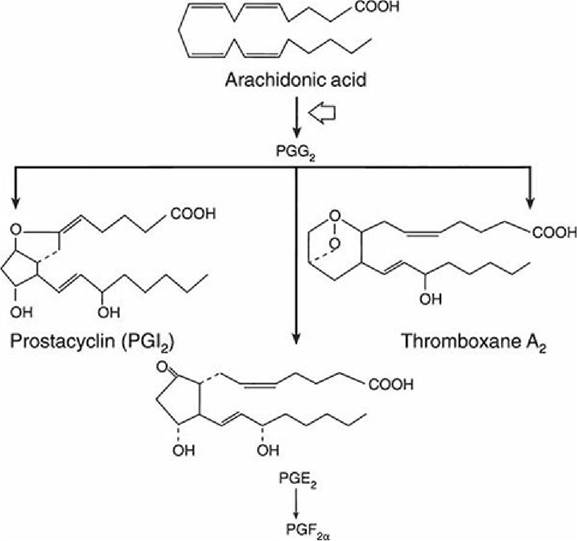
■ FIGURE 6-9 Three major pathways of prostaglandin synthesis. The open arrow indicates the site of aspirin inhibition. Thromboxane A2 is biochemically related to the prostaglandins and is formed from them as shown. Thromboxane A2 promotes the platelet release reaction associated with blood coagulation. Therefore, aspirin retards blood coagulation.
The functions of prostaglandins have been studied most in regard to their role in the reproductive process. Prostaglandin F2α (PGF2α) is the natural luteolytic agent that terminates the luteal phase of the estrous cycle and allows for the initiation of a new estrous cycle in the absence of fertilization (see Chapter 15 ). PGF2α is also particularly potent in terminating early pregnancy.
The prostaglandins promote inflammation. The anti-inflammatory activity of aspirin (and perhaps of other drugs) is a result of its ability to inhibit the synthesis of prostaglandin G2 (PGG2) from arachidonic acid. The anti-inflammatory action of the glucocorticoids might also be caused by interference with prostaglandin synthesis. Other functions of some prostaglandins include inhibition of gastric secretion and relaxation of bronchial smooth muscle. One prostaglandin (prostacyclin, PGI2) that is produced in the endothelium of blood vessels inhibits platelet aggregation (essential for blood coagulation) and a prostaglandin derivative (thromboxane A2) favors platelet aggregation (see Chapter 3).
■