REPRODUCTION IN THE AVIAN MALE
1. Contrast the location of avian testes with that of mammals.
2. Is there a pampiniform plexus for cooling of the testes in birds, as there is for most mammalian species?
3.
How does the avian epididymis differ from that of mammals?4. What are the storage sites for avian spermatozoa?
5. What structures provide for seminal plasma?
6. What name is given to the penis.of birds?
7. Describe the route of ejaculated sperm from the vasa deferentia to the exterior in the cock and tom.
8. Which ones of the domestic birds accomplish intromission at the time of mating?
9. Where is maturation of spermatozoa accomplished in birds?
0. Is there a long life for spermatozoa once they are deposited into the female vagina?
The paired testes of the male bird are located within the body cavity, in contrast to those of most mammals (Figure 14-18). In this location they are able to function at body temperature (about 41 °C to 42 °C for domestic species). The internal structure is composed of seminiferous tubules, Sertoli cells, stem cells, and Leydig cells, similar to that of mammals. The blood supply to the testes does not provide for a pampiniform plexus, which in mammals is present to assist in cooling the testes. Instead of an epididymis as arranged in mammals, there are tubules (vasa efferentia) conducting sperm from the testis to a short epididymal duct that is continued as the ductus deferens. The deferent ducts terminate as an enlargement before its opening into the cloaca at a papilla. The deferent duct and the enlargement serve as storage sites for spermatozoa. The accessory organs of the male include the vasa efferentia, epididymides, vasa deferentia, ejaculatory groove, and phallus (penis). Seminal plasma is derived from the seminiferous tubules and vasa efferentia inasmuch as birds do not have a prostate gland, bulbourethral gland, and seminal vesicle.
The ejaculatory groove of the erected phallus (Figure 14-19) is formed at the time of sexual excitation when several folds in the ventral cloaca become engorged with lymph. The engorged folds direct semen through the groove of the erect phallus. The phallus of the male chicken (cock or rooster) and turkey (tom) do not perform intromission, but rather transfer semen to the female by touching their phallus to the female vagina, that part of the female reproductive tract terminating at the cloaca. Ducks and geese have sizable penises and intromission is accomplished at mating.
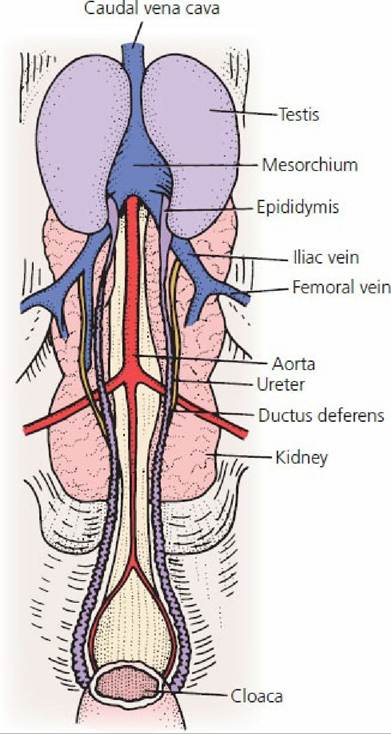
■ FIGURE 14-18 The urogenital system of the male chicken (ventral view). The testes are located within the body cavity and the ductus deferens conduct spermatozoa to the cloaca. (From Sturkie PD, Opel H. Reproduction in the male, fertilization, and early embryonic development. In: Sturkie PD, ed. Avian Physiology. 3rd edn. New York: Springer-Verlag, 1976.)
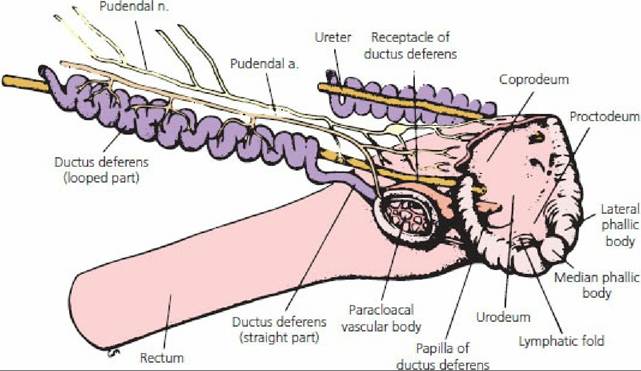
■ FIGURE 14-19 Lateral view of the cloaca and the terminal part of the vas deferens (ductus deferens) of the domestic fowl. The ejaculatory groove (not shown) is formed at the time of sexual excitation when the lymphatic folds become engorged with lymph, forming a trough-like structure to direct the flow of semen. The paracloacal vascular body is the source of the lymph. The receptacle of the ductus deferens serves as a storage site for spermatozoa. (From Lake PE. Male genital organs. In: King AS, McClelland J, eds. Form and Function in Birds, Vol. 2. San Diego, CA: Academic Press, 1981.)
In the cock, protrusion of the genitalia and forceful expulsion of semen follows external stroking of the base of the tail. Phallic eversion follows similar stimulation in the tom, but semen is generally released only after pressure is applied to the terminal storage depots (terminal enlargements of the deferent ducts).
The gonadotropic influence of LH and FSH on testicular function is similar to that of mammals, wherein LH acts on Leydig cells to promote their development and testosterone production, and FSH acts on Sertoli cells. Full testicular function results from the combined action of FSH and testosterone.
The collection of semen from cocks and toms is practiced widely. The average volume of cock ejaculate is about 0.5 mL and that of the tom is about 0.3 mL. Sperm concentration of the cock is about 4 billion/mL.and is about 10 billion/mL for the tom. The chemical composition of seminal plasma varies among birds as well as in mammals. See Figure 14-16 for the comparison of a spermatozoon of the cock with several mammalian species. Spermatozoa of toms are similar to those of cocks. It seems that cock sperm are functionally mature before they leave the testes. Much of the maturation of mammalian spermatozoa occurs in the epididymides.
After mating or artificial insemination, sperm are found in sperm storage glands of the female that are located in the vagina, near its junction with the uterus. They persist at this location for a variable period of time. It is likely that sperm are nourished by the uterovaginal sperm storage glands and/or are placed into reversible quiescence (quiet period).
■