REPRODUCTIVE SYSTEM
Hamsters can reach sexual maturity from 6 weeks of age but for optimal breeding it is best if the male is 10-12 weeks and the female at least 8-10 weeks before being bred. Breeding ceases after 14 months of age.
Male
The anogenital distance is longer in the male, which has a more prominent genital papilla. There is a baculum or os penis consisting of two lateral prongs and a dorsal prong.
In mature males a thick fat pad covers the proximal end of the testicle and almost half the epididymis (the dorsomedial side of the testicle), giving the hamster a very large scrotal silhouette (Bivin et al. 1987; Ferm 1987). Male accessory glands include the ampulla glands, seminal vesicles, coagulating glands, three lobed prostate, and bulbourethral glands. Like other rodents, the adult male hamster produces a urethral plug (Kent 1968).
The jejunum is 2.5 times longer than the duodenum (Bivin et al. 1987). The ileum is short and leads into the cecum, which is sacculated and divided into an apical and basal portion. The cecum bends back on itself and divides into four valves (Bivin et al. 1987). The normal bacterial flora are Bacteroides spp. and lactobacillus, plus a few coliforms and clostridia. The pH here is higher than in the non-glandular stomach, which suggests either more active fermentation or perhaps better buffering.
CLINICAL NOTE
Hamsters exposed to natural daylight and temperature will show seasonal variation in testicle size, having the lowest masses in winter. Hence, the number of anxious pet owners presenting at veterinary clinics in summer concerned that their “female” hamster has suddenly developed two enormous tumors!
Liver and pancreas
Female
The liver has four lobes: right and left medial, and right and left lateral. The gall bladder is located in the ventral median lobe in the right cranioventral section.
The pancreas is well The urinary opening is cranial and the anus is caudal, with the vaginal opening in between. The vagina has a pair of vaginal pouches that extend caudally, terminating at the level of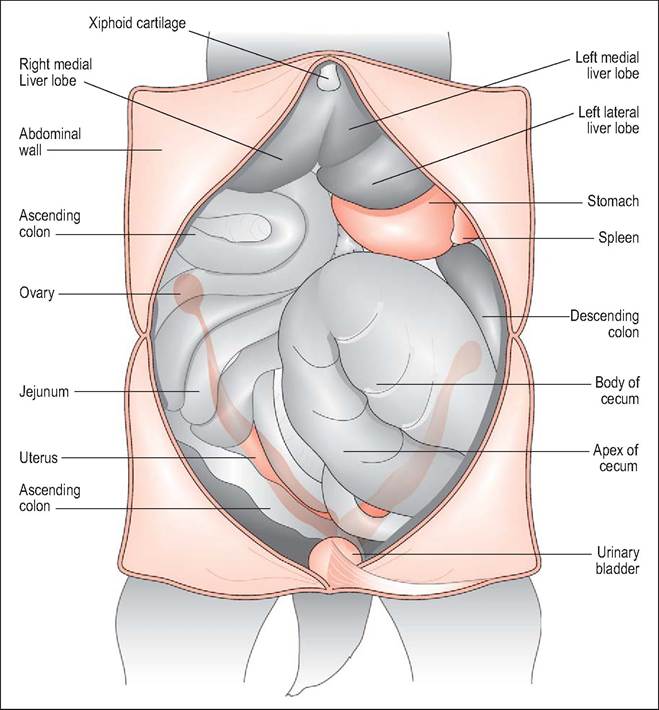
Figure 11.8 • Ventral view of female hamster showing abdominal viscera. The right uterine horn is shown, shaded, behind the intestines. From Popesko, P., Rajtova, V., & Horak, J. (1990) A colour atlas of anatomy of small laboratory animals. Vol. 2. Aylesbury, UK: Wolfe with permission.
the vaginal orifice. Like the rat, the uterus is duplex and leads into two cervices with the undivided part being 7-8 mm long (Bivin et al. 1987; Ferm 1987; Kent 1968). There are 6 or 7 pairs of mammary glands extending from the thorax to the inguinal region (Fig. 11.10). Flank glands are present but are less prominent than in the male, owing to their lighter pigmentation.
The ovaries are oval, situated dorsolateral to the kidneys, and are completely enclosed in a fat-filled ovarian bursa. The oviduct is long and tightly coiled. Like in the guinea pig and rat, the uterine artery in the hamster provides a major portion of the blood supply to the ovary (Bivin et al. 1987). In some hamsters, coils of the ovarian and uterine arteries anastomose close to the ovary (Del Campo & Ginther 1972; Ferm 1987).
Estrous cycle
The hamster is seasonally polyestrous and has a very regular 4 day estrous cycle. Ovulation occurs about 12 hours after the luteinizing hormone (LH) surge, usually resulting in the release of the ova at night, which is in keeping with the hamster's nocturnal habits. The female hamster will become sexually receptive only for the few hours post ovulation. On the 2nd day of estrus she will produce a white stringy discharge which becomes waxier on day 3. At the end of estrus the female produces a copious white, viscous discharge that has a distinct odor (Harkness & Wagner 1995; Kent 1968).
The usually pugnacious female will tolerate the male at peak estrus and copulation takes place immediately after introduction of the male. This usually last 30 minutes and a copulatory plug can be observed after mating. Pseudopregnancy can occur after infertile mating.
CLINICAL NOTE
Although the vagina and cervix do show cyclical changes in response to ovarian hormones, vaginal cytology is complicated by the presence of vaginal pouches. These paired vaginal pouches collect exfoliative cells and leukocytes, so only smears made daily would be accurate (Whittaker 1999).
Gestation
The Syrian hamster has the shortest known gestation for any eutherian mammal, being only 15-18 days (Lipman & Foltz 1996; Newcomer et al. 1987; Whittaker 1999). The young are born altricial, with closed eyes and earflaps, but
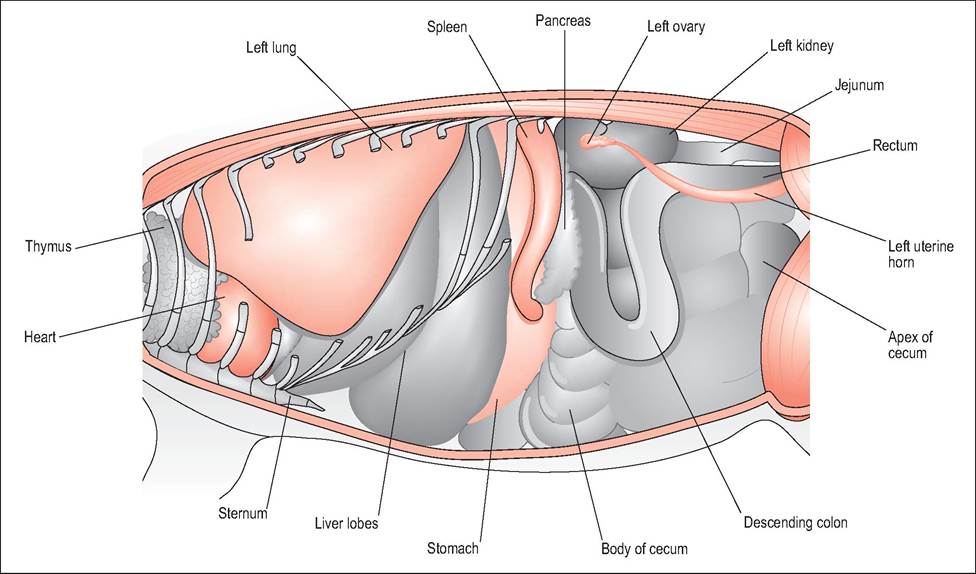
Figure ll.9 • Lateral left side of abdominal cavity of female hamster (ribs removed). From Popesko, P., Rajtova, V., & Horak, J. (1990) A colour atlas of anatomy of small laboratory animals. Vol. 2. Aylesbury, UK: Wolfe.
do have sharp teeth (Fig. 11.11). Pups weigh 2-3 g at birth and their eyes and ears open at 5 and 15 days, respectively. Weaning is at around 3 weeks (Harkness & Wagner 1995; Kent 1968).
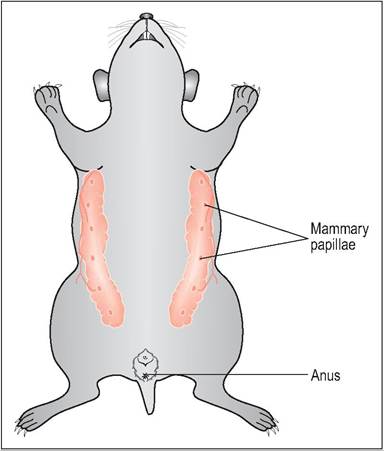
Figure 11.10 • Ventral view of mammary glands in the female hamster. From Popesko, P., Rajtova, V., & Horak, J. (l990) A colour atlas of anatomy of small laboratory animals. Vol. 2. Aylesbury, UK: Wolfe with permission.