SPERMATOGENESIS
The complete process by which germinal epithelial cells develop into spermatozoa is referred to as spermatogenesis. It is divided into two phases: spermatocytogenesis and spermiogenesis.
Spermatocytogenesis is the proliferative phase whereby spermatogonial cells multiply by a series of mitotic divisions, followed by the meiotic divisions that produce the haploid (n) number of chromosomes. The spermatogonia are located in the basal compartment of the seminiferous tubules. A single cell replaces the recently divided cell in a spermatogonium during mitotic division, and it remains in the basal compartment. The other cell becomes a type A spermatogonium, which migrates through the Sertoli cell barrier to the adluminal compartment. Type A spermatogonia undergo mitotic division until large numbers of type B spermatogonia have been produced. Type B spermatogonia undergo the last of the mitotic divisions, which results in the formation of primary spermatocytes with 2n chromosome numbers. Primary spermatocytes undergo meiotic
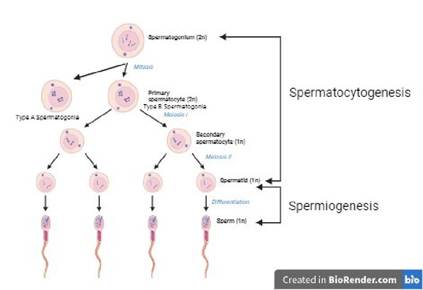
FIGURE 20.4 Spermatogenesis
division to form secondary spermatocytes, which in turn undergo meiotic division to form spermatidswith n chromosome numbers.In the bull, 64 spermatids are formed from one type A spermatogonium.
Spermiogenesis involves the maturation of the spermatids while they are still in the adluminal compartment. Spermiogenesis comprises a series of nuclear and cytoplasmic changes and transformations from a nonmotile cell to a potentially motile cell in which a tail has formed. The mature spermatids produced during the final phase of spermiogenesis are released into the lumen of the seminiferous tubules as spermatozoa. The release of mature spermatids into the lumen of the seminiferous tubules is known as spermiation (Figure 20.4).
20.8