SYNAPTIC TRANSMISSION
A synapse is a specialized junction between two neurons or between a neuron and a target cell (a muscle or gland cell) that allows communication between them (Figure 8.7).
Synaptic transmission is the process by which neurons communicate with each other in the nervous system.
It occurs through the release of various neurotransmitters into the synaptic cleft. It involves the release of neurotransmitters from the presynaptic neuron, which then bind with receptors on the postsynaptic neuron, leading to the generation of electrical signals or impulses.At chemical synapses, neurotransmitters are released from the presynaptic neuron and bind to receptors on the postsynaptic neuron. This binding can lead to the opening of ion channels, allowing the movement of Na+, K+, and Ca2+ ions in or out of the neuron. The movement of these ions is influenced by both concentration gradients and electrostatic forces.
An action potential travels down the axon of the presyn- aptic neuron to the axon terminal. The depolarization of the membrane at the axon terminal causes voltage-gated calcium channels to open, allowing calcium ions to flow into the presynaptic neuron. The influx of calcium ions triggers synaptic vesicles, which contain neurotransmitters, to move toward and fuse with the presynaptic membrane. This process is facilitated by proteins such as synaptotagmin and
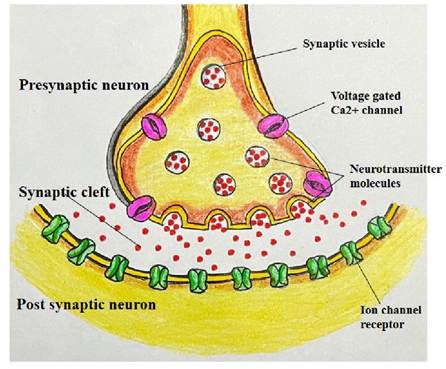
FIGURE 8.7 Synapse
SNARE proteins (SNAP-25, Synaptobrevin, and syntaxin). Upon fusion, the vesicles release their neurotransmitter contents into the synaptic cleft through a process known as exocytosis. The neurotransmitters diffuse across the synaptic cleft and bind to specific receptor sites on the postsynap- tic membrane. These receptors can be ionotropic (directly linked to ion channels) or metabotropic (indirectly linked to signaling pathways).
Binding of neurotransmitters to receptors causes ion channels to open or close, leading to changes in the postsynaptic cell’s membrane potential (Figure 8.8).This can result in an excitatory postsynaptic potential (EPSP) or inhibitory postsynaptic potential (IPSP), depending on the type of neurotransmitter and receptor involved. The action of neurotransmitters is then terminated through various mechanisms, such as reuptake into the presynaptic neuron, enzymatic degradation, or diffusion away from the synaptic cleft. This process is fundamental for all aspects of
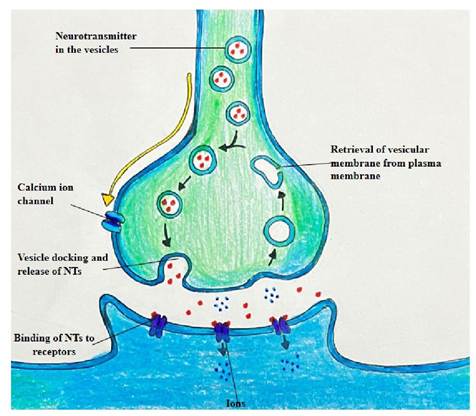
FIGURE 8.8 Synaptic transmission
brain function, including sensory perception, motor control, memory, and emotion.
There are two types of synapses: electrical and chemical synapses
1. Electrical synapse: Electrical synapses are less common than chemical synapses. In this type, the cytoplasm of two neurons is connected by gap junctions, allowing ions and small molecules to pass directly from one cell to another. This direct transmission results in rapid and synchronized signaling between neurons. Electrical synapses are found in various brain regions and are involved in processes like coordination of movement and synchronization of neural activity.
2. Chemical synapse: Chemical synapses are the most common type of synapse in the nervous system. They involve the release of neurotransmitters from the presynaptic neuron into the synaptic cleft, where they bind to receptors on the postsyn- aptic neuron, leading to changes in the postsyn- aptic membrane potential. This process allows for signal transmission between neurons and is essential for functions such as learning, memory, and sensory processing. Chemical synapses can exhibit various properties, including excitatory or inhibitory effects on the postsynaptic neuron, and can undergo processes like synaptic plasticity, which underlies learning and memory.
8.15