TCVM treatment
4.1 Etiology and pathology
The available methods of animal cancer treatment imply separate or combined application of surgery, radiation therapy, and chemotherapy targeted at the particular cancer cells.
However, there is also a general concern about the quality of life of pets/canine patients. This gives much space to the alternative medicine, in particular, the traditional Chinese veterinary medicine (TCVM), which not only focuses on the tumor but also accounts for the overall health condition by regulating the so-called Yin and Yang constituents. Through the balance of Yin and Yang, the patients suffering from the disease could also improve their physical health. Tumor, in the TCVM perspective, is the morphological tissue structure change, which imply functional changes of the specific organs or tissues. Those pathological changes of tissues are defined by TCVM as phlegm, toxin, dampness, blood, and stasis. Therefore, the tumor’s mechanism can be briefly summarized from the TCVM standpoint as stagnation of blood or (heat-) toxin, accumulative dampness or phlegm, and Qi (energy) stagnation. The stagnation or lack of a free Qi/Blood movement results in the formation of pathological tumors in human and animal patients. Those with hepatic carcinomas often have the hormone/gastrointestinal symptoms [Liver (wood) Ke Spleen (Earth)] causing the Spleen Qi deficiency.Spleen Qi is responsible for food intake and digestion; this process is called transformation and transportation. Both two functions of the spleen are critical for the production of Zheng Qi. Zheng Qi deficiency mainly focuses on the root of neoplastic formation. Zheng Qi is composed of Nutritive Qi and Defensive Qi (Wei Qi). As Wei Qi is a defensive deficiency, several external pathogenic factors (cold, wind, heat, summer heat, dryness, and dampness) cannot be easily detected and expelled from the body.
These pathogenic factors will cause the blocking of Qi and impede the blood circulation. However, some other factors should be considered: emotional stress, unhealthy diet/lifestyle, and the environment. For example, negative emotional stress, inappropriate diet, and too humid environment are considered by TCVM as induction factors that trigger a liver tumor. Both internal and external factors may contribute to phlegm, Qi, and Blood stagnation, blood stasis, and ultimately lead to neoplasia [12, 19, 21, 22].4.2 Pattern differentiation and treatment
The TCVM has been used as an alternative treatment for years in Asia. However, its current applications to domestic animals/pets suffering from carcinomas are based on individual expert opinions, while there are no outlined veterinary treatment strategies and guidelines for clinical practice in this field. The most lucrative concept accepted nowadays is a comprehensive combination of global/Western and TCVM components, the latter being aimed at adjunct therapy and recurrence prevention. Adjunct therapy should reduce the side-effects of chemotherapy, radiation therapy, and surgery. Based on the pattern differentiation, it is essential to treat the liver tumor using TCVM drugs and acupuncture techniques capable of regulating Qi, nourishing blood, strengthening the body and organs, and improving the resistance to pathogenic factors. The TCVM is likely to improve the canine patients general conditions, remove the disease/pathogen, inhibit oncogenesis, alleviate side-effects, and improve the survival rate as shown in Figure 8.
The TCVM treatment is usually provided to canine patients undergoing a surgical treatment or after radiotherapy/chemotherapy. In most of these patients, tumors could not be eliminated entirely, and the adjunct treatment should improve their
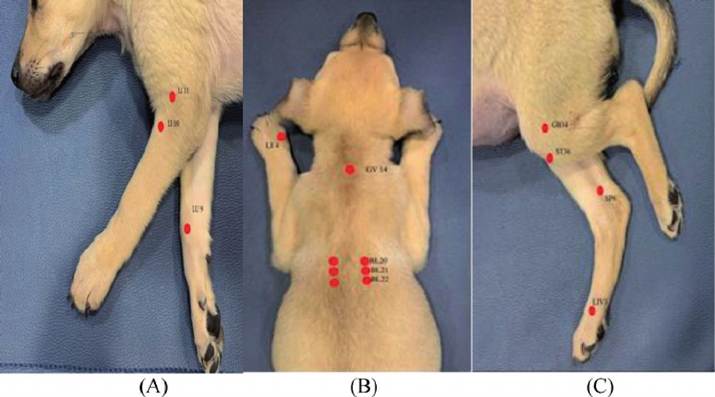
Figure 8.
Acupuncture points. (A) LU 9: In the depression distal palmar to the most medial prominence of the radial styloid process, overlying the radiocarpal joint, medial to the radial artery, and the tendon of the flexor carpi radialis muscle.
LI 10: In the depression in the muscular groove between the extensor carpi radialis and the common digital extensor mm. Of the forelimb, two cun distal to the transverse cubital crease. This is most evident when the elbow is flexed.LI 11: In the depression in the transverse cubital crease, just cranial to the lateral epicondyle of the humerus, between the extensor carpi radialis and common digital extensor mm. This point is easily palpated when the elbow is flexed. (B) LI 4: In the depression between the 2nd and 3rd metacarpal bones, approximately in the middle of the 2nd metacarpal bone. GV14: In the depression on the midline between the dorsal spinous processes of the 7th cervical and 1st thoracic vertebrae. BL 20: In the depression, 1.5 cun lateral to the caudal border of the spinous process of the 12th thoracic vertebra. BL21: In the depression, 1.5 cun lateral to the caudal border of the spinous process of the 13th thoracic vertebra. BL 20: In the depression, 1.5 cun lateral to the caudal border of the spinous process of the 12th thoracic vertebra. BL22: In the depression, 1.5 cun lateral to the caudal border of the spinous process of the 1st lumbar vertebra. (C) LIV 3: In the depression on the dorsum of the rear foot, between the 2nd and 3rd metatarsal bones, at the level of the junction of their heads and shaft, just proximal to their associated metatarsophalangeal joints. SP 6: In the depression 3 cun proximal to the tip of the tibia's medial malleolus, on the caudal border of the tibia. GB34: In the depression cranial and distal to the head of the fibula. ST36: In the depression, just lateral to the distal aspect of the cranial border of the tibial tuberosity (tibial crest), approximately in the middle of the cranial tibialis muscle.quality of life, maintain their physical condition, and prolong survival time. TCVM has shown significant efficacy in the symptomatic treatment of canine patients suffering from the deficiency of vital Qi, leading to physical pain, fever, anorexia, nausea, gastrointestinal problems, fatigue, and constipation.
Although liver heat and dampness are considered as the most probable causes for the formation of liver carcinoma and viral hepatitis in human patients, the animal/canine ones are less prone to viral pathogens. From the TCVM perspective, there are two patterns controlling liver carcinomas in small animals/dogs.4.2.1 Thefirstpattern: “blood stasis with Qi deficiency”
The Qi deficiency is more specifically related to “Spleen Qi deficiency”, leading to “Blood Stasis”. The main TCVM principles are to improve blood circulation, nourish the blood, resolve the stagnation or accumulation, tonify the spleen, and relieve pain. Refer to Table 4; acupuncture on specific points can improve and enhance the symptoms described earlier. Xiao Yao San, which is compounded by various herbs, is a transitional Chinese medicine described in the “Formulary of the Tai Ping Welfare Dispensary Bureau’ Collections of Medicinal Formulations” compiled by Chen Shi-wen et al. in 1151. A modified herb formula of Nei Xiao Wan, called “Stasis Breaker”, has been introduced by Xie et al. specifically for animals [19, 32] to reduce phlegms and stasis, clear toxin substances, and promote Qi and Blood circulation. The significant effect of “Stasis Breaker” breaks the blood stasis, softening the hard nodes and tumors. Furthermore, some studies prove that Bai Hua She She Cao and Ban Zhi Lian can inhibit cell mutation, tumor growth and clear the “heat-toxin” [19, 33, 34].
4.2.2 The second pattern of liver carcinoma: “blood stasis with Yin deficiency”
Heat and liver stagnation are supposed by TCVM to result in Qi and Blood stagnation. The consumption of fluid will injure the Yin in the Middle Burn. Once Liver Yin and Kidney Yin are injured, the tumor will be gradually formed. This treatment pattern focuses on nourishing Yin and Blood, resolving pain and stagnation, tonifying Qi, and resolving tumor. The recommended acupuncture points are shown in Table 4. [35]. Yi Guan Jain, a herbal medicine, described in the “Supplement to the Classified Case Records of Famous Physicians” by Wei Zhi-Xiu in 1770. It is intended to tonify the Liver’s and Kidney’s Yin and clear the “false heat’. The combination of Yi Guan Jain and “Stasis breaker” effectively improves the immune system
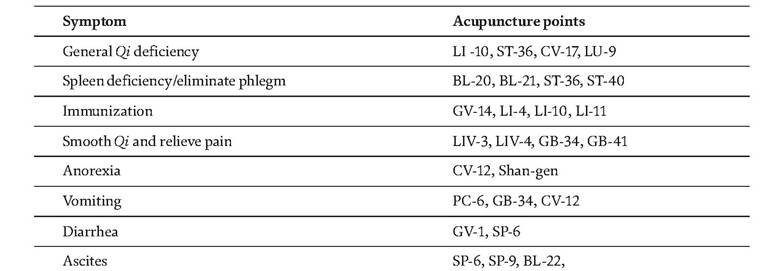
Table 4.
TCVM acupuncture points for tumor.
performance, inhibiting tumor growth, mutation, and metastasis. This combination can also mitigate chemotherapy/radiotherapy side-effects and improve life quality [12, 19, 21, 22].
5.