The Greater Omentum (Figure 3.1)
The dorsal mesogastrium attaches to the greater curvature of the stomach and grows caudally as a net-like cover over the ventral aspect of the intestines; it becomes the greater omentum.
The greater omentum actually comprises two layers like a pouch with a parietal or superficial part and a visceral or deep part. The two layers extend cranially to the transverse colon, where they pass either side and form attachments to the pancreas and the spleen. The enclosed cavity is the omental bursa and has only one entry, the epiploic foramen, located caudomedial to the caudate lobe of the liver. The epiploic foramen is dorsal to the caudal vena cava and dorsomedial to the hepatic portal vein. It is slit-like and measures about 4 cm in the dog.In the ruminants the deep layer of the greater omentum attaches just ventral to the right groove of the rumen. The superficial layer attaches to the left groove of the rumen so that the ventral sac lies within the omental bursa. The supraomental recess is the space dorsal to the deep layer of the great omentum in ruminants; it contains the intestines and opens caudally.
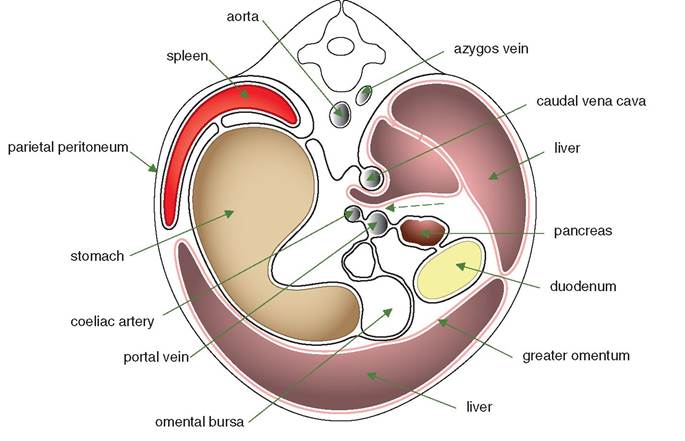
Figure 3.1 Transverse diagram of the abdomen to show the greater omentum, omental bursa and epiploic foramen (dashed arrow).
3.2
More on the topic The Greater Omentum (Figure 3.1):
-
Veterinarian -