Classification and Molecular Aspects
Molecular and ultrastructural studies have positioned Paracoccidioides spp. taxonomically in the phylum Ascomycota and order Onygenales. The order comprises numerous pathogenic fungi.
The thermally dimorphic genus Coccidioides is classified in the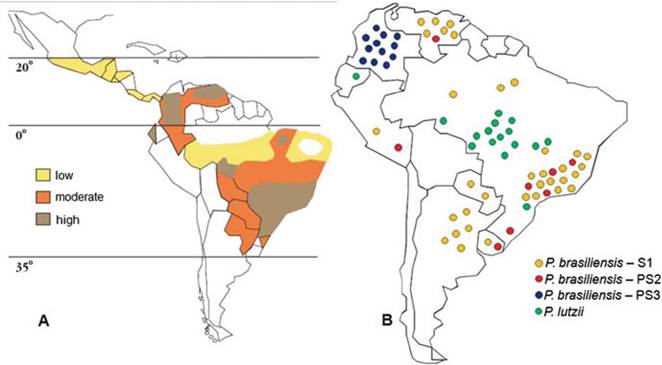
Fig. 6.1 (a) Endemic areas of paracoccidioidomycosis, according to Shikanai-Yasuda et al. (2006). (b) Geographic distribution of the cryptic species of P. brasiliensis and P. lutzii, based on Theodoro et al. (2012)
family, Onygenaceae, while Blastomyces and Histoplasma are with Paracoccidioides in Ajellomycetaceae (Untereiner et al. 2004). Species of these groups have a saprophytic phase that occurs in soil containing animal remains (feces and carcasses) in relatively protected locations, such as animal burrows, caves, buildings liners, and other enclosed spaces. Members of the family Ajellomycetaceae also comprise other, less common species which are also associated with animals, such as Lacazia loboi, Emmonsia-Xike (Herr et al. 2001; Vilela et al. 2009; Theodoro et al. 2011), now described in Emergomyces (Dukik et al. 2017).
Molecular phylogenetic studies have indicated that P. brasiliensis is a species complex with distinct genotypes and/or cryptic species, such as S1 (species 1, which occurs in Brazil, Argentina, Paraguay, Peru, and Venezuela), PS2 (phylogenetic species 2, found in Brazil and Venezuela), and PS3 (phylogenetic species 3, found mainly in Colombia) (Matute et al. 2006a, b; Theodoro et al. 2011) (Fig. 6.1). Additional studies have indicated a genetically more distant group of isolates that was formally described as a separate species, Paracoccidioides lutzii, as a tribute to Adolfo Lutz who first described the disease (Theodoro et al. 2012; Teixeira et al. 2014a, b). It has been also suggested that this group can be divided into separate taxonomic species: P. brasiliensis sensu stricto (S1), P. americana sp. nov. (PS2), P. restrepiensis sp. nov. (PS3) (Turissini et al. 2017). The phylogenetic species PS4, described by Teixeira et al. (2014a), received the name of P. venezuelensis sp. nov. (Turissini et al. 2017).
6.3