I consider this opening chapter to be a very important part of this text. My goal is to provide veterinary students and practicing veterinarians alike with a framework that can be used to approach diagnosis of digestive system disorders in an organized manner based on a thorough understanding of the patient's history.
It is clearly recognized in veterinary practices throughout the world that gastrointestinal (GI) problems are among the most common reasons that pet owners seek veterinary consultation.
In fact,probably only dermatologic disorders are evaluated more commonly on a daily basis. The challenge to the clinician who is presented with a patient exhibiting clinical signs of GI distress or dysfunction is to determine whether or not the problem represents an emergency or is potentially serious and subsequently to make appropriate decisions regarding diagnostic evaluation (may be limited to history and physical examination or may require limited or more extensive testing) and treatment (outpatient versus inpatient). It is well known that the digestive tract is a very resilient system, capable of withstanding a variety of challenges and insults with minimal untoward effect, and that in many pets with clinical signs such as acute vomiting or diarrhea the problem resolves uneventfully, with or without the benefit of routine supportive care. However, some patients that exhibit acute GI symptomatology have potentially life-threatening disorders (e.g., gastric dilatation-volvulus, intestinal obstruction, pancreatitis, severe parvoviral enteritis, addisonian crisis), and failure by the clinician to recognize important historical and physical findings may lead to crucial errors in patient management.It is also very important that the clinician make a timely determination regarding when patients with seemingly mild intermittent or chronic persistent signs due to an as yet undiagnosed disorder should undergo thorough diagnostic evaluation to define the problem more accurately. It concerns and saddens me that many patients with chronic GI disorders, which can often be associated with periods of discomfort caused by nausea, vomiting, abdominal cramping and/or pain, could often have had their problem resolved or controlled much earlier if only an accurate diagnosis had been established.
It is often stated that one of the most important steps in approaching a clinical problem is to obtain an accurate history and perform a thorough physical examination.
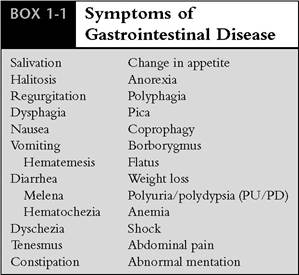
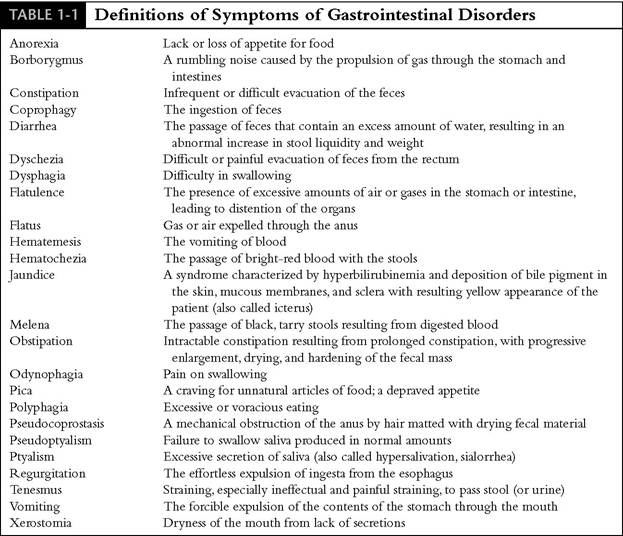
Nothing could be more true about the digestive system, in which disorders can be associated with a wide variety of signs and symptoms. In light of the fact that disorders of other body systems can cause clinical signs of GI dysfunction (e.g., hyperthyroidism, renal failure, feline heartworm disease, hypoadrenocorticism), the need for careful initial screening becomes even more important. It is essential that the patient's history be well understood so that diagnostic evaluation addresses the problem as directly as possible.This chapter provides an overview of the diagnostic approach to GI disorders based on the presenting signs and symptoms. Emphasis is placed on the meaning of various historical and physical examination findings. Once an accurate review of the history has been established, a concise list of most likely differential diagnoses can be established. A list of clinical signs that are associated with digestive system problems appears in Box 1-1. Definitions of symptoms of GI disorders are listed in Table 1-1. Symptoms discussed in this chapter include dysphagia; regurgitation; vomiting; grass ingestion/coprophagy/pica; diarrhea; borbo- rygmus and flatulence; bloating, fullness, and abdominal discomfort; fecal incontinence; and constipation. Additional symptoms are discussed in other chapters throughout the text. Vomiting and diarrhea, the clinical signs that occur most commonly with GI disease, are given the most emphasis in this chapter.