Crimean-Congo hemorrhagic fever virus lineages Europe 1 and Europe 2 in Bulgarian ticks
In order to determine prevalence of CCHFV in ticks, a total of 2315 ixodid ticks were collected from 216 animals (cattle and sheep) in five Bulgarian districts, where CCHF cases were reported in the last 5 years, namely, Blagoevgrad, Kardzhali, Haskovo, Yambol, and Burgas.
The majority of the ticks (2231/2315) were adults and the rest (84/2315) were nymphs.By real-time reverse transcription polymerase chain reaction (RT-PCR), 623 H. marginatum and 107 R. sanguineus s.l. ticks were examined [19]. CCHFV RNA was detected in none of R. sanguineus s.l. ticks and in 39 of H. marginatum ticks (6.3%). The CCHFV RNA-positive ticks were collected from 13 animals: 9 cattle and 4 sheep (6% of all 216 domestic animals tested) in the districts of Burgas and Kardzhali, where the mean percentage of infected animals was 10.0% and 11.4%, respectively. (range 3.7%-17.7%). All positive samples were further tested by the RT-nested PCR. A total of 28 (71.8%) of them were again positive. Sequencing of these samples showed that they clustered into CCHFV lineage Europe 1. Average 8.8% of investigated H. marginatum ticks in Burgas and 8.6% in Kardzhali districts were infected with CCHFV Infestation rate ranged per village from 2.7 to 15.2% [20].
Specific RT-nested PCR for CCHFV lineage Europe 2 [10] was applied to test negative real-time RT-PCR R. sanguineus s.l. ticks. A total of 49 (11.8%) of 415 investigated R. sanguineus s.l. ticks were positive. Very high rate of AP92-like CCHFV was found in R. sanguineus s.l. ticks from Kardzhali district (40.4%). In the district of Haskovo, infestation rate was 2.6%. Europe 2 lineage CCHFV was not detected in districts of Blagoevgrad, Burgas, and Yambol (Figure 2). Sequences were submitted to the GenBank DataBase (accession numbers KR092373, KR092374, and KX227372-KX227377) [20].
Detection of CCHFV lineage Europe 1 only in H.
marginatum ticks supports its leading role as competent vector for CCHFV in Bulgaria. It is of interest that H. marginatum tick species is the predominant species in the two CCHF endemic districts: Kardzhali and Burgas. In some villages in these districts, H. marginatum ticks were infected with CCHFV up to 13.9 and 15.2%, respectively. In other Balkan countries, rates of CCHFV infection in H. marginatum ticks are as follows: 9.1-10.9% in Turkey [21, 22] and 11-15% in Kosovo [23, 24], although in another study in Kosovo, CCHFV was not detected in ticks collected from livestock in otherwise highly endemic regions [16].CCHFV lineage Europe 2 was detected for the first time in Bulgaria: in 40% (46/114) of ticks in Kardzhali district. The previous study showed that the seroprevalence in human population in Kardzhali and Burgas districts is also high [25].
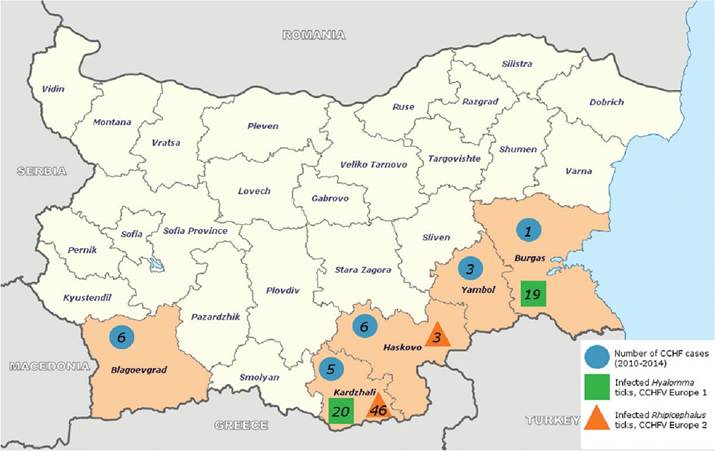
Figure 2.
Detection of CCHF virus lineages Europe 1 and Europe 2 in tick from Bulgaria.
Since CCHFV strain of lineage Europe 2 has been related with mild human disease in Turkey, the high infection rate of ticks in Kardzhali and Burgas districts may be connected with possible undetected mild or asymptomatic CCHF cases in these regions.
Summarizing the data, CCHFV lineages Europe 1 and Europe 2 were found in the district of Kardzhali. Both lineages were never detected simultaneously in ticks from an individual animal. One possible explanation could be superinfection exclusion of closely related viruses. All sequences from R. sanguineus s.l. ticks belong to CCHFV Europe 2 lineage. This lineage has been originally detected in R. bursa ticks from Greece, and much later similar sequences were detected in R. bursa and H. marginatum ticks in Turkey, in R. bursa ticks in Kosovo, in H. aegyptium ticks in Algeria, as well in a fatal CCHF case in Iran.
The tick study showed that Bulgarian ticks are infected at higher rate with the low pathogenic CCHFV lineage Europe 2 than with the high pathogenic lineage Europe 1 [20]. Possible widespread circulation of the low pathogenic CCHFV lineage Europe 2 strains might explain the discrepancy between high seroprevalence rates in humans and only few CCHF cases detected per year.
Further studies are needed especially where Europe 2 CCHFV strains were detected in order to investigate any association with human disease. In the area where Europe 1 lineage was detected, increased awareness about its pathogenicity to humans is needed.
3.