Countrywide seroprevalence study on Crimean-Congo hemorrhagic fever in general population of Bulgaria
To test current circulation of CCHFV in the country, we conducted a seroepi- demiological study. The main objective of the study was to estimate the prevalence of IgG antibodies to CCHFV, as stable and long-persisting antibodies, in general human population of Bulgaria.
Serum samples were collected prospectively from 1500 residents of all 28 districts in Bulgaria. Participants were selected randomly among persons referred to public biochemistry laboratories in the regional primary healthcare centers to follow noninfectious diseases or for routine prophylactic checkup. Persons previously vaccinated against CCHFV were excluded from the study.
All serum samples were tested for anti-CCHFV IgG antibodies using commercially available ELISA kits according to the manufacturer s instructions (VectorBest, Novosibirsk, Russia). Positive serum samples were tested also for specific IgM antibodies against CCHFV by ELISA kits from the same manufacturer. Positive samples for CCHFV IgG antibodies were additionally tested by commercial immu- nofluorescent kits (Euroimmun, Lubeck, Germany).
Specific IgG antibodies to CCHFV were found in 55 (3.7%) of the 1500 people tested by both ELISA and IFA tests. No CCHFV IgM antibodies were detected in these 55 samples. Analysis of the risk factors revealed that age over 40 years, tick bites, contact with livestock and residency in Haskovo district, are associated (95% CI) with an increased risk of CCHF [14].
Positive samples were found in residents of 20 out of the 28 districts in Bulgaria (Figure 1). The highest seroprevalence rate was observed in Southeastern Bulgaria: in districts of Haskovo (28%) and Yambol (12%), both well-known endemic regions. Notably, considerable seroprevalence rates were detected in districts where no CCHF cases have been reported, like in some northern and western districts [14].
A few CCHF cases are reported every year in Bulgaria. Nevertheless, results of the seroprevalence study revealed that actual significance of the disease is much higher with a high rate of subclinical infections. The mean established CCHF seroprevalence is comparable to those in other Balkan countries: 4.2% in Greece [15] and 4.0% in Kosovo [16]. The seroprevalence in the endemic Bulgarian districts is close to that in the endemic Turkish regions [17, 18], experiencing a large outbreak.
As found in previous studies, risk factors for CCHFV seropositivity are contact with livestock and tick bites. At higher risk are also residents of Haskovo district, where the highest seroprevalence is detected. There is no significant difference between the age groups. Nevertheless, there is significant difference in the
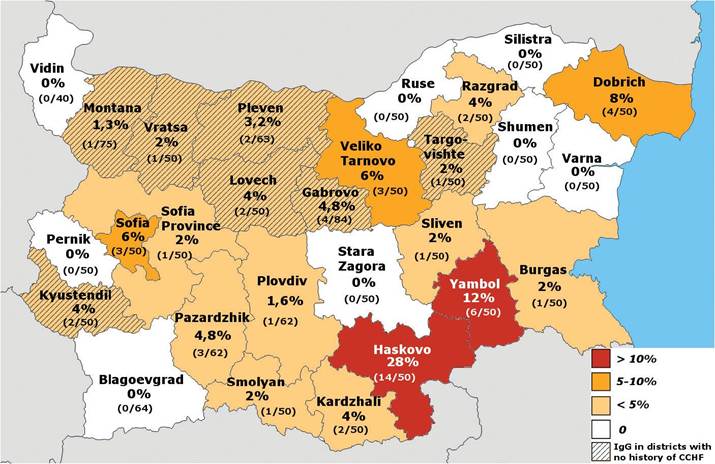
Figure 1.
CCHF seroprevalence by districts in Bulgaria.
seroprevalence rates in groups over and bellow 40 years. However, probability of contacting the virus also increases with age.
In the last years, almost all CCHF cases in Bulgaria are reported in southeastern districts, close to the national borders with Greece and Turkey (districts of Kardzhali, Yambol, Haskovo, and Burgas). On the other side, specific IgG antibodies against CCHFV were found in almost all Bulgarian districts (in 20 of 28 districts), high seroprevalence in the endemic districts, located in Southeastern Bulgaria, Haskovo (28%) and Yambol (12%), and significant seroprevalence in non-endemic areas in Northern and Western Bulgaria. The data presented indicate two important findings: (1) CCHFV increased substantially its circulation in the endemic regions and (2) CCHFV was introduced in many new areas.
In addition, the seroprevalence data revealed that CCHF may go asymptomatic or present with very mild manifestation in many cases. Increased awareness among physicians about subclinical forms of CCHF is needed.
2.3
More on the topic Countrywide seroprevalence study on Crimean-Congo hemorrhagic fever in general population of Bulgaria:
- Countrywide seroprevalence study on Crimean-Congo hemorrhagic fever in general population of Bulgaria
- Savic Sara (ed.). Vectors and Vector-Borne Zoonotic Diseases. ITexLi,2019. — 110 p, 2019
- References