Disorders of Sexual Development (the Intersex)
Although the older literature describes hermaphrodites (ovarian and testicular tissue both present) and pseudohermaphrodites (gonads of one sex but some morphologic structures typical of the other sex), the term intersex is preferable and can be applied even when the exact nature of the gonads is unknown.
An intersex, then, is an animal that shows both male and female characteristics. In human medicine, the intersex condition is referred to as a “disorder of sexual development.”The Polled Intersex
Within the breeds originating in western Europe - such as Saanen (Soller 1963), Alpine (Boyajean 1969), and Toggenburg (Eaton 1943) - there is a well-known and much studied association between the natural absence of horns and the intersex condition. The condition also occurs in the Damascus or Shami goat (Al-Ani et al. 1998). It is likely that Nubian and Angora goats have a different inheritance of horns (Crepin 1958). The polled intersex condition is not reported in these breeds, although freemartins may occur.
Etiology
The polled condition in the European breeds is determined by an autosomal dominant gene that is the same as or very closely linked to a recessive gene causing infertility. One older theory held that this gene, where homozygous, causes expression of H-Y antigen (Wachtel et al. 1978). The H-Y gene is normally on the Y chromosome. Translocation of a subcritical portion of H-Y genes to an autosome would give rise to a recessive mode of inheritance. H-Y antigen is secreted in hormone-like fashion and binds to cells of the developing ovary (Wachtel 1980). A variable H-Y dosage would explain the extreme variability in phenotype of polled intersex goats (Shalev et al. 1980).
Polled intersex goats have been shown to be negative for SRY, the sex-determining region of the Y chromosome, which is one of the major genes responsible for testicular induction (Just et al.
1994). Recently, an 11.7 kb deletion on chromosome 1 of the goat known as the polled trait- related intersex syndrome (PIS) deletion has been identified as causing the polled condition (Basrur and Kochhar 2007). The deleted segment of DNA normally has regulatory effects on nearby genes for horn bud development and development of fetal ovaries. Female goats homozygous for the deletion show sex reversal because testis-promoting genes in the fetal ovary become active; the intricacies of the sex determination cascade in the developing fetus are detailed by Basrur and Kochhar (2007). Recently, long-read whole-genome sequencing has further clarified the structure of the variant gene on chromosome 1 of polled goats, and a diagnostic PCR has been developed to genotype carriers of this variant (Simon et al. 2020).Clinical Signs and Management
Affected animals are genetically female, but may exhibit male, female, or mixed external characteristics (Eaton 1943). An enlarged clitoris in a doe-like animal or a decreased anogenital distance in a more masculine individual is typical. Hypospadias may be present. The gonads (usually testes or ovotestes) may be scrotal, inguinal, or abdominal in location and are smaller than the testes of normal bucks of the same age. In one instance, the uterine tubes attached to the scrotal testes also herniated into the scrotal sac (Ramadan et al. 1991). Testosterone is commonly produced, which accounts for masculine behavior, neck development, erect hair on the neck, and odor (Hamerton et al. 1969; Zlotnik 1973). Sperm are not produced, and thus the intersex can be used as a teaser animal. Gonadectomy is generally required if the animal is to be kept as a pet.
Unless the masculinized intersex goats are counted as females, the sex ratio in European breeds favors males rather than females (Eaton 1945; Soller et al. 1969). Polled does heterozygous for the variant chromosome tend to have a larger litter size than do horned does (Soller and Kempenich 1964; Constantinou et al.
1981).Diagnosis
The anatomic variations just described are very suggestive of this condition, if the animal is naturally polled and both parents were polled. In this regard it should be remembered that some breeders disbud every kid at a very young age, without paying close attention to hair swirls that would permit differentiation of polled from horned animals (Chapter 18). Thus some polled goats have been “disbudded” and recorded as horned. Likewise, a small horny scur is usually taken as evidence of previous horn removal, but conceivably could represent partial growth in a heterozygous animal. If a polled doe is fertile, she is presumed to be heterozygous for the polled gene. Differentiation of a polled intersex from a freemartin requires karyotyping; the polled intersex is a chromosomal female.
Difficulties are encountered in identifying the intersex animal with normal or nearly normal (slight projection of the vulva) external genitalia. Failure to exhibit estrus, development of male odor or behavior during the breeding season, a shortened vagina on speculum examination, or smaller than normal teats may be the first signs that the intersex condition is present. At the other end of the spectrum, polled genetic females with male phenotype and hypoplastic testes are difficult to identify without a karyotype until they are old enough that sperm production would be expected (Corteel et al. 1969; Soller et al. 1969). Karyotyping is available from various commercial laboratories, including the Texas A&M Molecular Cytogenetics and Genomics Laboratory.
Prevention
The occurrence of intersex goats associated with the polled condition can be avoided by insisting that one goat in each breeding pair has been born with horns and is therefore homozygous for the gene for horns (p). This ensures that no kids are born homozygous for the PIS polled gene muta- tion/deletion (P) and its associated recessive effects on fertility. A polled buck can be heterozygous or homozygous.
A polled doe, on the other hand, must be heterozygous if she is fertile. The potential for obtaining undesirable offspring by mating polled animals is detailed in Figure 13.10.Freemartins
A freemartin is a female rendered sterile by being co-twin to a male fetus.
Pathogenesis
In cattle, freemartinism is common because the fetal membranes from twin calves generally fuse, thereby permitting exchange of cells and hormones (testosterone and Mullerian inhibiting substance) between male and female fetuses (Padula 2005). Although multiple births are common in goats, freemartins are not. This is presumably because placental fusion does not usually occur, at least not until after differentiation of fetal gonads is completed (Basrur and Kochhar 2007).
Diagnosis
Caprine freemartins cannot be distinguished on the basis of external or internal genitalia from polled intersexes (Basrur and Kochhar 2007). The gonads may be partially descended testes devoid of germ cells or internal testes or ovotestes. The goat may be polled or horned. A male litter mate must have been present in the uterus early in embryologic development, but might not have persisted to term (the case of the missing womb mate). The diagnosis can be confirmed by demonstrating XX-XY blood chimerism (BonDurant et al. 1980; Ricordeau 1981; Smith and Dunn 1981; Bosu and Basrur 1984). The expense of karyotyping is usually prohibitive. Some laboratories, such as the Veterinary Genetics Laboratory at the University of California, Davis, offer freemartin testing of goats for a lower price than a karyotype, but even this may not be warranted, because clinical management of a freemartin is the same as for a polled intersex.
Other Chromosome Abnormalities
The karyotype of the domestic goat consists of 60 chromosomes; all except the small metacentric Y chromosome are acrocentric. Because the acrosomes appear similar under conventional staining techniques, identifying individual autosomes requires special staining techniques such as G-banding (Cribiu and Matejka 1987a) and R-banding (Cribiu and Matejka 1987b).
More modern and less laborious techniques have been reviewed by Kozubska- Sobocinska et al. (2016).If karyotyping is done on infertile goats, very occasional animals are identified that have abnormalities other than the polled XX intersex condition or XX-XY blood chimerism of freemartins. One survey from India identified numeric chromosomal abnormalities in 51% of 47 goats that were classified as “reproductively inefficient” (Bhatia and Shanker 1996). Fusion of embryos and other genetic accidents may be proposed. Goats that are true hermaphrodites are often whole-body chimeras (Basrur and Kochhar 2007). There is a report of a single fertile Saanen ? Beetal buck goat with both XY and XXY cell lines in its blood, but the mechanism by which this mosaic was created could not be determined. At least 4 of the buck's 16 progeny were culled for breeding problems (Bhatia and Shanker 1992).
Robertsonian Translocation
An inherited centric fusion (Robertsonian translocation) of two acrocentric chromosomes (resulting in a chromosome number of 59 instead of 60) has been identified in a family of Saanen goats (Soller et al. 1966). Similar Robertsonian translocations involving different chromosomes have been reported in other populations of Saanen or Toggenburg goats (Popescu 1972; Cribiu and Lherm 1986; Burguete et al. 1987). In most instances, no anatomic abnormalities have been identified. In one case, two sterile bucks (with one and two polled parents) were found to have a centric fusion (Ricordeau et al. 1972b). Females carrying this chromosomal abnormality tended to produce fewer kids than did non-carrier sisters (Ricordeau 1972), which suggests increased embryonic mortality rates. Homozygotes with 58 chromosomes were not reported (Ricordeau 1981), again suggesting that the trait was lethal in the homozygous state.
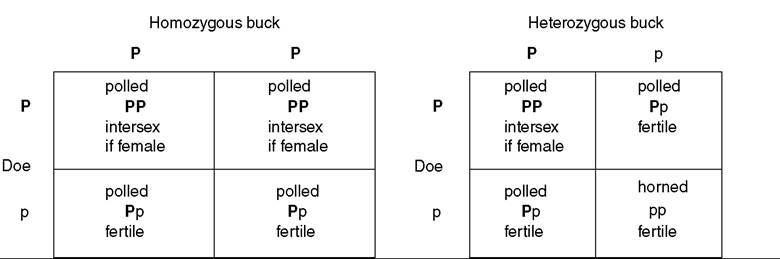
Figure 13.10 Results of crossing a polled doe (always heterozygous, Pp) with a homozygous (PP) or heterozygous (Pp) polled buck.
A translocation involving chromosomes 5 and 15 in a Saanen buck in Brazil, imported from Switzerland, produced no adverse effects on fertility. Test matings showed that homozygous offspring were viable and produced in the expected frequency (Gonqalves et al. 1994).