Dry Matter Intake
The nutrient values of feeds and the requirements of animals are usually converted to a DM basis to simplify ration calculation. DM is also important in its own right. be broken down, the sooner it exits and the larger the volume of feed that can be consumed at the next meal.
Thus, the capacity of ingestion is limited by the digestibility and especially the fiber content of the feed in question. The cellulolytic activity of the microbial population is also important, and this depends in a major way on the energy in the diet available to support growth of the microbes. With some forages such as mature grass hay or straw, it is the nitrogen available in the rumen that limits microbial growth and thus the total dry matter intake (TDMI). In other instances, trace minerals become limiting. The quantity of water in a feed is usually unimportant unless green chops are harvested at an immature stage (less than 18% DM).Concentrates
Concentrates are generally ingested and digested more rapidly than forages, such that the substitution on a DM basis of grams of grain per grams of forage is not 1 : 1. In moderate amounts, concentrates improve the digestibility of poor forages by supplying energy needed for growth of the microbial population. If consumed rapidly in large quantities, concentrates decrease the rumen pH level to a point at which activity of cellulolytic bacteria is compromised and digestion of the forage is slowed (see Indigestion and Rumen Acidosis, below). Dividing the concentrate portion of the ration into several smaller meals is thus desirable because acidosis is prevented. The consumption of hay can only be increased in a limited fashion (less than 10%) by offering multiple meals, but it is important that the forage be available for many hours each day to encourage consumption (Jarrige et al. 1978). A total mixed ration is ideal, but few goat farms can afford the equipment required to combine hay or silage and grain intimately, and even then the goat may sort out preferred components of the ration.
Forages
The quantity of feed that an animal is actually capable of ingesting in a day often limits the nutritive value of a ration, even if it is offered free choice.
This is especially true of forages. The rumen is normally filled with a mass of feed in the process of being digested. The volume in the body cavity that the rumen can occupy and the distension of the abdominal wall possibly are limiting factors in feed consumption. Individual particles can only leave the retic- ulorumen and pass to the omasum and abomasum when they have been reduced to a certain small size by mastication and microbial digestion. The quicker the feed canIntake Limits
Some feeds are eaten in smaller than expected quantities because the goat finds them unappetizing. This is often true of heavily fermented silages or moldy feeds. Many goats refuse to eat hay that has fallen to the ground and been walked on. When the ration is adequately ingestible and digestible for the ruminant to meet its nutritional needs, the level of production often becomes the factor limiting ingestion. High-producing animals voluntarily consume a larger quantity of DM. For this reason, tables ordinarily increase the TDMI for each kg of milk produced or gram of bw gained.
Voluntary DMI is often expressed based on bw or metabolic weight, depending on whether animals are of similar or very different sizes. This is not a very accurate approach because it ignores the variations in digestibility and substitution. It does, however, permit discussion of gross trends in DM intake. During growth of a goat kid, the TDMI increases as the bw increases. This is because both maintenance requirements and volume of the rumen increase. The TDMI relative to bw decreases during growth. This is especially true at the end of the finishing period when internal body fat limits rumen volume. It remains nearly constant when expressed in terms of metabolic bw. Similarly, in late pregnancy, the increased volume of the uterus results in a relative decrease in TDMI, although high estrogen levels are also involved. After kidding, TDMI increases as the volume available for the rumen is increased by the involution of the uterus and the rumen epithelium develops to improve absorption of the end-products of digestion.
However, the requirements for high milk production increase even more rapidly than does TDMI, and thus the goat must either mobilize body reserves or give less milk.The maximum DMI for goats approaches 5-6 kg/100 kg bw, and animals with such elevated intake are naturally the best producers in the herd (Morand-Fehr 1981a). In goats fed alfalfa hay and grain during lactation, the average DMI varies from 2.8 to 4.2 kg DM/100 kg according to the stage of lactation. During lactation, daily DMI as hay may reach 3-3.5% of live weight. Intake is decreased during gestation. Typically the total DM intake is 2.2-2.8 kg/100 kg bw during the last eight weeks of pregnancy. Intake of hay varies from 1.7 to 2.3 kg/100 kg bw during this time.
These figures were obtained from Alpine dairy goats. For the same type of goat, a regression equation has been constructed based on 11 600 daily rations consisting of alfalfa hay and grain (Morand-Fehr and Sauvant 1978): 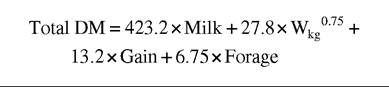 where
where
DM = dry matter intake in g/day
Milk = kg/day of 3.5% milk Gain = weight gain in g/day
Forage = percent of roughage in the ration
Such an equation only applies to the particular forage for which it was constructed. Similar trends have been demonstrated in West African Dwarf goats, in which voluntary intake of pelleted alfalfa during peak lactation was almost double that of non-lactating goats of a similar age. Goats suckling twins had greater TDMI levels than goats suckling singles (Adenuga et al. 1991). More recently, many studies have been summarized to produce predictions of the voluntary DMI of lactating goats, Angora goats, growing, and mature goats, independent of the forage consumed (Luo et al. 2004c).
Encumbrance
French nutritionists have proposed a unit of encumbrance or fill unit system as a better way of determining the TDMI of various rations (Demarquilly et al. 1978; Jarrige 1988; INRA 2007).
In this system each category of animal has a single value for capacity of ingestion, while each forage has several ingestibility values, determined by the category of ruminant. At first, “standard” sheep (wethers at the end of their growth period) were used to determine ingestibility values. The quantity of a forage eaten by the sheep was then divided into the amount of a reference forage consumed (young pasture grass of a certain energy density) to obtain the encumbrance value, EV. Ingestibility values were later determined for lactating dairy cattle (units of encumbrance for lactation, UEL, or milk fill units, MFU) and also fattening cattle. Encumbrance has been applied to dairy goats (Morand-Fehr and Sauvant 1988; INRA 2007). The “standard” goat weighs 60 kg and produces 4 kg of milk with 3.5% butterfat. It consumes 2.65 MFU per day. Capacity is adjusted by 0.23 MFU for each kg of 3.5% fat- corrected milk. Voluntary DMI increases in a non-linear fashion after parturition until its maximum at approximately eight weeks of lactation. For dairy goats, the DMI is approximately 72%, 85%, 92%, 95%, and 98% of the maximum value during weeks one, two, three, four, and five, respectively, of lactation (Sauvant et al. 1991b; INRA 2007).Tables have been constructed for goats of varying bw, weeks in lactation, and levels of milk production. Selected values have been compiled from the INRA (2007) tables to create Table 19.5. These numbers presume a refusal level of 15% and digestible forage.
Encumbrance values are not routinely included in American feed tables. They are most useful when forages of variable quality are fed. These principles can be demonstrated by several examples. A 60 kg goat at maintenance can consume 1.30 MFU. An early-cut grass hay might have an EV of 1.06 MFU/kg DM if it was cut in good weather. Hay from the same field cut late and rained on might have an EV of 1.25 for dairy cattle and goats (but 1.98 for sheep). For the first hay, the goat can eat 1.30/1.06 = 1.51 kg DM.
For the weathered hay, it would eat only 1.30/1.25 = 1.04 kg DM. The French tables for TDMI (as given in Table 19.5) are constructed for a ration based on alfalfa hay or corn silage supplemented with concentrates (Morand-Fehr and Sauvant 1988). The NRC tables, on the other hand, indicateTable 19.5 Daily dry matter intake (in kg) and capacity for ingestion (MFU).
| Live weight of goat | 50 kg | 60 kg | 70 kg | |||
| DMI | MFU | DMI | MFU | DMI | MFU | |
| Last month gestation | 1.16 | 1.14 | 1.32 | 1.30 | 1.49 | 1.46 |
| After peak lactation (milk production) | ||||||
| 1L | 1.57 | 1.38 | 1.74 | 1.54 | 1.90 | 1.70 |
| 2L | 1.90 | 1.62 | 2.06 | 1.78 | 2.22 | 1.94 |
| 3L | 2.22 | 1.86 | 2.38 | 2.02 | 2.54 | 2.18 |
| 4L | 2.54 | 2.10 | 2.70 | 2.26 | 2.86 | 2.42 |
| 5L | 2.86 | 2.34 | 3.02 | 2.50 | 3.18 | 2.66 |
| 6L | 3.18 | 2.58 | 3.34 | 2.74 | 3.50 | 2.90 |
DMI, dry matter intake; MFU, capacity for ingestion in milk fill units.
not the capacity for TDMI, but the amount of DM to be consumed when a ration has a certain energy density, to meet the energy requirements of the goat at maintenance. The ability of the goat to do this is not considered.
Substitution
When feeding concentrates in addition to the forage, it is helpful to know by how many grams the ingestion of forage DM decreases for each 100 g of concentrate DM consumed. This depends on the forage and the percent of the final ration that will be grain. The substitution rate is appreciably less than 1 when small amounts of concentrates are combined with energy-poor forage. In fact, when feeding weathered grass hay with an EV of 1.9 and an energy density of 0.76 Mcal NElZkg DM, the substitution rate varies from 0.02 to 0.21, depending on whether 10 or 70% of the diet is grain. Thus, the TDMI increases substantially. The substitution of one feed for another on a DM basis also seems to depend on stage of lactation. For instance, if 100 g more grain is fed to a goat in gestation, she will eat 62 g less alfalfa hay. In early lactation, for 100 g more grain the goat will eat 78 g less hay. After the first two months of lactation there is almost an equivalent substitution of grain for good hay on a DM basis.
Conclusions Concerning Dry Matter
Out of all this confusion comes one clear message. Anyone constructing on paper or computer a ration for goats must subsequently verify that the animals in question will actually consume it. This means weighing forage fed, refusals, and the grain consumed. If the animals are not eating as much forage as they need, the amount of grain must be decreased or the forage quality improved. Of course, the situation with pastured goats is trickier. Here, the goat raiser needs both experience and experimentation to feed the herd properly.