Energy
All discussions of nutrition seem to begin with energy, probably because this is the best-defined requirement of farm animals and is expensive. In addition, shortages of energy are translated immediately into a drop in production in dairy animals.
Over a longer period of time, other effects such as retarded growth, delayed puberty, and decreased fertility become apparent.Energy Systems
Energy is expressed in many different ways and units, which vary from system to system and country to country This lack of uniform methodology slows the acquisition and application of knowledge relative to goat nutrition (Morand- Fehr 2005). American goat keepers should become familiar with total digestible nutrients (TDNs). This system assumes that the energy value of a feed depends only on its content in terms of digestible elements. Thus, TDN (expressed as a weight or as a percentage of the feedstuff) is the sum of digestible crude protein (CP), digestible carbohydrate, and 2.25 ? digestible crude fat. A single predetermined yield in energy is assumed to apply to all types of feeds, whether forages or concentrates. With this system, energy requirements can be expressed in terms of grams of TDN, kcal of digestible energy (DE), or kcal of metabolizable energy (ME).
These units are interrelated as shown in Figure 19.1 and Table 19.1. In this example, 1 kg TDN represents 4409 kcal DE, and 76 kcal DE yields 62 kcal ME (NRC 1981b). In fact, the numeric relationships vary from feed to feed. From this point, a lumper can use a global yield in net energy (NE), for instance that 62 kcal ME gives 35 kcal NE. Splitters, who are prevalent in dairy nutrition, admit that the energy losses associated with various types of production vary.
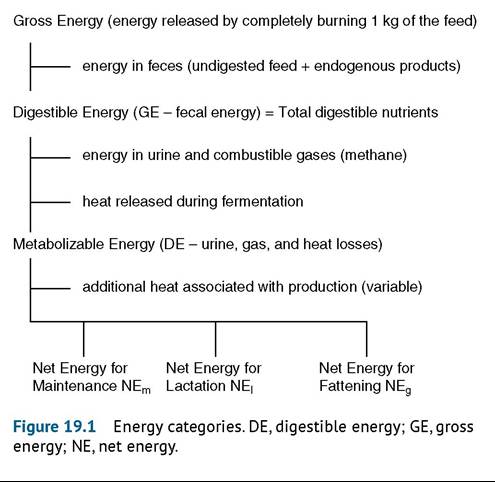
Within the TDN system, one can distinguish NE for maintenance (NEm) with a yield of 0.72 ? ME, NE for lactation (NEl) with a yield of 0.60 ? ME, and NE for growth or fattening (NEg), with a yield of 0.45 ? ME (Sauvant 1981).
This compares rather poorly with the global estimate of 0.56 demonstrated in Table 19.1. However, as long as care is taken to express requirements and nutritional content in the same type of NE, the results should be the same. The system does overestimate the energy value of forages compared with concentrates.The French system, like newer American systems for cattle, is based on NEl and NEg, and recognizes that different feeds have different yields in energy at each stage in the digestion/metabolism process (Vermorel 1978). For instance, long-stem forages are associated with more energy losses in the form of heat of fermentation and methane gas (eructated from the rumen) than are concentrates. As in the TDN system, NEm can be approximated by 0.72? ME (although the actual range is 0.66-0.76). Similarly, NEl is often assumed to be 0.60 ? ME (actual range 0.54-0.68), which corresponds to the actual yield given a typical dairy ration in which 0.57 of the ingested energy appears as ME. For all rations, the NEl yield is proportional to the NEm yield, such that NE requirements for both maintenance and lactation can be expressed in terms of NEl. Current French tables of nutrient composition and requirements use a new unit, the UFL, which is equivalent to 1700 kcal of NE for lactation (INRA 2007). The corresponding unit for NE for growth is the UFV, equivalent to 1820 kcal of NE for growth.
The energy requirements for goats that will now be outlined follow French recommendations, because much work has been devoted in that country specifically to the nutrition of the dairy goat. In addition, much of the original research has been summarized in one text (Morand- Fehr 1991) and updated tables are available (INRA 2007). Forage analysis reports currently available in the United States through the Dairy Herd Improvement Association and many computerized ration calculation programs also deal with NEl. Readers who prefer the TDN system may refer to the NRC publication Nutrient Requirements of Small Ruminants (2007).
If goats differing greatly from European dairy breeds are to be fed, or if the climate is not temperate, then the estimates of other authors may be more appropriate (Rajpoot et al. 1981).Table 19.1 Interrelationships of energy units in the total digestible nutrient system.
| GE (kcal) | 100 | Gross energy | ||||
| TDN (kg) | 1 | 0.227 | 0.278 | 0.492 | Total digestible nutrients | |
| DE (kcal) | 76 | 4409 | 1000 | 1226 | 2171 | Digestible energy |
| ME (kcal) | 62 | 3597 | 816 | 1000 | 1771 | Metabolizable energy |
| NE (kcal) | 35 | 2030 | 460 | 564 | 1000 | Net energy |
Maintenance
The energy required for maintenance of a goat depends in a specific way on the bodyweight (bw) of the animal. However, this is not a linear relationship and most people without access to calculators prefer consulting a table such as NRC (2007) or INRA (2007) to working through the arithmetic. Numerous studies for various breeds and ages of goats have each produced a different equation meant to represent the energy requirements. These equations may calculate either ME or NE and energy units may be in either kcal (total DE system) or kilojoules (SI or International System) units. One such equation (Vermorel 1978) demonstrates that the daily NEl needed in kcal for maintenance is proportional to the metabolic weight. The weight is expressed in kilograms and this is raised to the 0.75 power:
Maintenance (NEj ) = 65.3 ? Wkg0'75
Table 19.2 indicates the metabolic bw and NEl requirements for goats of various weights using this equation as an example. It can be used in conjunction with NRC requirement tables, with 1 Mcal equal to 1000 kcal.
For countries using SI units, note that 1 kJ = 0.239 kcal, and 1 kcal = 4.184 kJ.Recently, many equations have been summarized and used as the basis for the energy recommendations in the 2007 NRC tables (Luo et al. 2004d; Nsahlai et al. 2004a; Sahlu et al. 2004). The factor by which the metabolic weight is multiplied depends on the age and breed of goat under consideration. This in turn makes the resultant tables more accurate when applied to a given class of goats.
Environment
The energy requirements for maintenance also vary with environmental conditions (such as temperature, humidity, and wind) and with exercise. The heat of fermentation normally lost during digestion helps to maintain the body temperature of ruminants in a cold environment. In fact, a goat on a high-roughage diet has the benefit of an internal hot water bottle, the rumen, to keep it warm. Supplemental grain feeding further increases the heat production from the rumen, even though the proportion of the digestible energy of concentrate feeds released as heat is less. Animals without active rumen function must shiver to maintain body temperature. For this reason a “goat coat” (i.e., a sweatshirt or commercial coat) or a blanket is often beneficial to an animal off feed because of illness or surgery.
The thermoneutral zone (TNZ) is the Iemperalure range in which the animal is most productive with least stress and is approximately0-30 °C (32-86 °F)ingoats(Constantinou 1987). The upper critical temperature is the upper limit of the TNZ; above this temperature the animal experiences heat stress. High-producing animals, with increased metabolic heat, are more susceptible to heat stress (NRC 1981a). The adaptabiiity of goats to heat stress has been reviewed (Sarangi 2018). The lower critical temperature is the lower limit of the TNZ. The lower critical temperature varies between animals and depends on haircoat, presence of insulating fat, and level of feeding. Shearing during cold weather increases the energy needs of hair goats and often leads to deaths.
Energy requirements need to be adjusted for very cold weather. When a goat is outside its TNZ, more energy is required for maintenance. For instance, for every degree centigrade below the TNZ, an additional 0.7 could be added to the 65.3 factor in the equation given above (figure used for beef cattle; Simons and Hand 1986). The effect of wind velocity can be crudely estimated to be equivalent to a decrease of 0.6 °C (1.08 °F) for each mile per hour (mph). Thus, for a temperature 10 °C (18 °F) less than the TNZ in the presence of a 20 mph wind, the equivalent temperature difference would be 10 + (0.6 ? 20), or 22 °C, equivalent to a difference of 39.6 °F. The maintenance requirement for a 50 kg goat would then be (65.3 + (22 ? 0.7)) ? 500'75 or (65.3 + 15.4) ? 18.8 = 1517 kcal rather than the usual 1228 kcal. Wetness causes an additional decrease in “effective temperature” below that calculated by the wind chill factor. These corrections need to be verified for goats. Perhaps an increase of 1% in the maintenance energy for each °C below the TNZ is a reasonable starting estimate.
Table 19.2 Maintenance energy requirements for goats.
| Weight (kg) | Weight (lb) | Metabolic wt (kg) | Daily NEl (kcal) | Daily NEl (MJ) |
| 10 | 22 | 5.62 | 367 | 1.536 |
| 20 | 44 | 9.46 | 618 | 2.586 |
| 30 | 66 | 12.82 | 837 | 3.502 |
| 40 | 88 | 15.91 | 1039 | 4.347 |
| 50 | 110 | 18.80 | 1228 | 5.138 |
| 60 | 132 | 21.56 | 1408 | 5.891 |
| 70 | 154 | 24.20 | 1580 | 6.611 |
| 80 | 176 | 26.75 | 1747 | 7.309 |
| 90 | 198 | 29.22 | 1908 | 7.983 |
| 100 | 220 | 31.62 | 2065 | 8.640 |
MJ, megajoule; NEl, net energy.
Adjustment in the energy density of the diet may be required, because even though voluntary intake increases in cold weather, the energy requirement for maintenance usually increases more rapidly (Ames 1987).
Activity
An increase in NEl of 20-25% more than the maintenance requirements for stabled animals has been suggested for goats engaged in light grazing. Animals traveling longer distances to find food and water need substantially more, but the exact amount is hard to quantify. An additional 40% more than simple maintenance is suggested for distances of 6.5 km a day (4 miles), and 60% for 9.5 km (6 miles; Morand-Fehr and Sauvant 1978). The increase suggested by NRC (1981b) for long distances and great changes in altitude is 75%. Thus, a goat weighing 60 kg is estimated to need 1408 kcal a day if it stays in the barn, 1690 if it grazes nearby, and approximately 2250 if it travels 9.5 km (6 miles). Activity level and energy expenditure among goats in a single herd are actually quite variable.
Lactation
The proportion of ME that is used for lactation is independent of the level of production. However, it is necessary to adjust the NEl requirements as the fat, protein, and lactose content of the milk change. Using a reference milk containing 3.5% fat, 3.1% protein, and 4.3% lactose, the energy requirement per kg of milk produced is 676 kcal NEl (INRA 2007). If the fat content of the milk differs markedly from 3.5%, the NRC (1981b) recommendation to change the ME needed by 16.28 kcal for each 0.5% fat would translate to adjusting the NEl by 12 kcal.
Growth and Weight Gain
Yearling goats are still growing during lactation, and need extra nutrients to support this growth. In addition, high- producing goats lose weight (up to 7kg; INRA 2007) during the first months of lactation because they mobilize body reserves to produce milk. They will eventually need to regain this weight. Approximately 6kcal NEl is needed for each gram of live weight gain. The average mature Alpine goat replacing her reserves needs 270kcal∕day extra for this purpose (Morand-Fehr and Sauvant 1978). This represents a weight gain of 45 g∕day. By way of comparison, NRC (2007) uses values of 5.52kcal ME/g daily gain for meat and dairy kids and 6.81 kcal ME∕g of weight gain for mature animals.
Gestation
There is no extra energy requirement until the last two months of pregnancy. French workers use the bw at breeding time to calculate maintenance energy for a doe and then add 830 kcal NEl∕day for the last two months. In the experimental data used to derive this, the average weight of the kids at birth was 7.6 kg; 1 kg of kid thus required 109 kcal∕day extra energy. In general, if the supplemental energy for pregnancy is dropped to less than 500 kcal the goats will be prone to pregnancy toxemia, while above 1100 additional kcal of NEl there will be digestive accidents, difficult births, and poor milk production in the subsequent lactation (Sauvant 1981). These situations are discussed in detail later in this chapter. The current French recommendation is to multiply the maintenance energy requirement by 1.15-1.30 for the last two months of gestation (INRA 2007). The current NRC tables (2007) distinguish between dairy and non-dairy does carrying singles, twins, or three or more kids when determining the energy (and protein) requirements.