Etiopathogenesis of food allergy
Both the intestinal mucosal barrier and the phenomenon of oral tolerance work synergistically to minimize the risk of food hypersensitivity reactions. The mucosal barrier consists of interrelated immunological and non-immunological components, which 1) block the penetration of ingested antigens (via an intact epithelial barrier, normal peristalsis, and a mucus glycocalyx coat); 2) promote the degradation of ingested antigens (via gastric acid, pancreatic enzymes, and brush border enzymes); and 3) facilitate antigen exclusion from the mucosa (via antigen-specific secretory IgA [sIgA] in the gut lumen).
Oral tolerance is defined as the specific local and systemic immunological unresponsiveness to an orally administered anti- gen.3 This suppressor function is derived through the generation of antigen-specific regulatory T-lymphocytes (cellular immunity) and sIgA (humoral immunity), which is secreted onto the mucosal surface. Impairment of these mucosal defense mechanisms predisposes patients to food allergy.The immunological mechanisms responsible for food allergy have not been fully elucidated but are likely to involve Type I (IgE-mediated) hypersensitivity responses. Without the development of oral tolerance to dietary antigens, an animal will develop a local IgE response towards that dietary antigen and
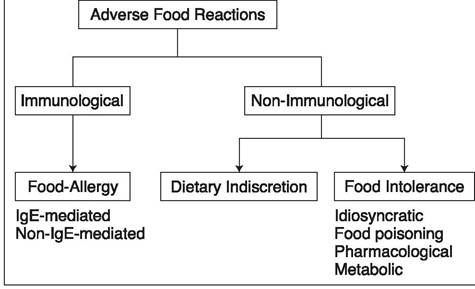
Figure 9.1:
Adverse food reactions. This figure shows the different types of adverse food reactions seen in veterinary patients.
Table 9.1: Types of adverse food reactions
| Type of intolerance | Response |
| Food idiosyncrasy | Abnormal host response to a food substance or additive. Example is a reaction to food additives. |
| Food intoxication / | Abnormal host response to organisms contained in |
| poisoning | food or the presence of food toxins. Examples include aflatoxicosis and botulism. |
| Anaphylactic food | Mimics real anaphylaxis, but is not mediated by |
| reaction | immunological release of chemical mediators. |
| Metabolic food | Affects metabolism of the host after food intake. |
| reaction | Example is lactose (disaccharidase) intolerance. |
| Pharmacological | Drug-like effect of a food substance on the host. |
| food reaction | Example is chocolate toxicosis. |
will become sensitized to it. Upon subsequent exposure to the sensitizing antigen, mast cell degranulation occurs, which in turn triggers the release of inflammatory mediators (e. g., pro- inflammatory cytokines) causing intestinal inflammation. These Type I responses occur within a few minutes to several hours after ingesting the offending antigen. More systemic (e. g., dermatological) reactions can occur when the antigen escapes from the gut and reaches sensitized basophils or IgE-bound mast cells in the skin. It has been suggested that non-IgE-me- diated food hypersensitivity may also occur in dogs and cats.4
9.1.4