Foodallergies
The specific dietary proteins a patient can develop an allergy towards have been poorly documented. In human beings with food allergy, food allergens are almost exclusively glycoproteins of a molecular mass range of 10-70 kDa.5 There is no data defining the exact molecular mass of food allergens in dogs or cats.
Factors such as stability and immunogenicity of the protein are likely to play an important role in defining the allergenicity of different dietary components. For example, allergens maintain their stability to a varying degree when treated with heat, acid, or proteases.6 Furthermore, allergenicity can be influenced by food processing where protein denaturation destroys some epitopes (antigenic determinates) or exposes new ones, with a decrease or increase in allergenicity, respectively.7Due to the large number of food proteins in commercial pet foods, it is difficult to identify specific food allergens. A metaanalysis of twelve different studies comprising 265 dogs, showed that two-thirds of the dogs, which developed dermatological lesions associated with adverse food reactions, were fed beef, dairy products, or wheat.8 Adverse reactions to chicken, chicken eggs, lamb, or soy accounted for approximately 25% of the reported food allergies in dogs. Another study in dogs with food allergy showed that IgG was the single dominant antigen in cow’s milk, beef, and lamb.9 Rarely, dogs show adverse reactions to corn, pork, rice, or fish. Finally, in separate feline studies, it was shown that 80% of adverse food reactions (e. g., cutaneous lesions or GI signs) in cats were associated with diets containing beef, dairy products, or fish.8
Whether animals most commonly develop single or multiple food hypersensitivities has not been clearly established. According to Walton et al., multiple hypersensitivities are uncommon in dogs and cats.10 In contrast, Harvey and Patterson showed that 35-48% of dogs with food hypersensitivity were allergic to more than one food component.11,12 Similarly, Guilford et al.
showed that 50% of cats with chronic gastrointestinal signs had food hypersensitivities towards multiple food allergens.13 Cross-reactivity among food allergens has not been extensively investigated, but appears to be unlikely.Clinical signs in dogs and cats
Canine or feline dietary hypersensitivity may manifest clinically as dermatological and/or GI signs. Surprisingly, dermatological rather than GI signs in response to food allergy appear to predominate in both species.
Food allergy in dogs
Food hypersensitivity reactions are responsible for approximately 1% of all skin diseases in dogs.14 Food allergy is reported to be the third most common skin allergy after flea allergy and atopic dermatitis. There does not appear to be an age, gender, or breed predisposition. One-third of cases occur in young dogs less than one year of age. Some authors report that a contact time with the sensitizing food allergen must occur for 1-2 years before the first signs appear.6 Dermatological manifestations typically occur as non-seasonal pruritic dermatitis, occasionally accompanied by GI signs. The pruritus varies in severity, but is often intense. Lesion distribution is similar to that seen with atopic dermatitis, where the face, feet, axillae, perineal region, rump, and ears are often affected (Figures 9.2, 9.3, and 9.4). Twenty to thirty percent of dogs with food allergy may have concurrent allergic disease, such as flea allergy or atopic dermatitis.15 In some patients, otitis externa may be the only presenting complaint in dogs with food allergy. The GI manifestations of food allergy may include vomiting, diarrhea, weight loss, and abdominal discomfort.4,6,15
Food allergy in cats
As in dogs, food allergy is responsible for approximately one percent of all skin diseases in cats and represents a common cause for allergic dermatitis along with flea-allergy dermati- tis.14,16 Age and gender predispositions have not been reported.
However, Siamese and Siamese-cross breed cats may be at an increased risk since they account for nearly one-third of all cases. Dermatological signs include 1) severe generalized pruritus without lesions; 2) miliary dermatitis; or 3) pruritus with self-trauma around the head, neck, and ears. Otitis externa may occur alone or in combination with other dermatological lesions. Gastrointestinal signs, such as vomiting or diarrhea are present in 10-15 percent of cases.14Other disorders
Food-related immunological responses may contribute to the pathogenesis of several different enteropathies in the dog and cat (Table 9.2). In contrast to food allergy, these conditions are only associated with the GI tract in affected dogs and cats.
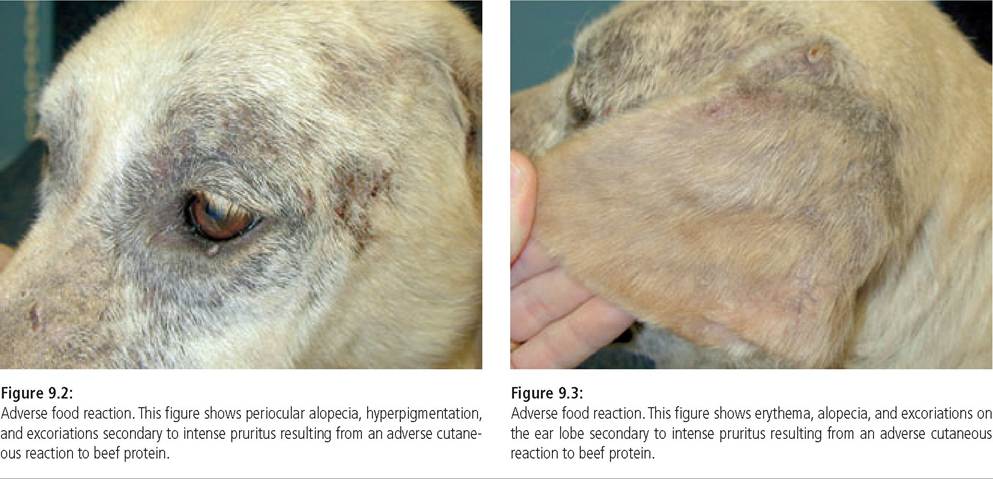
Table 9.2: Role of food-related immunological responses in enteropathies
| Disorder | Role of Food Allergens | Treatment(s) |
| Inflammatory bowel | Dietary antigens may | Elimination diet + |
| disease | contribute to GI inflammation | immunosuppressive drugs |
| Gluten-sensitive | Aberrant muscosal immune | Gluten-free diet |
| enteropathy | response to gliadin | |
| Protein-losing | Severe food allergy leads to | Elimination diet + |
| enteropathy of SCWT | enteritis and PLE | immunosuppressive drugs |
GI = gastrointestinal;
PLE = protein-losing enteropathy;
SCWT = Soft-coated Wheaten Terrier
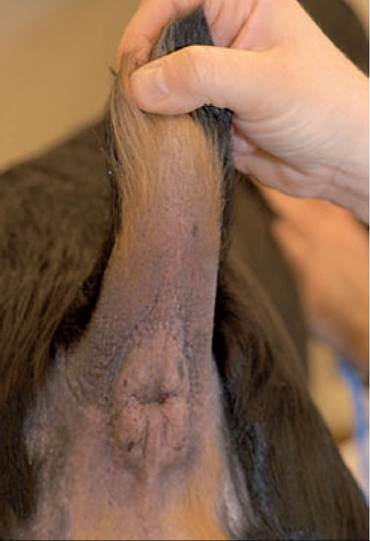
Figure 9.4:
Adverse food reaction. This figure shows perianal alopecia, erythema, lichenifica- tion, and hyperpigmentation secondary to intense pruritus resulting from an adverse cutaneous reaction to chicken protein.
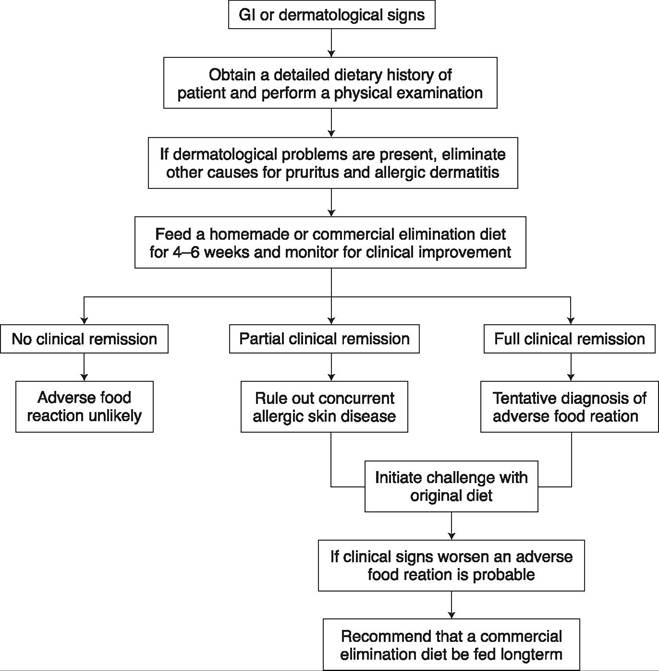
Figure 9.5:
Practical approach to elimination trials for the diagnosis of adverse food reactions (modified from Roudebush 200515).
Diagnosis
A dietary elimination trial is the most important diagnostic tool in dogs and cats with suspected adverse food reactions.
In-vitro testing (e. g., RASTs or ELISAs), biopsies, intradermal skin testing, or gastroscopic food sensitivity testing are unreliable for diagnosing food allergy.6,15 Colonoscopic delivery of food allergens, Doppler ultrasound analysis of mesenteric arterial blood flow, and perinuclear antineutrophilic antibodies (pANCA) have been suggested as having some diagnostic utility in dogs with suspected food allergy.17-19 However, further studies are necessary to confirm these preliminary findings.Treatment of adverse food reactions
Concept of a dietary trial
The first step of a dietary trial is to discontinue the previous diet (offending foodstuff) and feed an elimination diet followed by a challenge with the patient’s original diet (Figure 9.5). If clinical signs recur on the former diet and resolve on the elimination diet, a diagnosis of an adverse food reaction can be made. Provocation testing can help in identifying the offending antigen or antigens, but is often impractical in a clinical setting. A recommendation for an appropriate commercial elimination diet can then be made based on the results of the challenge studies.
Defining an elimination diet
The ideal elimination diet should 1) include a protein hydrolysate or a reduced number of novel, highly digestible protein sources; 2) avoid protein excess; 3) avoid additives and vasoactive amines; and 4) be nutritionally adequate for the animal’s life stage and condition.15 A variety of different diets may be fed including homemade elimination diets and commercial elimination diets.
A homemade elimination diet should consist of a single protein source and also a single carbohydrate source. This is because, even though carbohydrates are only poorly antigenic, every carbohydrate source does contain small quantities of a variety of proteins. Suggested food components in dogs include fish, rabbit, venison, rice, potatoes, and tofu; while, the use of baby food with protein sources such as lamb or rabbit and a carbohydrate source, such as rice is recommended in cats.
Homemade diets are often advocated as the initial test food for dogs and cats with suspected food allergy. Caution is advised when feeding homemade diets for longer than 3 weeks, as they may be nutritionally inadequate.15 Most commercial elimination diets are indicated for the long-term management of dogs and cats with adverse food reactions. These products are attractive because they are convenient, balanced, and nutritionally complete for either dogs or cats. Protein hydrolysate diets contain proteins that have been hydrolyzed into smaller peptides and amino acids, which reduces the antigenicity and allergenicity of the diet. The clinical superiority of one elimination diet versus another in the treatment of adverse food reactions has not been clearly established.Duration of a dietary trial
The optimal duration of a dietary trial has been subject to considerable debate. Generally speaking, patients with dermatological signs will require longer elimination periods (610 weeks), while patients with GI signs will require shorter elimination periods (3-4 weeks). Cats with food allergy may respond to dietary trials in as short as 3-7 days.13
Interpreting dietary trials
A tentative diagnosis of an adverse food reaction can be made if the level of pruritus and /or the severity of GI signs markedly decrease subsequent to a dietary trial. However, a challenge with the original diet is necessary to confirm the diagnosis. Elimination trials may be difficult to interpret because of concurrent allergic skin disease. Thus, flea-allergy dermatitis and atopic dermatitis should be ruled out through appropriate diagnostic testing in partial responders.
Prognosis
The prognosis for adverse food reactions is generally good once the disorder is correctly identified and treated with a dietary elimination trial. In the author’s (AEJ) experience, the offending food component is rarely identified since provocation testing is not permitted by most pet owners. Clients should be counseled that long-term (indefinite) feeding of a commercial elimination diet is usually required to maintain clinical remission.
Key Facts
■ Adverse food reactions may be immunologically (i.e., food allergy) or non-immunologically (i.e., food intolerance) mediated.
■ Dermatological signs (pruritic dermatitis) of food allergy predominate in both dogs and cats.
■ A dietary elimination trial is the most important diagnostic tool in dogs and cats with suspected adverse food reactions.
■ The prognosis for adverse food reactions is generally good once the disorder is correctly identified and treated with a dietary elimination trial.