Euthanasia and Slaughter
When euthanasia of a pet or hospitalized patient is required, overdose of an IV barbiturate is usually most appropriate. If an IV catheter is not already in place, use of a 19-gauge butterfly catheter reduces the risk of perivascular drug deposition.
Disposal of the body must preclude poisoning of scavengers. For commercial animals or for salvage slaughter on the farm, gunshot or captive bolt application to the head is a humane alternative (AVMA 2020), as long as the operator is aware of the landmarks and the brain is not needed for rabies testing or other diagnostic evaluation. The animal is restrained with a halter and offered food if able to eat. The captive bolt gun or firearm is aimed from the top of the skull down toward the spine when the neck is flexed (Figure 17.2), or from the back of the skull, between the horn bases, toward the mouth (Figure 17.3) (Longair et al. 1991; AVMA 2020). Either a penetrating or a non-penetrating captive bolt device is adequate to induce unconsciousness if properly applied (Collins et al. 2017). This should be followed by an adjunctive method such as exsanguination or pithing through the bolt hole to ensure death. Plummer et al. (2018) have proposed that a better description for a dependable anatomic site and orientation of the bolt gun is at the intersection of lines drawn from the lateral canthus of one eye to the middle of the base of the opposite ear, with the gun placed perpendicular to the skull surface. This approximates the location used in Figure 17.2 and is recommended by the AVMA (2020).Goats are commonly killed by Muslim or Jewish ritual slaughter. A very sharp knife is used to cut the carotid arteries near the jaw, thereby causing rapid exsanguination, without first stunning the animal. Although ritual slaughter is exempt from humane slaughter laws in the United States (Grandin 1994), the animal should not be unduly stressed by inhumane restraint (such as shackling and hoisting upside down from a chain) before slaughter. Welfare during halal or kosher slaughter can be improved by restraining the goat in an upright position with its head and neck extended (Regenstein 2009).
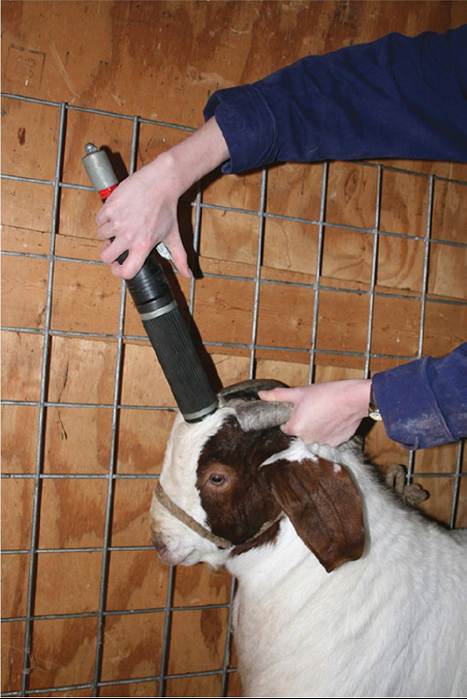
Figure 17.2 Placement of captive bolt for euthanasia perpendicular to the skull and at the intersection of lines from the lateral canthus of the eye to the base of the opposite ear. Source: Courtesy of Dr. M.C. Smith.
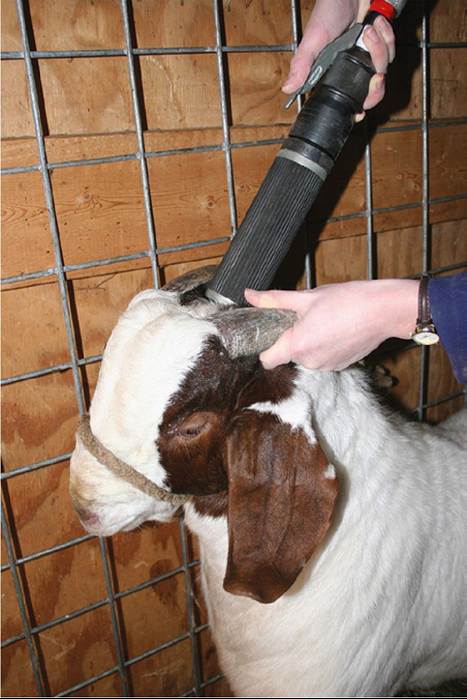
Figure 17.3 Placement of captive bolt for euthanasia between the horns, directed toward the mouth. Source: Courtesy of Dr. M.C. Smith.