Gastric secretion
Parietal cells have receptors for acetylcholine (ACh), gastrin, and histamine, all of which stimulate hydrochloric acid secretion (Figures 4.3 and 4.4). The secretion of gastric juice occurs in three phases: cephalic, gastric, and intestinal.
The cephalic phase, triggered for example by the smell and /or sight of food, is activated through vagal stimuli and neuropeptides, and leads to a direct stimulation of the parietal cells via ACh and gastrin. The histamine-containing enterochromaffin-like cells (ECL cells) in the gastric fundus are also activated through ACh and gastrin. Histamine, released from the ECL cells, subsequently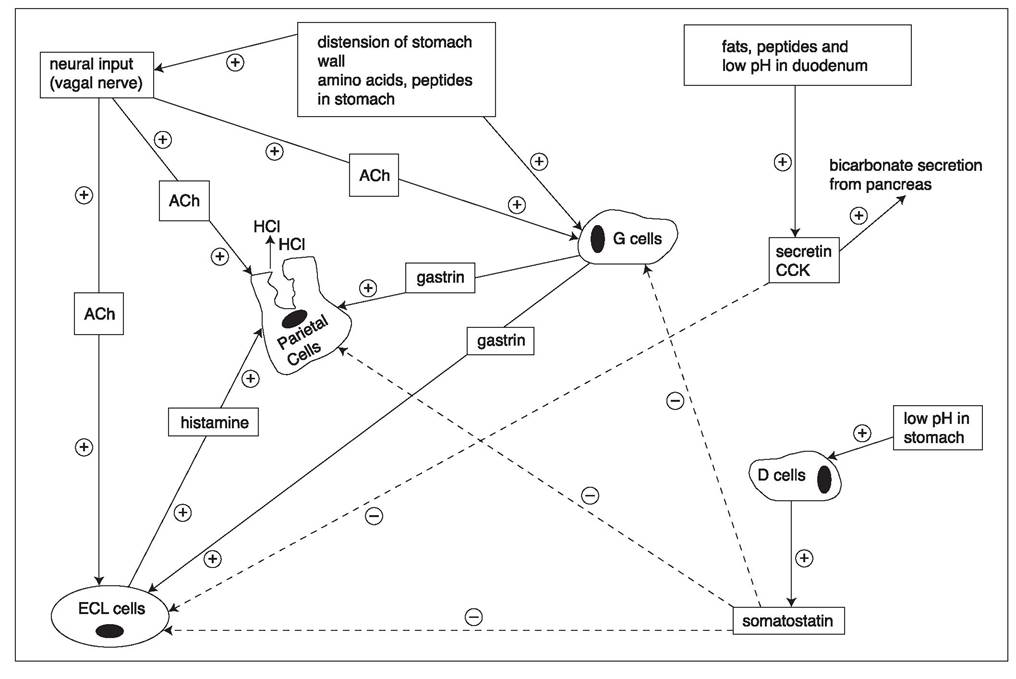
▲
Figure 4.3:
Regulation of gastric acid secretion by the parietal cells. The secretion of gastric acid by the parietal cells is regulated by a complex interaction of stimulatory and inhibitory factors. Stimulatory factors are depicted by "+", while inhibitory factors are depicted by"-". The presence of a particular mixture of stimulatory and inhibitory factors is dependant on the digestive phase of the stomach (interdigestive, cephalic, gastric, or intestinal phase).
Figure 4.4:
Gastric acid secretion by the parietal cell. Carbonic anhydrase catalyzes the reaction that generates H+ and HCO3- from H2O and CO2 within the parietal cell. The HCO3- ions then diffuse out of the parietal cell and into the vascular space in exchange for the Cl- ions, which in turn will be secreted into the gastric lumen. This HCO3- diffusion into the vascular space leads to an increase in blood pH during gastric acid secretion, producing the alkaline tide after a meal. K+ moves along its electrochemical gradient into the gastric lumen.
The H+, K+ ATPase actively secretes H+ ions into the gastric lumen in exchange for K+ ions, resulting in HCl accumulation in the gastric lumen. H+, K+ ATPase inhibitors (e.g. omeprazole) are the most effective inhibitors of gastric acid secretion.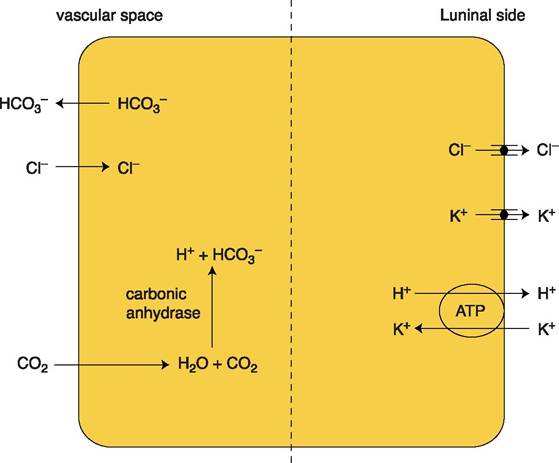
binds to parietal cell receptors and potentiates gastric acid secretion.
Distension of the stomach and release of peptides and amino acids from partially digested food marks the beginning of the gastric phase. At this stage, gastrin is released from the antral and duodenal mucosa. The beginning of gastric emptying leads to a decrease in duodenal pH (intestinal phase) and the release of secretin from small intestinal mucosal cells. Secretin stimulates the bicarbonate secretion of the pancreas. A low pH in the gastric antrum also leads to the secretion of somatostatin (from D-cells), which initiates a negative feedback mechanism on gastrin and, therefore, hydrochloric acid secretion. Cholecystokinin (CCK) release is stimulated through fatty acids and the presence of oligopeptides and amino acids in the duodenum. CCK further inhibits gastric acid secretion and stimulates exocrine pancreatic secretion. Pepsinogen release is mainly stimulated by acetylcholine and CCK, and indirectly through gastrin and vagal stimuli.
4.3.3