Hypofibrinogenemia
Decreased fibrinogen concentration, termed hypofibrinogenemia, can be detected via a modified thrombin time test, the Clauss TT, or via immunoassay using anti-fibrinogen antibodies.
Heat precipitation is useful to detect increased fibrinogen but is too insensitive to detect hypofibrinogenemia. Plasma fibrinogen levels represent the balance between fibrinogen production and degradation, an important concept in large animals since fibrinogen production is often increased due to inflammation (see Chapter 26) and increased consumption may potentially be masked. Pregnancy also can cause increased fibrinogen.50Hypofibrinogenemia may result from impaired hepatic synthesis, increased consumption with DIC, or uncompensated loss during massive hemorrhage (Boxes 27.10 and 27.11). Decreased plasma fibrinogen is uncommon in liver disease of large animals; increased production due to concurrent inflammation appears to be more common. With DIC and fibrinolysis, decreased fibrinogen concentration due to consumption is expected in most species. However, hypofibrinogenemia is not common in horses with DIC. Horses with colic in one study had evidence of increased coagulation postoperatively, including decreased ATIII and increased D-dimer, with concurrent hyperfibrinogenemia.51 Hypofibrinolysis has also been shown in horses with DIC.17
Hereditary afibrinogenemia has been described in a family of Saanen dairy goats with a hemorrhagic diathesis in newborn kids that included umbilical bleeding and recurrent hemar- throses.14 Fibrinogen was undetectable in the affected animals, while heterozygotes had hypofibrinogenemia.
■ BOX 27.10
Causes of Hypofibrinogenemia in Horses
Uncommon Causes
Acute hepatic necrosis
Acute severe disseminated intravascular coagulation (DIC) Severe hepatic fibrosis
■ BOX 27.11
Causes of Hypofibrinogenemia in Ruminants
Uncommon Causes
Hereditary afibrinogenemia (goats)
Acute severe disseminated intravascular coagulation (DIC)
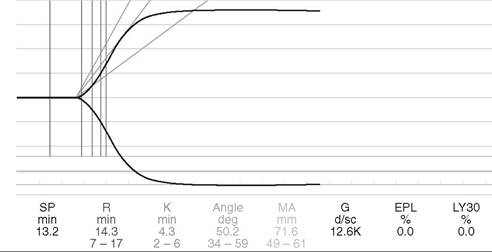
FIG. 27.2 Thromboelastograph (TEG) tracing from a horse demonstrating increased maximum amplitude (MA), suggestive of platelet hyperresponsiveness and/or other potential causes of hypercoagulable tendency. Other values including the R (reaction) time and K (kinetics) time are within reference intervals.