Infectious, Toxic, and Parasitic Liver Disease
Acute Hepatitis in Horses
Joy E. Tomltnson
■ Etiology Theiler' disease, also known as idiopathic acute hepatic disease, serum hepatitis, postvaccinal hepatitis, and acute liver atrophy, is the most common cause of acute hepatitis and hepatic failure in horses in North America.1-5 The disease was first recognized by Sir Arnold Theiler in large numbers of horses in South Africa.
Horses developed the disease following immunization against African horse sickness with simultaneous administration of live virus and hyperimmune equine serum.6 Since then, Theiler's disease has been observed in two forms. First, it has been documented as a potential complication of any equine-origin biologic product used in horses, including plasma and serum products, and has most recently been suspected after allogenic stem cell treatment (unpublished). Theiler's disease has been most often associated with use of either tetanus antitoxin (TAT) or commercial equine plasma.3,5,7-11 A recent outbreak was also associated with equine antiserum to botulinum toxin.12 Second, Theiler's disease is occasionally seen without a history of recent equine-origin biologic product administration.1,7,13 This is often seen as a herd outbreak and may have a seasonal nature, occurring most frequently in the summer and fall.1,7,13 In addition, in outbreaks of biologic product-associated Theiler's disease, it is not uncommon for in-contact horses to also develop Theiler's disease, suggesting that an infectious agent may be involved.1,6,7,13Theiler's disease is primarily a disease of adult horses.1,5,7,10,11 There is no clear breed or sex predilection for Theiler's disease.3,5,6,9 Postfoaling mares and postcastration geldings may be at increased risk due to frequent use of prophylactic tetanus antitoxin in those horses.
Little has been known about the etiology of Theiler's disease until recently. An investigation into an outbreak of Theiler's disease in a group of horses receiving prophylactic botulinum antiserum resulted in the discovery of a pegivirus that was named Theiler' disease-associated virus (TDAV).12 Although this was initially suspected to be the cause of the outbreak, TDAV was not present in subsequent cases of Theiler's disease, and a new pathogen, Equine parvovirus-hepatitis (EqPV-H) was discovered.18 EqPV-H was retrospectively found to also be present in the botulinum antiserum outbreak.12,18 EqPV-H was present in sequential cases of non-biologic-associated cases of Theiler's disease, in biologic-associated cases, and in the biologic products implicated (unpublished). Experimental infection with EqPV-H in two adult horses resulted in acute necrotizing hepatitis.18 However, not all horses that have EqPV-H-positive serum confirmed by polymerase chain reaction (PCR) testing have clinical or biochemical evidence of hepatitis, which may suggest that other host factors, immune-mediated hypersensitivity reactions, or co-infection with other etiologic agents may be necessary for disease.12,18 Horses may become chronically infected with virus, with the majority remaining serum PCR positive for at least 1 year (unpublished).
■ Clinical Signs The clinical effects of Theiler's disease are associated with signs of acute hepatic failure and typically occur 1 to 3 months after administration of blood products.6,12,13 These signs include depression, jaundice, inappetence, pica, yawning, photoactive dermatitis, and hepatic encephalopathy.2,3,7,9,14,15 Fever has been described as absent or rare in horses affected with Theiler's disease.4 Intravascular hemolysis has been reported to lead to hemoglobinuria in some terminal
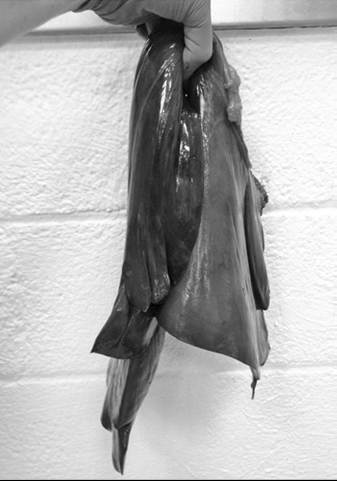
FIG.
33.2 Characteristic small, “dishrag” liver from a horse with Theiler’s disease. (Photo courtesy Sam Jennings, North Carolina State University.)cases of Theiler's disease.2 Evidence exists for a subclinical component in some cases.10,12,16 However, some horses that received tetanus antitoxin or botulinum antitoxin have clini- copathologic evidence of liver disease without developing clinical signs, indicating that disease severity may vary.5,10,12,16
■ Diagnosis Diagnosis of Theiler's disease is based on the anamnesis, clinical signs, serum biochemical analysis, and hepatic biopsy or necropsy. High serum levels of unconjugated and total bilirubin and serum bile acids, coupled with high serum activity of GGT, SDH, AST, GDH, LDH, and ALP are indicative of hepatic necrosis in horses.17 Additional findings with severe disease may include decreased blood urea nitrogen (BUN), hyperammonemia,17 prolonged clotting times (PT and activated partial thromboplastin time [APTT]), and decreased albumin. Theiler's disease may be confirmed by hepatic biopsy or postmortem examination of hepatic tissue. The liver is often small and has a characteristic “dishrag” appearance (Fig. 33.2). Typical histopathologic changes seen in specimens obtained by biopsy or at postmortem examination include widespread necrosis of hepatocytes that is most severe in the centrilobular and midzonal areas.1,8 The few remaining living cells are confined to the periportal areas and commonly contain cytoplasmic vacuoles.1,8 The normal architecture of the centrilobular and midzonal areas is replaced by a pale, eosinophilic granular mass in which ghost outlines of necrotic hepatocytes are present.8 A mild inflammatory cell infiltrate is seen in the portal areas, as are a number of spindle-shaped fibroblastic cells.8
Differential diagnoses include a variety of heavy metal and organic hepatotoxins (see the Pyrrolizidine Alkaloid Toxicity and Other Hepatotoxins sections later).
Acute onset of chronic pyrrolizidine alkaloid toxicity can cause a similar clinical and histopathologic presentation. Although EqPV-H is highly suspected to be a cause of Theiler's disease, the data remain associative and not definitive to date. PCR testing of serum or liver for EqPV-H is available.■ Treatment There is no specific treatment for Theiler's disease.19 Treatment should be aimed at supporting liver function and controlling abnormal behavior. Dietary adjustments are important and should consist of reducing the quantity of protein in the diet while increasing carbohydrate intake.2 Sorghum, milo, or beet pulp, which contains high levels of branched-chain amino acids, can be mixed with molasses to improve palatability and caloric content.2 Diets high in branched-chain amino acids tend to lessen the degree of abnormal behavior associated with hepatic encephalopathy.19 Oral (PO) neomycin, lactulose, and mineral oil may be administered to decrease ammonia production and absorption from the GI tract. Xylazine or detomidine may become necessary to sedate horses that display severe signs of hepatic encephalopathy,19 but high doses that cause extreme lowering of the head should be avoided if possible. Benzodiazepines (diazepam or midazolam) should be avoided. Continuous intravenous (IV) administration of dextrose and balanced electrolyte solutions to reduce hepatic workload and maintain plasma volume are recommended.16 If spontaneous bleeding occurs at injection sites or at sites of self-inflicted injury, plasma transfusions may be necessary to replace the deficient clotting factors.2 The use of glucocorticoids for treating Theiler's disease is controversial but may be indicated based on some histopathologic evidence of an immune-mediated etiology.14,17
Currently, no preventive measures are available. However, since administration of TAT is associated with substantial risk for development of fatal Theiler's disease,7,10,16 the routine practices of prophylactic administration of TAT to recently parturient mares or postcastration geldings should be strongly discouraged.
TAT use should be restricted to clinical situations necessitating tetanus prophylaxis in which a history of active tetanus (toxoid) immunoprophylaxis is absent or unknown. The risk of postvaccinal Theiler's disease should be addressed with the owner before administration of TAT. Although the prevalence of serum hepatitis associated with administration of commercial plasma appears to be low in horses, it should be considered an uncommon risk that can have a fatal outcome.11Theiler's disease may be observed sporadically or affect a group of horses. Recognition of Theiler's disease in one horse should necessitate careful observation of horses on the same premises for either clinical or serum biochemical signs of Theiler's disease.12,16 Based on recent case reports, it appears that not all cases of Theiler's disease are clinically apparent, and screening for its presence with routine serum biochemical analysis is useful in detecting subclinical cases.10-12,16