Introduction
For those who are not familiar with artificial intelligence (AI), imagine that some tasks that are done by humans, such as object detection, visual interpretation, and speech recognition, can be done by computers without human interference.
Why is that important? There are many benefits with the use of AI that we intend to discuss in this chapter.AI is growing in fields that require algorithms (mathematical instructions for computers) and machines to solve problems that are intellectually difficult for human beings but relatively easy for programmable computers. Nevertheless, “the true challenge of AI is to solve tasks that are easy for people to perform, but hard to be described, once it requires intuition [1]When we look at an image, our interpretation is instantaneous: Is there a car? Is there a person? Is there a house? Computers are able to interpret as well, but not in same way that humans do. Computers translate an image in numbers, as illustratively shown in Figure 1.
In the early years of artificial intelligence, a rapid growth has been experienced. “The AI index—2017 annual report, created at Stanford University, presents the volume of activities that involves AI. In this report, indicators help to understand the importance of artificial intelligence technologies for academia, industry, and
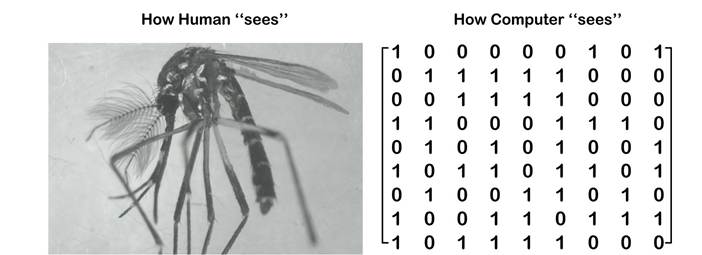
Figure 1.
Human vs. computer: how an image is recognized by each (illustrative).
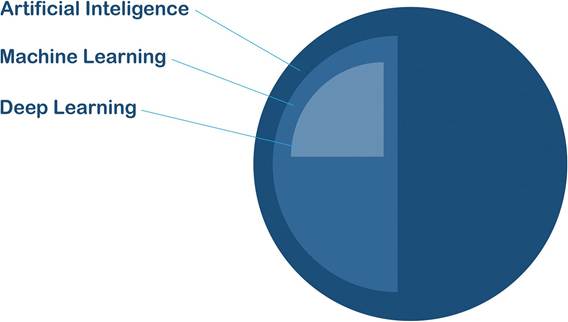
Figure 2.
Relationship between artificial intelligence, machine learning, and deep learning.
public sector. The number of AI published papers produced each year has increased by more than nine times since 1996. For industry, the number of active US startups developing AI systems has increased 14 times since 2000 [2].”
Machine learning (ML) is a subarea of artificial intelligence that is able to learn from previous experience.
“ML algorithms are design to solve problems extracting features from existing data, learn from these features and predict the outcomes” [3]. For example, intelligent mosquito’s trap can be designed with the functionality to classify harmful from beneficial insects, release the nontarget insects, and kill the target ones. The classifying process can previously learn from wingbeat frequency data of different species of insects, and whenever a new insect approaches the trap, it will automatically classify and take the decision—release it or kill it. That was exactly what “De Souza and Silva proposed using machine learning techniques” [4, 5].Recently, “Deep Learning (DL) methods—a subarea of Machine Learning—are considered essential for general object recognition” [6]. “Tasks that consist of mapping an input to an output and that are easy for a person to do rapidly, can be accomplished via Deep Learning, given sufficiently large models and dataset of labeled training examples” [1]. “In the largest contest for object recognition, ImageNet Large Scale Visual Recognition Challenge (ILSVRC), a breakthrough for deep learning occurred in 2012 when a Deep Learning network won the competition, bringing the state-of-art top-5 error rate from 26.1% to 15.3%” [1]. Figure 2 illustrates how artificial intelligence, machine learning, and deep learning are related.
An important field for application of artificial intelligence is health care. Based on the knowledge of medicine and historical data, AI can be used to support medical doctors to take better and faster decisions. For instance, AI can support medical doctors with robotics systems for some special tasks such as surgery, to increase the life expectancy of human beings, to increase the quality of life for people with some physical disability, and also to increase the community participation to improve the performance of a human care system.
In medicine, arboviruses have received a global attention, since “vector borne diseases are responsible for 17% of the estimated global burden of communicable diseases.
It causes more than 700,000 deaths yearly and at least 80% of the global population lives in areas at risk” [7]. Entomology research is considered priority by the World Health Organization for the development of tools that can be applied to reduce incidence and mortality and prevent epidemics due to vector-borne diseases globally.Identification of the species and sex of mosquitoes is essential to map and organize the control measurements by the public health system in most areas where transmission is actively occurring. In many places in the world, the methodology for identification of the mosquitos is done by visual examination from human trained technician. “This activity is time consuming and requires several years of experience to have skillful to do the job” [8].
This chapter addresses the application of artificial intelligence to help on the control of vector-borne diseases. Research trends and technologies connecting AI to vector-borne diseases are presented for a better understanding on how much researchers and institutions are becoming interested on both topics together. The use of machine learning and deep learning techniques, as a subarea of AI, is discussed for classification of mosquitos in their different life cycle—eggs, larval, pupal, and adult. Benefits and limitations are also presented to help the reader to understand the potential and challenges of artificial intelligence applied to entomology.
2.