Research and technological trends on AI and vector-borne diseases
Since 2000, a continuous growth on published research (papers) and patents granted relating artificial intelligence with vector-borne diseases has been noticed. Figure 3 represents the number of papers published yearly using the keywords: (insect OR mosquito OR culicid OR vector-borne OR zoonotic disease) AND (artificial intelligence OR machine learning OR deep learning).
This review considered the following sources: IEEE, PlosOne, Capes, PubMed Web of Science, Current Contents Connect, Conference Proceedings, and Inspec.It is interesting to notice that in 2017 the number of papers is almost six times it was in 2000. This result demonstrates that artificial intelligence has several possible applications on the control of vector-borne diseases as an important interest topic for many researchers around the world.
Figure 4 shows the number of patents granted in the world with the same keywords as the ones used for review papers. For the patents research, the platform Derwent Innovation was used.
In 2017, the number of patents granted is relevantly almost 10 times the average it was in the previous years. This result demonstrates that not only researchers but also companies have interest in intellectual property assets applying AI on the control of vector-borne diseases.
Figure 5 presents the top countries’ and regions’ intellectual properties’ ownership. China, Korea, and Japan are the countries with more granted patents.
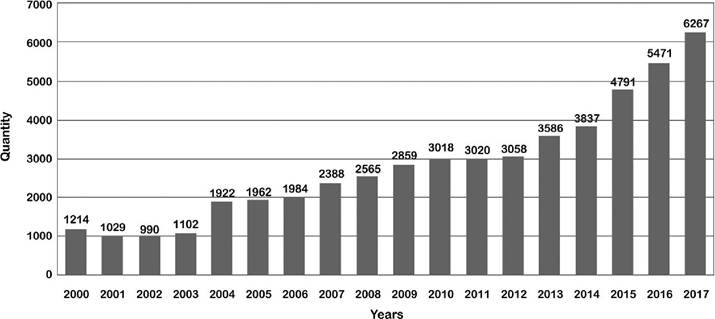
Figure 3.
The number of papers published from 2000 to 2017 relating Al to vector-borne diseases.
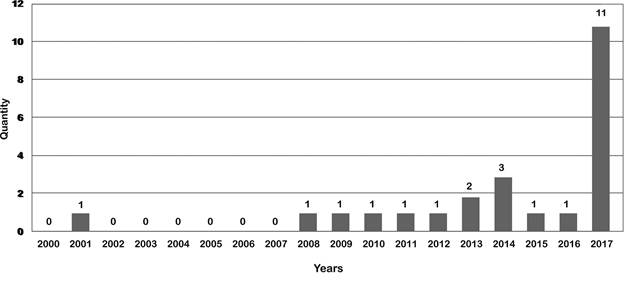
Figure 4.
The number of patents granted from 2000 to 2017 relating AI to vector-borne diseases.
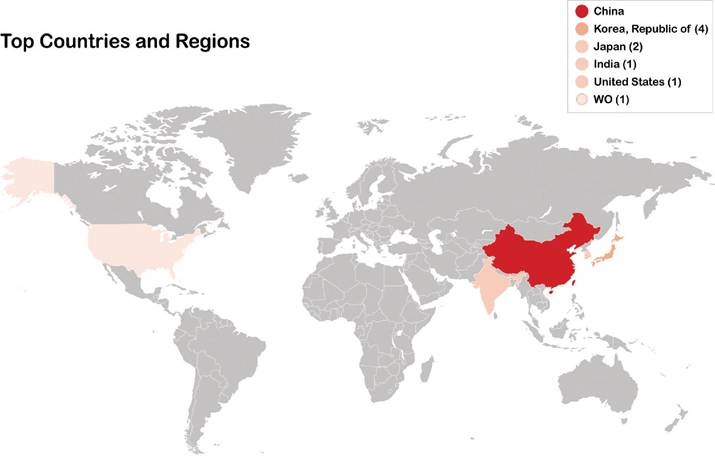
Figure 5.
Countries with more patents from 2000 to 2017 relating AI to vector-borne diseases.
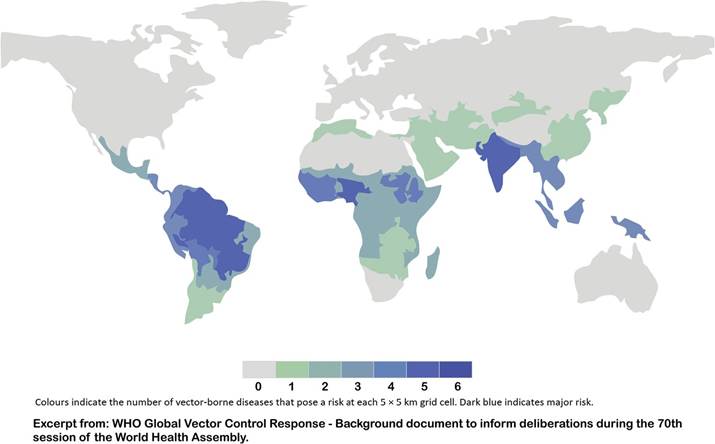
Figure 6.
Combined global distribution of seven major vector-borne diseases: malaria, lymphatic filariasis, leishmaniasis, dengue, Japanese encephalitis, yellow fever, and Chagas disease transmission [7].
Figure 6 presents the combined global distribution of seven major vector-borne diseases. Correlating Figures 5 and 6, some countries that own IP relating AI to vector-borne diseases are not among the main ones that appear in “the global distribution of seven major vector-borne diseases for which integration of vector control programs may be beneficial—malaria, lymphatic filariasis, leishmaniasis, dengue, Japanese encephalitis, yellow fever and Chagas disease transmission—which evidences that vector borne is everyone’s problem [7].”
3.
More on the topic Research and technological trends on AI and vector-borne diseases:
- Research and technological trends on AI and vector-borne diseases
- Savic Sara (ed.). Vectors and Vector-Borne Zoonotic Diseases. ITexLi,2019. — 110 p, 2019